I saw Benjamin Button last night. My three word review is: “a beautiful disappointment.”
Spoilers from here forward.
…
Seriously, major spoilers.
…
I saw Benjamin Button last night. My three word review is: “a beautiful disappointment.”
Spoilers from here forward.
…
Seriously, major spoilers.
…
Sunday’s show arrived two days late. So what? Think of it as a little trip into the future!
The guys talked about how life expentancy tables are off (in a good way), the coming smart electric grid, Blacklight power, the Pickens Plan, and much more!

Stream our latest shows:
Or:

Or download MP3′s for all the archived shows at:

Click “Continue Reading” for the show notes:
T. Boone Pickens came to my home town Shreveport yesterday as part of his campaign for the Pickens Plan. It was set to start at 10:30, and I showed up a few minutes early to make sure I could get a decent seat.
Out in front of the Shreveport Civic Center were two CNG vehicles. One was a GM Impala and the other was a Chesapeake work truck. Unfortunately neither is in production right now. If you want to be a CNG early adopter you essentially have one choice in the United States today – the Honda Civic GS CNG.
I got inside and got a great seat on the second row. When the rally started 30 minutes later, the room was completely full (picture gallery here [Hey, that's me in photo 8]).
A video showing T. Boone’s travels on this campaign rolled to the tune of Johnny Cash’s “I’ve Been Everywhere.” T. Boone is shown hopping from city to city on various talk shows and rallies throughout the country.
Then our local Senator David Vitter came out and introduced T. Boone.
Pickens was given a standing ovation as he approached the podium from the back of the hall. Shreveport is a very friendly crowd for this guy. He’s advocating a move from petroleum to natural gas to people living on top of the biggest gas field in the United States.
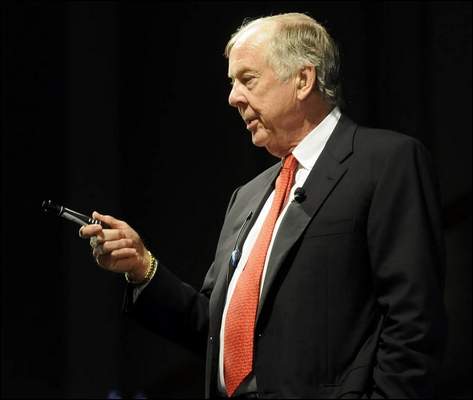
T. Boone looks like he’s one of those rare 80-year-old guys with another 20 years left in him. He got to the stage and – with a quick hand up from Vitter – did this funny hop step 3 feet up onto the stage. He didn’t bother with the stairs at the side of the stage.
He got straight to the point – we import 70% of our oil. Nixon thought we had a problem back when we imported 24% of our oil. At this summer’s peak prices we were sending $700 Billion overseas annually for petroleum. We can’t afford this now. And if we don’t do something it will get worse. Pickens says that by 2018 we’ll be paying $300 a barrel for oil. It will break this country.
Phil and I spent some time Sunday night talking about various technogies that we think will have a profound impact on the future. We mentioned the space elevator, nuclear fusion, a universal assembler, cure for aging, and friendly artificial general intelligence.
Seemingly endless possibilities make predicting the future a fool’s game. But we play the game anyway here at the Speculist and on FastForward Radio because its just that fun.
With all the possibilities and uncertainty about the future it is surprising that there is a broad consensus amoung futurists about what technologies will be most important in shaping the future:
Each of these four areas have the potential to cause a profound disruption in the way we do things today. And all four areas interact and build on one another in an exponential process I’ve called “Spock’s Chessboard.”
The combination of these emerging and converging technologies really should have a single accepted name. But as of right now, there are at least five competing acronyms. The prosaic “NBIC” (the four technologies listed in the above order) seems to have some official standing because it was used in a report sponsored by the US National Science Foundation.
Joel Garreau used “GRIN” (genetics, robotics, information tech, and nanotechnology) in his book Radical Evolution. Douglas Mulhall used the similar word “GRAIN” (genetics, robotics, artificial intelligence, and Nanotechnology). Ray Kurzweil, I think, used GNR (genetics, nanotechnology, and robotics) in his books.
But I prefer the acronym that’s being popularized by the ETC Group – “BANG.”
It’s easy to remember and the word invokes the potential of these technologies to explode upon the world in ways that are both scary and exciting.
Celebrating the First Year at Blog Talk Radio!
Tonight Phil Bowermaster and Stephen Gordon celebrated the first full year of weekly FastForward Radio on Blog Talk Radio.

Come enjoy the cake! Phil and Stephen talked about the subjects covered over the last year and stuff that they want to do in the year to come.
Stream our latest shows:
Or:
Or download MP3′s for all the archived shows at:
Click “Continue Reading” for the show notes:
This could be the engine of the next economic boom:
UPDATE:Paul Rothemund has pioneered the field of DNA origami. He uses special CAD software to come up with a design:

He then orders long DNA strands with short “staple” DNA strands. He mixes it together and they self-assemble:

The result – 50 Billion smileys floating around in a single drop of water. In other experiments he’s put circuit components on the staples and the DNA self-assembles a switch.
In order to scale this up, DNA oragami produces tiles that then bind together in predictable ways. These tiles can also count themselves. This will be handy so that the process will know when to stop. If you ask it to grow a cell phone, it has to know when to stop.
This is beyond fab-labs. This is the enabling technology for nano-factories.
When the world’s most powerful supercomputer goes online in 2011, it won’t come pre-installed with user-friendly software applications. Not to worry! To solve that problem, The Great Lakes Consortium for Petascale Computation will spend the next three years ramping up for the world’s first sustained petascale computational system by developing new computing software, applications and technologies designed for open scientific research.
The Great Lakes Consortium is the result of collaboration among colleges, universities, national research laboratories and other educational institutions dedicated to the Blue Waters Project.
The Blue Waters Project, based at the University of Illinois at Urbana-Champaign’s National Center for Supercomputing Applications, will build a machine in conjunction with IBM capable of sustaining computations of one to two petaflops – computing parlance for 1 quadrillion calculations per second – on many practical scientific and engineering applications.
The consortium’s ultimate goal is for Blue Waters to be fully user-friendly for scientists across the country, so when it launches, it will include intense support for application development, system software development, interactions with business and industry and educational programs.
Iowa State University researchers Srinivas Aluru, Mark Gordon and James Oliver say they’re eager to help the scientific community step into what they call the second revolution in information technology.
Aluru, a Stanley Chair in Interdisciplinary Engineering and a professor of electrical and computer engineering, will direct ISU’s work with the consortium.
“The dramatic increase in computing capability makes this project a national asset,” he said. “A lot of money will be poured into this research. To justify public expenditure we want to be ready.”
The National Science Foundation is supporting the supercomputer project with a $208 million grant, said Aluru, whose research group has used supercomputing power to help with the recently concluded effort to sequence the corn genome. To do that, they developed software that uses thousands of processors to build genome assemblies in days instead of months.
And now Aluru is ready to make the leap to even more powerful computing. But before that can happen, researchers must work out the bugs and bottlenecks that petascale computational levels might present.
The issue is not just Blue Waters’ peak potential, but its sustained capacity while solving problems, he said.
“That efficiency depends on the code we write,” he said. “We need to find the way to get higher than 70 percent efficiency on solving several challenges.”
Mark Gordon, ISU’s Frances M. Craig Distinguished Professor of chemistry and the director of the applied mathematics program for the U.S. Department of Energy’s Ames Laboratory, said parallel computing in chemistry, for example, has used, at most, clusters of 32-128 computers for supercomputing challenges for the past 15 to 20 years. Researchers therefore haven’t had the hands-on opportunity to work through the potential bottlenecks for using up to 100,000 clusters.
“It’s a whole new ballgame with new bottlenecks,” he said. “When you move toward the petascale range, we might run up against physical limitations, such as the speed of light. And the communications and data sharing issues increase by orders of magnitude. We’ll need an efficient way of communication and comparing and collecting.”
One of the consortium’s strategies will be forming petascale application collaboration teams or PACTS, Aluru said.
“Each team will work on individual problem to figure out how to use the petascale computer and avoid mistakes,” Aluru said.
Aluru said the Nation Science Foundation-funded project will provide two “step-up machines” along the way.
James Oliver, the director of ISU’s CyberInnovation Institute, said the jump to petascale computing power calls for tools such as C6, ISU’s six-sided virtual reality room that displays computer-generated images at the world’s highest resolution. He said C6 would be an ideal place to build interfaces that can display and work with all the data produced by the supercomputer.
Aluru said the consortium held its inaugural meeting this week to begin to lay out the technical challenges it faces. Back at ISU, Gordon said he’s waiting for word from the National Science Foundation to grant his team early access to the Blue Waters team and hardware.
“We’re looking forward to trying out our ideas to see if they’re going to work.”
FFR listeners know of my fondness for the first Ghostbusters movie. To me, it is the Godfather of comedy. For years fans have wanted a decent sequel. Finally, it looks like there’s some chance that it might happen.
Skip to the 5 minute mark:
Interestingly, they aren’t going with traditional Prius-like hybrids – where a gas engine directly pushes the drivetrain. Rather, they are going full EV for sports cars and Volt-like range-extension for everything else (where the electric engine always pushes the drive train and a small gas engine charges the batteries when necessary).
Chrysler plans on bringing these vehicles to market in two years.
More at Wired.
…fast!
12-year-old William Yuan has invented a new, improved 3D solar cell.

William invented a novel solar panel that enables light absorption from visible to ultraviolet light. He designed carbon nanotubes to overcome the barriers of electron movement, doubling the light-electricity conversion efficiency. William also developed a model for solar towers and a computer program to simulate and optimize the tower parameters. His optimized design provides 500 times more light absorption than commercially-available solar cells and nine times more than the cutting-edge, three dimensional solar cell.
You know, this kid might just have kicked us over the Solar Singularity finish line. Grid parity has already been achieved in Hawaii – where there is plenty of sun and electricity is otherwise produced via diesel. But this development could bring solar to the rest of us.
More on 3D solar cells here.