Monthly Archives: November 2008

On Burying the Lead

Or as some would call it, “burying the lede.”

Sunday evening we spent the better part of a 75-minute show talking about expanding our view of the possible so that we can have a clearer idea of what it’s reasonable to expect will happen. The crux, which I got around to rather late in the program, is this: what is it reasonable to expect will happen?

Anything and everything that can happen.

Just about anything you can imagine happening (as long as it’s possible, and if you need a definition of that, listen to the show.)

A lot of things you have never imagined. In fact, those will probably far outnumber the things that you have imagined.

Okay, so then when will all this amazing stuff happen? My guess would be (assuming that it isn’t already happening) soon. Very soon, by historical standards.

Maybe we’ll spend some time on that on the next show.

Top 10 Revisions to the Star Trek Universe that Would be Fine by Me

There is no small amount of fear among the Star Trek faithful that the latest entry in the film series, due out in a few months, is going to present significant changes in the backstories of some of our beloved characters. Of course, the continuity between the various TV series and the movies (and even within each) has never been as pristine as the faithful would like. Still, things like having Kirk and Spock be roughly the same age and attending Star Fleet Academy together, if that is indeed what’s going on, is a pretty big change — bigger than any that have come before.

Some have been upset by the new trailer. Not me. I think it looks pretty cool. Perhaps it suggests that there are massive changes in store for the Trek continuity, but director JJ Abrams at least assures us that Chekov will still pronounce his V’s as W’s, even though Russians don’t really do that.

Now that is some serious respect for tradition.

Of course, Star Trek fans have the right to be a little nervous about turning their baby over to this particular sitter. First Alias and then Lost have shown a tendency on the part of the unquestionably brilliant Mr. Abrams to apparently just sort of make stuff up as he goes along. And anyone who has heard about his script for a Superman reboot a few years back — in which Krypton is never destroyed, Jor El is a martial arts expert, and Lex Luthor is a CIA agent (and, no, I’m not kidding) — has reason to be anxious.

We can only hope that Abrams got most of that kind of nonsense out of his system in writing that script, and that any broad and sweeping changes he has made to the Star Trek universe won’t immediately strike us as overwhelmingly and unforgivably stupid. Besides, let’s get with the program, folks. They make big changes when they make movies about historical figures. Showtime has been retconning the life of Henry VIII like crazy on the The Tudors, and HBO did the same thing with Caesar, Mark Antony, and Augustus a few years back on Rome. So in that spirit, let’s do a little creative destruction of our own. There must be a little dross amongst all that glitters in the Star trek treasure chest. If we could make a few changes to Star Trek as we know it, what would they be?

Here are 10 thoughts on the subject.

All In

Just saw this Facebook notification for our FFR chat host Michael Darling:

Michael went all-in in Texas Hold ‘Em Poker and won $2,441 chips in one hand. World-class playing!

Not bad at all! Unfortunately, a few minutes later this notice appeared:

Michael bet their way to success in Texas Hold ‘Em Poker, walking away with $999.

I’ll leave the atrocious grammar alone for a moment. You win almost $2500 on a single hand, and a while later you cash out having lost over $1400 of that. As they say on the TV shows:

“That’s poker.”

Anyhow, he still finished up by a grand. Not too shabby. If only it were real money!

Michael displayed one of the hallmarks of intelligent gaming behavior in this sequence of events. He quit while he was ahead. Along the way, he had to demonstrate his intelligence repeatedly by placing, raising, and folding bets each at the appropriate time, comparing what he knew about his own hand with what he could surmise about his opponents’ hands, as well as their likely behavior in the face of his next move. He had to play smart when he got good cards, and even smarter when he didn’t.

If a computer could demonstrate the kinds of behaviors that Michael did in winning his $1000 on Facebook poker, we would almost certainly credit it with possessing some level of intelligence. Via GeekPress, New Scientist reports on how last summer a computer program beat some of the world’s best poker players at Limit Texas Hold ‘Em (a slightly less random and complex variation of the game than the No-Limit version that Michael was playing.)

pokerchips.jpg

Convergence 08 Wrap-Up

Well, it was a great couple of days.

Our second edition of FastForward Radio presented live at the unconference was even bigger than the first one. I think we had more guests on FFR over those two days than we had had over the previous six months. And what a lineup! Our thanks to all who took part.

George Dvorsky (once again) provides a good recap of the final panel on longevity. I think there are a lot of tremendous developments on the horizon in this field, but the importance of eating right and getting exercise can never be overstated. Not all that cutting edge, perhaps, but perfectly doable.

PJ hosted a terrific session on the importance of empathy, as well recounted by you-know-who (maybe we should just start thinking of The Speculist as a kind of “staging blog” for Sentient Developments.) Some really interesting discussion ensued. I deliberately set my own talk up as a sort of part two of PJ’s session, hoping to leverage some of her thoughts on tribalism and fear of the Other in talking about potential audiences.

While my intended topic was a discussion of different outreach channels to a mainstream audience — and whether people generally thought making such an outreach is a good idea — I sought to use a little misdirection by giving the session a somewhat provocative title: “Winning the Meme Wars.”

I’m very glad that I used that title, although I spent at least half of the time trying to referee discussions about whether memes actually exist and whether Nazi Germany provides a good example of meme warfare in action. (Even after admitting — let’s face it, insisting — that “meme warfare” wasn’t the intended topic!) That was all worth it, though, because of the fascinating perspectives that emerged. And I’m not sure that they would have emerged in response to a less stridently phrased question.

I opened up by asking whether the fact that we’re planning to completely transform the world doesn’t require us to provide some kind of notice to the people who, you know, live in the current world. In response, I had members of the group tell me…

…that we have no particular obligation to the general public; that there are always leaders and followers in times of change and that it falls on us to be the leaders.

…that the general public is a potential threat to what we’re trying to do and that we need to “disarm” them.

…that, after all, the average IQ of the participants at Convergence 08 is a couple or three standard deviations higher than that of the public at large.

A few members of the group objected to this line of reasoning pretty vociferously, but they were apparently in the minority, and the whole atmosphere was a little too collegial for anyone to let loose with a “Hey, knock it off with the mad scientist stuff! We don’t want any part of your creepy megalomaniacal ravings!” — although I did hear a few objections to that effect as asides after the fact.

But honestly, I don’t think that megalomania is the issue*. I just think this is PJ’s tribalism and lack of empathy in action, and it’s really just a kind of preemptive defensive posturing. We’re mostly geeks, after all, and by and large we learned early on that there’s rarely any point bothering with most of the other kids — they don’t “get” us and they can be pretty mean when they want to. And there’s no way of saying it that doesn’t sound conceited, but we know it’s true: we’re smarter than they are. A lot smarter. And one of these days, we’ll find a way to settle the score.

Somehow.

So, yeah, I think it would be healthy if we found a way past all this schoolyard trauma. It may be true that — as the great and wise Gilbert said — none of us will ever really be free until nerd persecution ends, but what if the persecution is already over? The schoolyard was a long time ago, and in today’s world geeks really are powerful. We’ve got the great ideas; we’ve got the plan for transforming the world. Besides, it’s no longer a question of reaching out to a mainstream audience. Geek culture is becoming mainstream (it’s the geekification of culture, to use another one of PJ’s favorite terms.) The way I see it, geeks have to act as role models in this new emerging society. Or, if you will, they are the new heroes.

The thing is, heroes really oughtn’t to sneer at (or be intimidated by) the people they’re helping. It’s unseemly. It’s unheroic. I think we can do a lot better.

* Well, okay, there is the one dude who always wants to talk to me about his plan for an army of robotic Supermen. (I believe I posted a video of him talking about that at the Singularity Summit last year.) Anyhow I think he’s kidding. I mean, he’s most likely kidding…right?

FastForward Radio Live at Convergence 08!

This weekend we presented not one, but two editions of FastForward Radio, both coming to you live from the Convergence ’08 Unconference in Mountain View, California. Phil traveled to the event to report on developments and talk with the participants, while Stephen held down the fort in the FFR International Command Center in Shreveport, LA.

For those of you who didn’t make the Unconference, this is a chance to hear some of the participants and get a flavor of the event. We caught up with old friends and made some new ones as we discussed technologies and ideas that are shaping our world. Some of the things talked about at the conference included:

  • Neurotechnology
  • Artificial general intelligence
  • Synthetic biology
  • Human enhancement
  • Space tourism
  • Social software
  • Prediction markets
  • Nanotechnology
  • Smart drugs
  • Bioethics
  • Cleantech
  • NBIC startup tips
  • Reputation systems
  • Life extension / anti-aging
  • Accelerating change
  • Biotechnology
  • Open source everything
  • Surveillance / privacy

Saturday’s show started at 5:30 pm (Pacific). Sunday’s show was at 12:00 pm (Pacific).


Listening Options:

Stream our latest shows:


Or:

add_to_itunes.gif

Or download MP3′s for all the archived shows at:

Listen to FastForward Radio... on Blog Talk Radio


Click “Continue Reading” for the show notes from both the Saturday and Sunday shows:

Convergence 08 Day 1 Continued

First off, credit where it’s due — our good friend George Dvorsky is providing updates in near real-time via his blog and pretty nearly real real-time via Twitter, so he is the guy to catch you up on the latest Convergence 08 goodness.

I gave a fair run-down of what went on yesterday on the Podcast, but I have a few notes in addition, so here goes:

Once again, George gives the definitive coverage of the opening panel on AI. The entire discussion was worthwhile, and I was particularly impressed with the answers that Ben Goertzel gave to the first three questions. The first question was “Why are you here?” Ben pointed out that he’s been thinking about these issues since childhood and that he first attempted to build a thinking machine when he was 16-17 years old. When I look back on the kind of stuff I was doing and thinking about when I was that age, I can’t help but be impressed.

The second question had to do with the technology and the Haves vs. Have Nots, (and issue we’ve been dealing with lately from a somewhat different point of view) and whether technology is exacerbating economic differences. Ben talked about harsh economic conditions that he has observed up-close in Brazil — and noted that conditions are even worse in other places, including parts of Africa. He said that his heart goes out to people living under such conditions, and that he feels that the greatest leverage he can exercise to help them is to continue his work towards artificial intelligence, noting that AI is a major component in bringing about a world where scarcity no longer exists. Ben notes that in a future world where material scarcity has been eliminated, “haves vs. have nots” will be more a question of psychology and culture than material well-being.

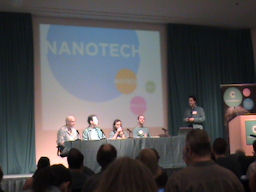
c08panel.jpg

Finally, the third question to the panel was what would you do if you were appointed by President-Elect Obama to the new post of CTO. All the panelists gave intriguing answers, but Ben’s cut straight to the heart of the matter. It’s insane to put a trillion dollars into corrupt banks and failing auto makers. If you really want to push the economy forward, put that money into nanotechnology and AI research.

Amen.

A couple of additional notes on the Paul Saffo keynote (again, well-covered by George). Paul used the typical S-curve that technological developments follow to show how technologists often make bad predictions twice — first by being too optimistic just when an initial slow-down is likely to occur, then by being too pessimistic just before the big push is about to occur. Very interesting.

Yesterday, I pondered whether life extension is going to be the next personal computer / Internet revolution. Paul showed a graph tracking both of those major trends, examining what the enabling technologies behind them were, and made the following forecast: the coming thing is robots. So if you’re looking to invest in the Next Big Thing, take a look at what’s going on in that field.

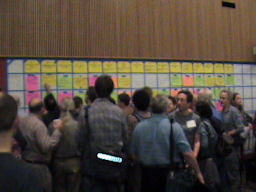
c08bigboard1.jpg

c08bigboard2.jpg

Folks creating their own agenda with the Big Board.

c08studio.jpg

Our studio.

c08studioretouched.jpg

What it should have looked like.

Day 2 looms. We have our second edition of FFR, pus I think I’ll be leading a session. More later.

Convergence 08 Day 1

Last night I met up with P. J. Manney and we attended a Senior Associate get-together in Sunnyvale. Along the way, we bumped into Tyler Emerson and James Clement. At the event, I got the chance to chat with Christine Peterson (briefly) and with John Smart.

The event had two speakers. First up was science fiction writer and UC Irvine professor Dr. Gregory Benford. Benford has won two Nebula awards, one of which was for his ground-breaking novel Timescape. But he wasn’t talking science fiction last night; he was giving us the background on his new company Genescient, which develops treatments for diseases related to aging. It sounds like they have some pretty serious research backing up what they’re doing; my guess is that we will be hearing a lot from companies like this over the next few years.

I got to pondering similar get-togethers in the Silicon Valley 15-20 years ago, introducing radical new business models based on emerging internet technology — or maybe even 30+ years ago, where the speaker might have introduced a radical concept like the personal computer. I wonder if businesses built on longevity therapies are going to follow a similar trajectory?

We also heard from Science Comedian Brian Malow, who is carving out an interesting niche for himself. I had the chance to see Brian once before at a Bay Area comedy club, and he is quite a funny guy. Plus he obviously has guts — would you want to try to make a room full of geeks laugh? I’m hoping we’ll hear from him on one of our podcasts this weekend.

Back at the hotel, I got the chance to say hi to James Hughes and Geroge Dvorsky. Looking forward to seeing more of all these folks over the next two days.

This morning I’m getting things organized for the the first day of the unconference, and starting to round up potential guests for this evening’s podcast. More later.

Seeing Is Believing

When I was a kid, we didn’t know for sure whether there were any planets outside the solar system. It seemed likely that there would be planets out there, and one could assert that it was highly probable that they were out there, but we didn’t for sure.

Then, suddenly, we did know. Astronomers began to crack the code, identifying the presence of planets by the way stars wobbled and other giveaway behaviors. So then there were a few known planets outside the solar system, and before long there were a few dozen — to the point where now most people probably couldn’t tell you (within 50, or even 100) how many extrasolar planets we have discovered.

Do you know? Take a look.

Surprised?

See we have discovered hundreds them, using various clever indirect detection methods. But no one has ever actually seen an extrasolar planet. Until now, that is:

extrasolar1.jpg

And then, one the same day we see one, we see two at the same time.

extrasolar2.jpg

All the details are here. What an amazing time we live in.

Prioritizing the Future

On Sunday’s FastForward Radio, we talked a little about Bjorn Lomborg’s recent piece in the Wall Street Journal in which he makes the case that funds spent today on solutions to climate change would be more effective if spent directly on other problems such as poverty, hunger, and disease:

Whatever is spent on climate policies saving one person from hunger in 100 years could instead save 5,000 people today.

This same point is true, whether we look at flooding, heat waves, hurricanes, diseases or water shortages. Carbon cuts are an ineffective response. Direct policies — such as addressing hunger directly — do a lot more.

Taking Lomborg’s figures as being anywhere nearly correct, dealing with the future versus the present places us in a major moral dilemma. Do we help a few in the future or a great many today? This is an intriguing problem, and (unfortunately) on the show, we didn’t deal with it as effectively as I would have liked, instead allowing ourselves to be caught up in two major digressions.

1. Free Markets Vs. Central Planning

This is beside the point. Lomborg assumes a government solution either way — he’s talking, after all, about the most effective way to spend government funds — but one can assume a free market solution or a hybrid government / free market solution, and the problem is the same. Whether it’s government, business, NGOs, or whatever, the question is do we get the benefits now or look for benefits later?

What’s interesting about Lomborg’s analysis is that it flies in the face of the normal present good / future good dichotomy. Normally, we say we can save a few lives right now or many lives later. But in the case of the specific benefits of climate change spending, Lomborg argues, we get more benefits spending the money now directly on those problems than we would trying to solve them via climate change.

2. Adoption Rates of Technology

This arose primarily because I misstated one of Lomborg’s arguments. I made it seem that Lomborg was arguing that Germany should not spend money on solar energy now, but that they should wait until the technology is better and they can get more benefit from it. This led to protests that this is a circular argument — the technology will always be better in the future, so one should never buy it now.

In fact, Lomborg is saying something else. He doesn’t state a position as to when Germany should adopt solar energy — now or later — he just uses how much they are spending as a departure point to talk about how the money could be better spent. In this case, he argues that $150 billion is better spent on making renewable technologies better than deploying them now:

Amazing good could come from using Mr. Obama’s $150 billion primarily to invest in creating new technologies, rather than simply subsidizing existing ones.

Investing in existing inefficient technology (like current-day solar panels) costs a lot for little benefit. Germany, the leading consumer of solar panels, will end up spending $156 billion by 2035, yet only delay global warming by one hour by the end of the century.

If Mr. Obama invested instead in low-carbon research and development, the dollars would go far (researchers are relatively cheap), and the result — maybe by 2040 — will be better solar panels that are cheaper than fossil fuels.

Obama’s proposed $150 billion and Germany’s proposed $156 billion are different buckets of money (although they are roughly the same amount.) Lomborg is suggesting that we get more leverage spending on development now and deployment later. As an economist, my guess is that he would suggest an economic inflection point occurs when our development dollars have secured technologies that can be deployed roughly as efficiently as the technologies they are replacing.

On the program, Stephen noted that massive improvements in solar technology might come quite a bit sooner than Lomborg’s projection of 2040. He also described a somewhat different inflection point, when consumers — rather than governments — will be ready to make the switch:

The pragmatic public has little reason to adopt solar power until its cheaper than buying electricity off the grid. When it becomes cheaper to adopt solar than to use the grid – meaning the payback period for the equipment is reasonably short – the public will begin adopting solar. Even as solar continues to be improved.

Ray Kurzweil has called the point at which solar becomes cheaper than grid the Solar Singularity.

The difference between how the public looks at these problems and how larger institutions — corporations, NGOs, government agencies — is that as individual consumers, we are going to spend money on technology only when we think it’s a good buy. An early adopter might have bought an LCD or plasma TV just when those technologies became available, and pushed the market along for relatively late adopters like myself. But even the early adopter would make the purchase thinking he or she was getting a good deal for the money. Being first has a lot of value in and of itself.

However, how many consumers will pump money directly into television R&D? In that model, you don’t actually get a TV to use now, but you know that later there will be better TVs and you will be able to purchase and enjoy one of those. Would consumers ever be willing to divert entertainment dollars today for a better future tomorrow? Well, Brian Wang makes the intriguing argument that they should be willing to do just that:

People should consider diverting $100-150 per year in science fiction movies, DVD, books, toys and games towards actual scientific attempts at life extension and molecular nanotechnology. This does not include another average of $60-100 per person on cosmetic surgery, vitamins and dietary supplements. Why settle for imagination, illusion and fake procedures and invest in attempts at real solutions ?

Note: You can also just divert some money from this or other sources depending upon your personal priorities. ie. still buy science fiction but eat out less or buy less junk food which is bad for you anyways. Go to the movies less and rent the DVD and accumulate a fund for putting towards actual research. Recognize that in most cases vitamins do nothing and put those funds towards research that has the potential to make a big difference.

I think this is an excellent idea. And something we should think about is what are ways that we can make money spent on futuristic entertainment help to fund research to bring about a better future?

Still, I think that this is where institutions have the edge over individual consumers. On the program, I lamented something I called “institutional thinking,” which tends to view the future in a very limited and linear way. But the upside to institutions — and again, I’m thinking about government agencies, NGOs, and forward-looking corporations — is that they are perfectly willing to put funds into research now. They will spend money on direct research much more willingly than consumers will.

The real trick is to get both individuals and institutions focused on the kinds of disruptive, non-linear developments that can lead to massive positive change. Nanotechnology and biotechnology have the potential to do more to cut carbon emissions than any plans on any UN or other government agency drawing board. (Plus, these technologies offer the promise of reversing damage already done to the environment.) So what we need to see happen is for those developments to become part of everybody’s plans: consumers, government agencies, non-profits, corporations.

We need to strike a balance between funding research that will get us to those promising changes and funding relief to problems that currently exist. How that should play out for large institutions is the conundrum Lomborg faces us with, and the solution he offers is focusing on what will bring the largest overall benefit. Some of that will be future-directed, some will be in the here-and-now.

But as individuals, here’s a modest proposal: let’s make it a 50-50 split. If you donate $100 to Save the Children (or a similar organization), donate $100 to Singularity Institute for Artificial Intelligence (or a similar organization.) And let’s all find a way to give twice what we’re currently giving.

That should be a start.