Monthly Archives: October 2008

The End

I was looking for an embeddable version of the Canadian video tracking a meteor reentering the atmospheree from a couple of weeks ago, thinking it would make a cool Friday video — to no avail; looks like you have to go here to see it in action — when I came upon the video embedded below.

For those who haven’t heard, the end of the world is coming. December 21, 2012 is the final date on the Mayan calendar, and is thought by many to be the date of a coming apocalypse. Here Art Bell interviews an expert on the subject, with some nifty accompanying graphics.

So it turns out that 21 December 2012 is not necessarily the day the catastrophe happens — it is merely the epicenter of a window during which the cataclysm may take place. That’s a 40 year window, which of course we are well within at this point, so I guess we’re lucky the proverbial cosmic poop hasn’t already hit the proverbial cosmic fan.

Why is the world going to end? Well, our civilization is ripe for destruction. it seems we’ve lost the “mandate of heaven” and become almost “entirely materialistic.”

Blah blah blah.

This sounds eerily similar to the End Times stuff that was popular amongst conservative evangelicals back in the 70′s and 80′s. Actually, the topic is still popular today, although now evangelicals consume it more in the form of fiction rather than non-fiction, which somehow tells me that the sense of urgency is not what it was. Back in the day, people were trying to identify the Antichrist and put dates around when certain things would happen. I don’t think there’s as much of that now, but I could be wrong.

Anyhow, the certainty that the world will end soon seems to give a perverse sense of comfort to some people. Granted, an evangelical who is into this stuff will tell you that he or she ins’t keen on death and destruction, merely looking forward the second coming of Christ. And believers in the Mayan doomsday will tell you that they don’t want the world to end, but that they’re looking forward to the Age of Aquarius, the huge spiritual awakening that will come just after the catastrophe — or possibly just before, preventing it from happening.

And maybe these folks aren’t so far off. Maybe this really is the end — no, not the end of humanity, nor the end of civilization, nor even the end of “materialism.” (Sorry.) But maybe something is winding down, here, although not necessarily in keeping with any ancient Biblical or Mayan prophecies. Or it could be happening perfectly in line with those prophecies, my point being that one need not subscribe to them in order to see that something is, indeed, happening.

Perhaps we’re looking at the end, not of the beginning, but of the briefest of prologues, the preface, the inside cover page. Maybe what’s coming to an end is the big wind up, and we’re experiencing the final milliseconds before throwing the first pitch of the first game of what promises to be a very long season, indeed.

That’s the perspective from which I look at the future. Everything that has happened up to this moment, though it seems impossibly long and difficult (and was both) — is a blink, a twitch, a clearing of the throat, compared to what is to come. I don’t think we came all this way just to hit the reset button, and if the universe or God or Quetzalcoatl is evaluating us and responding to us in accordance with our performance, it’s hard to jibe the success that humanity has experienced and is experiencing with any massive divine disapproval.

Hubris, some will say. And maybe they’re right, and maybe the divine comeuppance is up and coming.

But maybe not. While in Las Vegas a while back, I happened to be standing at a roulette table with some business associates who were playing minimum stakes, and not doing terribly well. The last four or five spins had come up black. A man walked up to the table, looked at the board showing the progress of the last few turns, and plunked a $1000 chip down on red. I know this kind of stuff goes on all the time, but it was the first time I had ever seen anything like it. Quickly, several of the players threw an additional bet onto red, cheering this daring gambler.

The croupier called, “No more bets!” and we all held our breath a little as the stakes of the game had gone up quite a bit. The ball whirled around the spinning wheel, slowing as it bounced along until it came click-clicking to a stop at number 17, black.

The $1000-man was gone from the table before anyone could even gauge a reaction, but I will venture to guess that he wasn’t terribly happy. As he was raking in the chips, the croupier made an interesting comment.

“Guy thought he had a sure thing,” he said. “But the truth is, it makes as much sense to bet with the trend as it does to bet against it.”

At the Speculist, we’re betting with the trend. There is an undeniable trend in human history towards greater human capability, greater human freedom, and greater potential for human happiness. Arguably, this is a trend not just in human history, but in the history of the universe. The world may end, but that’s not where we’re putting our chips.

At the beginning of each edition of FastForward Radio, I reiterate my conviction that something is going to happen — something wonderful. If anyone is curious as to what that “something” might be, I have attempted to lay out what it might be reasonable to expect. But just as Art Bell’s guest can only provide a 40-year window for doomsday, I can only provide suggestions and hints as to what the future might hold: not because I’m unconvinced that the future will be good, but rather because I’m fairly certain that I lack the capacity, in a meaningful way, to articulate just how good it’s going to be.


Somebody Needs to Go to Mars

…and stay there! So says Buzz Aldrin

“…send people there permanently,” said Aldrin. “If we are not willing to do that, then I don’t think we should just go once and have the expense of doing that and then stop.”

He asked: “If we are going to put a few people down there and ensure their appropriate safety, would you then go through all that trouble and then bring them back immediately, after a year, a year and a half?”

Aldrin points out that there is water on Mars and that conditions are generally more Earthlike there than just about anyplace else. If we’re going to set up a permanent inhabited outpost anywhere in the solar system, Mars definitely presents some advantages.

I think there’s something to be said for this argument. We’ve already had our Christopher Columbus voyages via Apollo. Maybe now it’s time to start moving into the Plymouth Rock or Jamestown mode. This is one reason that it’s probably a good thing that we haven’t discovered life on Mars. If there is even bacteria there, some would argue that we have no right to set up permanent residence.

Let the settlers discover Martian bacteria, and find a way to peacefully coexist (as we do with a significant amount of the stuff on this planet.)

Firemakers

As we discussed in a recent edition of FastForward Radio, the mastery of fire was one of the most significant steps forward in human history. Stephen pointed out that human beings were able to use fire long before we developed the ability to create fire. So fire was a rare and precious substance that fell from heaven (dropped by Prometheus, no doubt) and which, once found, had to be carefully protected and preserved.

And then came that amazing, fateful day when human beings discovered that they could make fire virtually any time and any place they wised. But how long ago did this discovery take place? Longer ago than you might have thought, it turns out:

Humans made fire 790,000 years ago

JERUSALEM (Reuters) – A new study shows that humans had the ability to make fire nearly 790,000 years ago, a skill that helped them migrate from Africa to Europe.

By analysing flints at an archaeological site on the bank of the river Jordan, researchers at Israel’s Hebrew University discovered that early civilizations had learned to light fires, a turning point that allowed them to venture into unknown lands.

A previous study of the site published in 2004 showed that man had been able to control fire — for example transferring it by means of burning branches — in that early time period. But researchers now say that ancient man could actually start fire, rather than relying on natural phenomena such as lightning.

So we’ve had dogs with us longer than we realized, and we’ve been making fire for longer than we thought.

Like primitive agriculture and animal husbandry, fire is one of the fundamental technologies that had to be mastered in order to transform human society from its pre-civilized state to full-blown civilization. Terry Bisson published a wonderful short story many years ago entitled Bears Discover Fire in which, well, take a wild guess. But in actuality they never did, and neither did gorillas nor chimps nor orangutans.

Which is one of the reasons — not the only reason, but an important one — that human beings write blog posts about those species, but they never return the favor.

prometheus.jpg

Hmmm…should I save some of this stuff for the bears? Naaaaaaaa.

FastForward Radio

Sunday’s show arrived two days late. So what? Think of it as a little trip into the future!

The guys talked about how life expentancy tables are off (in a good way), the coming smart electric grid, Blacklight power, the Pickens Plan, and much more!


Stream our latest shows:


Or:

add_to_itunes.gif

Or download MP3′s for all the archived shows at:

Listen to FastForward Radio... on Blog Talk Radio


Click “Continue Reading” for the show notes:

Deciphering Alien Languages

One John Elliott of Leeds Metropolitan University believes that it is doable, at least to some extent:

Dr Elliott’s programme would compare an alien language to a database of 60 different languages in the world to search see if it has a similar structure.

He believes that even an alien language far removed from any on Earth is likely to have recognisable patterns that could help reveal how intelligent the life forms are.

“Language has to be structured in a certain way otherwise it will be inefficient and unwieldy,” he told New Scientist magazine.

So this approach doesn’t give us the content of an alien signal, but it might enable us to distinguish language from music or images. Elliott suggests that his software might give us some indication of how intelligent the aliens are, but I’m not sure that I agree that how many words get packed into a sentence is a particularly good measure of this. Intelligence might ultimately be reflected by economy of language.

Anyhow, the whole thing strikes me as a waste of time. I’ve been watching aliens on TV for years, and I can assure you that the vast majority of them are English-speaking white people. There is a little ethnic diversity, but not much.

Oh, and many of them have interesting facial ridges. But that doesn’t mean we can’t communicate with them. Experience shows that we can even reproduce with them if we wish.

typicalalien.jpg

I mean — if they wish, too, obviously.

But seriously, Elliott’s ideas provide a good reminder that any aliens we eventually encounter are likely to be far more alien than we can begin to imagine. Even the idea that we can recognize alien language as such might be optimistic.

Our Oldest Friend

Has been with us a lot longer than we thought:

An international team of scientists has just identified what they believe is the world’s first known dog, which was a large and toothy canine that lived 31,700 years ago and subsisted on a diet of horse, musk ox and reindeer, according to a new study.

The discovery could push back the date for the earliest dog by 17,700 years, since the second oldest known dog, found in Russia, dates to 14,000 years ago.

I wonder what part those early dogs played in bringing down the aforementioned horse, musk ox and reindeer? One thing is for sure — while these were no doubt fine and noble animals, they were not “cute” by any stretch of the imagination.

Well, okay — maybe as pups.

The New Space Age

Some awfully interesting developments over the past month or so. First we had this:

Spacewalk Taikonauts Receive Heroes’ Welcome

Cheering crowds in Beijing greeted the three returning Chinese taikonauts who fulfilled China’s third manned space mission over the weekend.

The Shenzhou-7 spacecraft landed in Inner Mongolia on Saturday afternoon and the taikonauts – including Zhai Zhigang, who conducted China’s first spacewalk while wearing a Chinese-made space suit and carrying a Chinese flag in one hand – have now returned to headquarters.

The mission “opened a new chapter of the Chinese nation in exploring and peacefully utilising space,” said General Guo Boxiong, Vice Chairman of the Central Military Commission.

The last week it was this:

India Celebrates Launch of First Moon Probe

India’s first space mission beyond Earth orbit was launched successfully Wednesday (Local Time) when an upgraded version of India’s Polar Satellite Launch Vehicle (PSLV) placed the Chandrayaan-1 lunar orbiter into an elliptical transfer orbit, the Indian Space Research Organization (ISRO) announced.

The 3,042-pound (1,380-kg) Chandrayaan-1, carrying 11 experiments including three from the European Space Agency, two from NASA and one from Bulgaria, is expected to fire its onboard liquid motor in a series of maneuvers intended to place it into a 62-mile (100-km) altitude orbit above the Moon’s surface by Nov. 8.

Then over the weekend we saw this:

Armadillo Aerospace Wins Level One of the Northrop Grumman Lunar Lander Challenge

Armadillo Aerospace team leader John Carmack wore a big smile yesterday as the team earned $350,000 in prize money for winning Level One of the Northrop Grumman Lunar Lander Challenge in Las Cruces, New Mexico. In addition to officials from NASA and other space-industry organizations, New Mexico Governor Bill Richardson was on hand to witness the victory and to show his support for the private spaceflight industry. Armadillo made an attempt at Level Two of the Challenge today, but experienced technical problems that prevented them from accomplishing a successful flight.

The Chinese are now at roughly at Project Gemini stage on their way to their own Apollo program. The Indians are in the game with their new lunar probe. And in the US, private developers are leading the way to a new era in space exploration. Exciting times!

Is it a new Space Race with China n the lead? Or is this a whole new ball game. I tend to think it’s the latter, but what does that mean, exactly? Next one to the moon wins? But we’ve already been…that ought to count for something. The real race might be to see who can put together a lunar exploration program that isn’t a dead end.

Now that would be exciting.

T. Boone Pickens Town Hall in Shreveport, LA

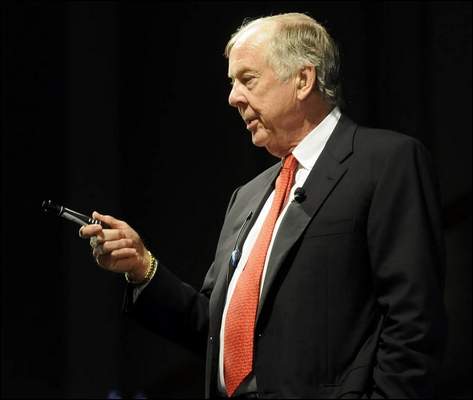
T. Boone Pickens came to my home town Shreveport yesterday as part of his campaign for the Pickens Plan. It was set to start at 10:30, and I showed up a few minutes early to make sure I could get a decent seat.

Out in front of the Shreveport Civic Center were two CNG vehicles. One was a GM Impala and the other was a Chesapeake work truck. Unfortunately neither is in production right now. If you want to be a CNG early adopter you essentially have one choice in the United States today – the Honda Civic GS CNG.

I got inside and got a great seat on the second row. When the rally started 30 minutes later, the room was completely full (picture gallery here [Hey, that's me in photo 8]).

A video showing T. Boone’s travels on this campaign rolled to the tune of Johnny Cash’s “I’ve Been Everywhere.” T. Boone is shown hopping from city to city on various talk shows and rallies throughout the country.

Then our local Senator David Vitter came out and introduced T. Boone.

Pickens was given a standing ovation as he approached the podium from the back of the hall. Shreveport is a very friendly crowd for this guy. He’s advocating a move from petroleum to natural gas to people living on top of the biggest gas field in the United States.

tboone.jpg

T. Boone looks like he’s one of those rare 80-year-old guys with another 20 years left in him. He got to the stage and – with a quick hand up from Vitter – did this funny hop step 3 feet up onto the stage. He didn’t bother with the stairs at the side of the stage.

He got straight to the point – we import 70% of our oil. Nixon thought we had a problem back when we imported 24% of our oil. At this summer’s peak prices we were sending $700 Billion overseas annually for petroleum. We can’t afford this now. And if we don’t do something it will get worse. Pickens says that by 2018 we’ll be paying $300 a barrel for oil. It will break this country.

What's with the 'God' Angle?

A startling headline, no doubt:

Self-assembling computer circuits, who needs God?

And a pretty amazing story to go with it:

On a cross between physics, chemistry, biology and what some could possibly call blasphemy, European scientists have developed a self-assembling integrated circuit, an important step towards the ultimate goal: self-assembling computers.

According to Geoff Brumfiel in Nature, a team of European physicists has developed an integrated circuit that can build itself. Today, the building of computer chips is slowly pushed to the limit. Computer chips are made by etching patterns onto wafers made of semiconductors. The details of these patterns are no more than a few tens of nanometres. For us humans, it is nearly impossible to realize how small this is. There are 1,000 millimetres in one metre (25.4 in one inch), there are 1,000 micrometres in one millimetre and there are 1,000 nanometres in one micrometre. In other words, there are 1 billion nanometres in a metre or one million in a millimetre. Current technology is really getting to the limit, therefore other methods have to be found.

Dago de Leeuw, a researcher at Philips Research Laboratories in Eindhoven, the Netherlands, thinks that the most obvious solution is to let these circuits build themselves. We know that this is possible, since nature is chock-full of self-assembling machines: microbes, plants and animals, including humans. This is done via our genetic code that steers the entire process. In order to create truly self-assembling computers, scientists must come up with an entire new but similar system that would be able to get insulators, conductors and semiconductors to automatically link to each other. According to de Leeuw, this is still a long way off.

Nevertheless, the team has made a first step, and as usual, the first steps are the hardest ones to take. They took quinquethiophene, a long organic molecule with mobile electrons that acts like a semiconductor. They attached it to a long carbon chain, terminated by a silicon group. The silicon group acts as an anchor.

They then took a circuit board with preprinted electrodes and immersed it in a solution of these new molecules. Billions of molecules hooked on to an insulating layer between the electrodes. As a result, they formed connections through which a current could flow.

“The different molecules are like little bricks,” says Edsger Smits, another researcher at Philips. “Frankly it worked much better than we expected.”

But then come to think of it, I don’t really see how that headline, or the article’s opening sentence, go with the story at all. Self-assembling machines aren’t considered blasphemous in any religion I’ve ever heard of. I suppose there might be some nature religions which take offense at all machines and which therefore might consider a self-assembling machine to be particularly egregious.

But then shouldn’t the headline read, “Who Needs a Goddess?”

I guess the reporter needed a hook, and wanted to come up with something more original than the standard “The machines are taking over” line.

I suppose we should be grateful for that. Still, he might consider another really fresh approach: simply reporting positive developments as positive developments. It could work.