 |
||
|
We’re just 11 Better All the Time’s away from our 50th edition. It’s
probably time to start planning some kind of major celebration…
|





Hope is a state of mind, not of the world. Hope, in this deep and powerful
sense, is not the same as joy that things are going well, or willingness to
invest in enterprises that are obviously heading for success, but rather an
ability to work for something because it is good.
Item 1
Need
a New Heart? Print One
The technology is the same as that of the simple inkjet printer found in
homes and offices, but Japanese scientist Makoto Nakamura is on a mission
to see if it can also produce human organs.The idea is for the printer to jet out thousands of cells per second, rather
than ink droplets, and to build them up into a three-dimensional organ.A heart made of cells originating from the patient could eliminate fears
that the body would reject it.In the emerging field of organ printing, Dr Nakamura bills his work as the
world’s finest printed 3D structure with living cells.The technology works a bit like dealing with sliced fruit: an organ is cut
horizontally, allowing researchers to see an array of cells on the surface.If a printer drops cells one by one into the right spots and repeats the
process for many layers, it creates a 3D organ.
The Good News
We are not too far away from a world in which there is no shortage of transplant
organs for those who need them, and where transplanted organs are never rejected.
This technology will not only ensure than anyone who needs a new heart or kidney
will have it, it may ultimately have a role to play in the extension of healthy
human lifespan. Might we not one day replace worn-down body parts the way we
currently put a new set of tires on our car?
We reported similar developments here
and here.

Item 2
Mobileye
develops a third eye for your car
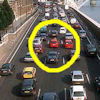
A computer chip and a tiny camera not much bigger than a dime installed on
the windshield behind your car’s rear-view mirror may now make the difference
between life and death.The Netherlands-based Mobileye Vision Technologies has developed an inexpensive
hi-tech driver assistance system called Mobileye AWS (advance warning system),
which can provide drivers with early warnings of potential road hazards.Founded by an Israeli, with its R&D based in Israel, the company says
the system has the potential to lower accident rates and teach people how
to be "smarter" drivers.The images generated from a front-facing camera are analyzed by the system’s
computer chip, which has been "taught" to recognize potential hazards
such as cars, buses, trucks, motorcycles and pedestrians, and uses audio warnings
to aid the driver in recognizing and maintaining safe distances from these
threats.
The Good News
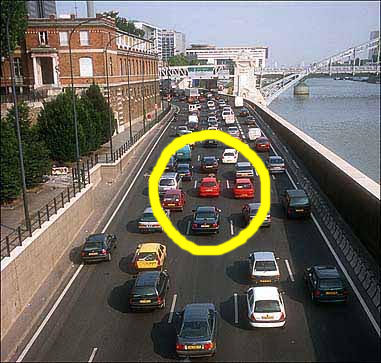
This development brings us a little closer to something I’ve been wishing for
for a long time — a comprehensive, real-time tactical interface for driving.
Why do we have to crane our heads around when backing up, or shift our attention
from one mirror with a partial and unreliable view to another mirror with a
partial and unreliable view when making a lane change?
I want my dashboard to show me everything that is in front of, behind, and
beside my vehicle at all times. As the linked article points out, automobile
accidents are the world’s leading cause of accidental death. Many accidents
are due to bad judgment, which such a system can counter by recommending against
a bad move. Many others are caused by bad decisions resulting from incomplete
information. The more complete the picture we have of our situation, the safer
we are likely to be.
Item 3
Internet
‘speeds up decision making and brain function’
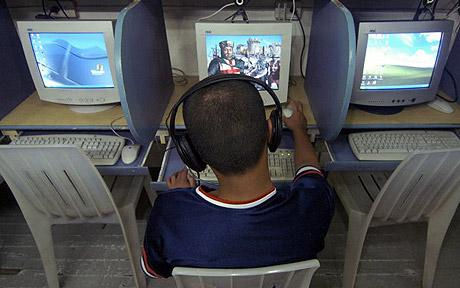
A study of the use of areas of the brain during different activities found
that it is markedly more active when carrying out an internet search than
when reading a book.The stimulation was concentrated in the frontal, temporal and cingulate areas,
which control visual imagery, decision-making and memory.The areas associated with abstract thinking and empathy showed virtually
no increase in stimulation.The study’s authors say it shows how our brains could evolve over the long
term with the increased use of technology.
The Good News
Here we see evolution occurring in real time. We are adapting to our new environment,
and it isn’t just a matter of making use of the technology that surrounds us.
We live in an era of accelerating change and we are learning the best way to
think so that we can not only survive, but thrive in such an era.
The Downside
But while the Internet brings benefits for the brain, they warned against
its overuse, which could come at the expense of other brain functions linked
to human interaction.Previous studies have warned that too much computer use could be responsible
for increasing levels of Attention Deficit Hyperactivity Disorder (ADHD).
We need to find ways to gain brain speed and power without losing little bits
of our humanity in the process. That’s why, at the Speculist, we throw in a
lot of fine art and poetry and mythological references and that kind of stuff
with all of our geeky technology blogging. Let the research continue!
Item 4
An End to Paralysis with Artificial Brain-to-Muscle Connectors
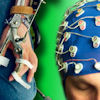
Using a computerized connector between the brain and muscles in the body, scientists
have been able to restore movement to paralyzed limbs. A group of neuroscientists
report in Nature today that they used a brain-computer interface to join the
motor cortex of an ape to the muscles in its wrist. After scientists paralyzed
the ape’s arm temporarily, it was still able to make its wrist move by sending
electrical impulses directly from its brain to the muscles, bypassing the
damaged nerves in between. The study has profound implications for people
whose nerves have been severed or damaged, leaving them paralyzed.
The Good News
It would be hard to overestimate the hardships and challenges that paralysis
represents to millions of people worldwide — not just the paralyzed themselves,
but the people who care about them and the people who care for them.
Surely one of the biggest challenges is mobility, or rather the lack thereof.
Developments such as this one promise to bring mobility back to many, providing
a wonderful new independence as well as health benefits associated with being
able to move around. This research doesn’t mention anything about restoring
feeling to paralyzed limbs, although there are some hopeful (albeit puzzling)
signs that this might also one day happen.
Now all we need is some better ways of connecting the human nervous system
with machines. Something like this, possibly:
Scientists create
organic wires for use inside the human bodyBaltimore (MD) – Research chemists at Johns Hopkins University (JHU) have
developed a water-soluble, organic, self-assembling electronic wire suitable
for use inside the human body. Derived from carbon materials, the lightweight,
flexible wires can power pacemakers, reconnect damaged nerve tissues, while
also interacting with real electronic device that could augment or stimulate
organic function.
Yeah. Something like that ought to just about do the trick!

Item 5
Does Everything But Bring
You a Beer
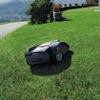
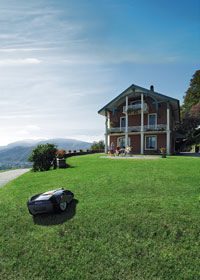
Being the worlds first fully automatic, robotic lawn mower, the Auto Mower
is the ultimate user friendly mower. You don’t have to lift a finger
to get a perfect lawn.Before the Automower can get to work, you will need to simply staple a wire
to the perimeter of the lawn. The wire will be overgrown and become invisible
within a month. This wire can be sensed by the robotic mower and will ensure
that only this area of grass is cut. The Automower will then work irregularly
around the lawn – whatever its shape – until all parts have been covered.
This gives the lawn an even result and a carpet-like finish. ‘Islands’
can be created by laying the wire around plants and flower beds. And if the
mower hits any other obstacle, such as a tree or rock, it just reverses safely
and selects a new direction before continuing.
The Good News
From the moment I first heard about Roomba,
I new this day was coming. A robotic lawn mower. Say it with me:
A robotic lawnmower.
Sure, we’ll have to be careful about pets and toddlers, but then we were always
pretty careful about those things with the old mowers, weren’t we? And, yes,
this will put some people out of work, but I just have to point out that one
of those people is me.
And I couldn’t be more delighted at the thought.
Item 6
Future
planes, cars may be made of `buckypaper’
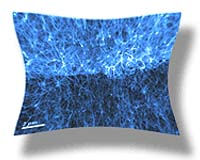
It’s called "buckypaper" and looks a lot like ordinary carbon paper,
but don’t be fooled by the cute name or flimsy appearance. It could revolutionize
the way everything from airplanes to TVs are made.Buckypaper is 10 times lighter but potentially 500 times stronger than steel
when sheets of it are stacked and pressed together to form a composite. Unlike
conventional composite materials, though, it conducts electricity like copper
or silicon and disperses heat like steel or brass."All those things are what a lot of people in nanotechnology have been
working toward as sort of Holy Grails," said Wade Adams, a scientist
at Rice University.
The Good News
So what can one do with buckypaper? Well, you name it. Here’s a partial list
from Wikipedia:
- If exposed to an electric charge, buckypaper could be used to illuminate
computer and television screens. It could be more energy-efficient, lighter,
and could allow for a more uniform level of brightness than current cathode
ray tube (CRT) and liquid crystal display (LCD) technology. - Since carbon nanotubes are one of the most thermally conductive materials
known, buckypaper lends itself to the development of heat sinks that would
allow computers and other electronic equipment to disperse heat more efficiently
than is currently possible. This, in turn, could lead to even greater advances
in electronic miniaturization. - Because carbon nanotubes have an unusually high current-carrying capacity,
a buckypaper film could be applied to the exteriors of airplanes. Lightning
strikes then could flow around the plane and dissipate without causing damage. - Films also could protect electronic circuits and devices within airplanes
from electromagnetic interference, which can damage equipment and alter settings.
Similarly, such films could allow military aircraft to shield their electromagnetic
"signatures", which can be detected via radar. - Produced in high enough quantities and at an economically viable price,
buckypaper composites could serve as an effective armor plating. - Buckypaper can be used to grow biological tissue, such as nerve cells. Buckypaper
can be electrified or functionalized to encourage growth of specific types
of cells. - The Poisson’s ratio for carbon nanotube buckypaper can be controlled and
has exhibited auxetic behaviour, capable of use as artificial muscles.
Wow. Whatever you do, don’t taunt buckypaper!
Top
Item 7
Wading
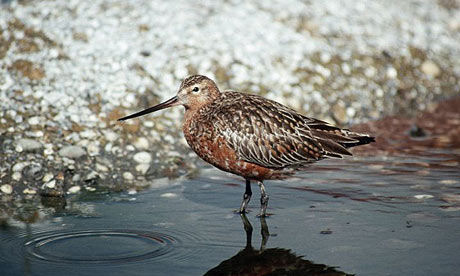
bird travels 7,000 miles nonstop to break flying record
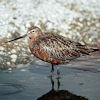
A bar-tailed godwit has been crowned the endurance champion of the animal
kingdom after completing an epic 7,200 mile nonstop flight across the Pacific
Ocean from Alaska to New Zealand.The wading bird’s journey lasted more than eight days with no rest or food,
and took it into a place in the record books. Scientists tracking the bird’s
flight said it was unprecedented.Theunis Piersma, a biologist at the University of Groningen in the Netherlands
who worked on the study, said: "There is something special going on here.
For a vertebrate this kind of endurance is just extraordinary."
The Good News
Seems to me that this little bird has a lot to teach us about
endurance and making the most of available resources.
The scientists agree:
Led by Bob Gill of the US Geological Survey, the scientists say: "These
extraordinary nonstop flights establish new extremes for avian flight performance
and have profound implications for understanding the physiological capabilities
of vertebrates."
Don’t forget: we’re vertebrates, too. We normally think of tasks such as a
Lance Armstrong Tour de France performance or swimming the English Channel as
defining the limits of human endurance. But perhaps by understanding the godwit’s
accomplishment better, we’ll learn more about our own abilities.
Solar Refrigeration:
A Hot Idea for Cooling
Fishermen in the village of Maruata, which is located on the Mexican Pacific
coast 18 degrees north of the equator, have no electricity. But for the past
16 years they have been able to store their fish on ice: Seven ice makers,
powered by nothing but the scorching sun, churn out a half ton of ice every
day.The key is the energy exchanged when liquids turn to vapor and vice versa—the
process that cools you when you sweat. By far the most common approach, the
one used by the refrigerator in your house, uses an electric motor to compress
a refrigerant—say, Freon—turning it into liquid. When the pressure
created by the compressor is released, the liquid evaporates, absorbing heat
and lowering the temperature.Absorptive chillers like solar refrigerators use a heat source rather than
a compressor to change the refrigerant from vapor to liquid. The two most
common combinations are water mixed with either lithium bromide or ammonia.
In each case, the refrigerating gas is absorbed until heat is applied, which
raises the temperature and pressure. At higher pressure, the refrigerant condenses
into liquid. Turning off the heat lowers the pressure, causing that liquid
to evaporate back into a gas, thereby creating the cooling effect.
The Good News
Turning heat into cold without creating any carbon emissions is a great idea.
It also raises an intriguing question — why can’t we do something like this
on a larger scale? If the climate is heating up, why isn’t there some global
way to turn that heat into cool? Freeman
Dyson has described how warming sea waters in Antarctica cause additional
snow, which actually helps to mitigate the loss of glaciers. Maybe there are
additional ways that the additional energy implicit in warming could help bring
about cooling.
It certainly seems worth looking into, doesn’t it?

Top
The
Stink in Farts Controls Blood Pressure
A smelly rotten-egg gas in farts controls blood pressure in mice, a new study
finds.The unpleasant aroma of the gas, called hydrogen sulfide (H2S), can be a
little too familiar, as it is expelled by bacteria living in the human colon
and eventually makes its way, well, out.The new research found that cells lining mice’s blood vessels naturally
make the gas and this action can help keep the rodents’ blood pressure
low by relaxing the blood vessels to prevent hypertension (high blood pressure).
This gas is “no doubt” produced in cells lining human blood vessels
too, the researchers said.
The Good News
Well, what can one say? Every cloud has a silver lining — even invisible clouds.
I mentioned on the most recent FastForward Radio that I have been following
a high-intensity weight-lifting workout recommended by Timothy
Ferriss. One of the concerns I had about the workout is that it involves
very long, slow exercises, and I wondered whether such activity might raise
my blood pressure.
Well, not to worry. At the same time I started the workout, I also started
following Ferriss’s Slow
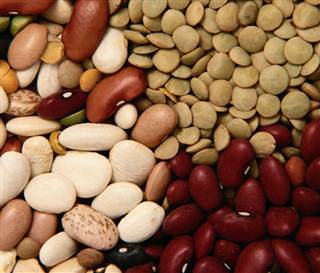
Carb Diet. It’s a very unusual diet plan — one that requires eating beans
with every meal.
See how things work out?
Better All The Time was compiled by Phil Bowermaster. Live to see it!