Dispatches from a rapidly changing, rapidly improving world
|
|
There’s a lot of bleak news out there, but let’s not let that blind us
to the good news. There is as much of it as ever — more in fact. This week
alone we have four good news stories about energy, hope for cancer treatment
from an unlikely source, confirmation of the power of the unconscious mind,
an "extinct" flower that’s back from oblivion, a cute robot that
might help usher in the next stage of evolution, and proof that smart guys
are sexier than jocks! Now what were you saying about the economy?
Today’s Good Stuff:
Quote of the Day
The universe is change; our life is what our thoughts make it.
Marcus Aurelius Antoninus
Top
Item 1
The Power of Unconscious Thought: Does It Result in Creative Problem-Solving?
No doubt many of us have all experienced a situation where, after long hours
of trying to solve a certain problem, we give up, and go get a break, only
to come back and solve the problem within moments. This appears to be a somewhat
commonplace situation. However, the science behind it is much more complex.
According to the authors of the study – Professor Adam Galinsky of the
Kellogg School of Management, Chen-Bo Zhong from the University of Toronto
and Ap Dijkstererhuis of Radboud University Nijmegen – unconscious thought
results in creative problem-solving in a two step process.
But this is not as simple as having an “Aha!” moment and moving
on. The trio note that while the distraction might be helpful in coming up
with the solution, a period of steady thought must follow so as to understand
the solution and how those solutions can be applied. Similarly, while such
moments might be useful in dealing with particularly tricky problems, easier
problems should be confronted the old fashion way.
The Good News
The research seems to show that conscious thought is better at solving straightforward
analytical problems, while unconscious thought gives a boost for solving more
complex problems. Clearly, we need a combination of both. But when faced with
a truly complex problem, it turns out that tendency to avoid thinking about
it might actually help.
Sometimes, anyway. But when in doubt…think.

Top
Item 2
Anything Into Ethanol
Biofuels could be a crucial weapon against both rising temperatures and dwindling
global oil supplies. They are made from organic material such as plants, so
they essentially recycle existing carbon in the atmosphere instead of releasing
new carbon from the depths of the earth; they are also, in principle, endlessly
renewable. But the best-known biofuel, ethanol, is looking decidedly unpromising
right now. Today most ethanol in the United States is made from corn, using
an energy-intensive process that may not actually save a lot of fossil fuel,
and in any case America cannot produce enough ethanol from corn to really
matter.
Scientists have long tried to devise an efficient way to make ethanol from
a wider range of raw materials, especially waste products rather than food.
The U.S. government has calculated that the country could generate 1.4 billion
tons of biomass a year. This could make 100 billion gallons of fuel or more,
enough to meet much of America’s demand for motor gasoline. One approach
to tapping into all that biomass focuses on cellulose, the material that gives
plant cells their strong walls. The cellulose is converted into sugar and
then from sugar into ethanol. But despite decades of research, the technology
is still far from commercially viable.
Now several companies, including Coskata and Range Fuels, say they have cracked
the problem. They are pursuing a different strategy, one that turns any carbon-rich
matter into a gas, which is then converted to liquid fuel. This approach can
use any organic material, so the potential sources for this fuel are virtually
unlimited. Soon, the companies claim, they will be able to refine vast quantities
of noncorn ethanol. Coskata even predicts they will do so for as little as
$1 a gallon.
The Good News
The article goes on to estimate that there is enough biomass in the southeastern
US alone to produce 15 billion gallons of fuel per year. Assuming that Americans
average about 500 gallons of gasoline each per year, and assuming that a gallon
of ethanol provides about 75% of the power that would come from a gallon of
gasoline, this biomass could meet the fuel needs of approximately 21 million
Americans, roughly 7% of us.
Plus, if the estimates above are anywhere near accurate, at $1.00 a gallon
— even providing quite a bit less energy per gallon than gasoline — this approach
would save us quite a bit of money. In fact, if that estimate is two times as
optimistic as it should be, and the ethanol would cost $2.00 a gallon to produce,
even accounting for the difference in energy provided and allowing for a reasonable
markup, we would be looking at the equivalent of $3.00 – $3.25 for a gallon
of gas. Not too shabby, even in these days of falling gas prices.

Top
Item 3
Nerds rejoice: Braininess boosts likelihood of sex
Lonely men ought to flaunt their copies of New Scientist. Women looking for
both one-night stands and long-term relationships go for geniuses over dumb
jocks, according to a new study of hundreds of university students.
"Women want the best of both worlds. Not only a physically attractive
man, but somebody in the long term who can provide for them," says Mark
Prokosch, an evolutionary psychologist at Elon University in North Carolina,
who led the study.
To many women, a smart man will appeal because he is likely to be clever
enough to keep his family afloat. But he may also pass on "good"
genes to his children, say Prokosch and his colleagues at the University of
California, Davis.
The Good News
Interestingly, these findings were based not on simply asking women what they
would prefer hypothetically, but by showing them videos of men alternatively
playing Frisbee, reading news reports, and talking about the possibility of
life on Mars. The guys who were rated as the most intelligent were also rated
as the sexiest.
Imagine that: men who talk convincingly about the possibility of life on Mars
are sexier than men who display athletic ability.
The Downside
Sorry ladies. These
guys are taken. But, hey, if you want to listen in and dream, that’s okay.
There’s nothing wrong with that.

Top
Item 4
World’s First 100% Renewable Jet Fuel is Created
The EERC is leading the way to proving a pathway to energy security in the
United States by achieved a major technical milestone in creating a 100% renewable
domestic fuel that meets the JP-8 aviation fuel screening criteria.
The EERC fuel was produced under a $4.7 million contract with the US Department
of Defense’s Defense Advanced Research Projects Agency (DARPA). The Department
of Defense is the largest consumer of petroleum in America, and securing a
domestic fuel source is a key operational challenge for the military. Production
is now under way to produce a large fuel sample for engine testing this fall.
The Good News
The quoted article goes on to explain that this new fuel is made from "various
crop oils and waste greases." I thought it was pretty cool a while back
to learn that Daryl Hannah was running a Cadillac off fuel made from french-fry
grease. That’s pretty cool, no doubt. But how much more cool if she
was flying one of these babies…

Top
Item 5
Rare Plant Thought Extinct Re-discovered in Upstate New York
A salt-marsh plant thought to have vanished from upstate New York is back.
But it has not come back to the inland salt marshes, of which only four remain
(three in New York and one in Michigan). Rather, the rare goldenrod was found
growing alongside local streets, probably competing well where run-off from
winter road salt suppresses other plant life. The species was discovered serendipitously
by Dr. Leonardo of the SUNY College of Environmental Science and Forestry
(ESF) as he was out walking.
"They’re coming out of asphalt, with no soil anywhere," Leopold
is quoted in an article in Syracuse. "And it’s striking because they’re
all blooming right now. It’s a visually spectacular plant." But the seaside
goldenrod’s beauty is not alone among it’s benefits to humanity and the environment.
The Good News
What’s great about this story is not only the good news that the seaside goldenrod
is still with us, but the wonderful adaptability that life on this planet can
display. No salt marshes available for habitat? Forget about it. This hardy
flower decides just to shoot up through the asphalt.
Furthermore
At The Speculist, we take an unusual stance on extinctions. Of course we think
they’re bad news. Terrible, in fact. It’s the Speculist view that we should
be doing all that we can to preserve our planet’s biodiversity and take what
steps are needed to prevent extinctions of animal and plant species from occurring.
So far, so good. But that sounds like everybody else’s view of extinctions,
doesn’t it?
Where we differ is in our belief that extinctions — while terrible and to
be avoided — are not the end of the story. We believe that advanced biotechnology
and nanotechnology will enable us one day to recover lost species. That doesn’t
mean that it’s okay to allow species to die out today, any more than it’s okay
to allow someone to go into preventable cardiac arrest because we can always
whip out the paddles and try to shock that heart into beating again. But it
does mean that there is hope that we will one day restore many species that
have been lost and are being lost now.

Top
Item 6
Solar Paint on Steel Could Generate Renewable Energy Soon
In three years, buildings covered in steel sheets could be generating large
amounts of solar electricity, thanks to a new photovoltaic paint that is being
developed in a commercial partnership between UK university researchers and
the steel industry.
A laboratory built to develop the new solar technology that replicates plant’s
photosynthesis is due to start work on October 30th in Shotton, North Wales.
The Good News
So we can grind up wood chips to power our cars
and we can use solar-steel buildings to power the electric grid. There certainly
does seem to be a wide range of options for how we might deal with our energy
problems. They don’t all have to work. A few select ones can make a huge difference.
Top
Item 7
Gut Microbe Strikes Again: Ulcer-Causing Bug May Also Prevent Cancer
The common ulcer-causing bug linked this summer to reduced rates of childhood
asthma and allergies may also help protect adults against one type of cancer,
according to a new analysis. Researchers report today in the journal Cancer
Prevention Research that they found the stomach microbe Helicobacter pylori
(H. pylori) may help prevent a major form of cancer of the esophagus (the
muscular tube that carries food and drink from the throat to the stomach).
The Good News
In the US alone, esophageal cancer kills nearly 15,000 people
each year. Any hope for prevention or treatment of this disease is, of course,
a wonderful thing. What makes this story especially wonderful is the source
of the hope. A bug that causes ulcers can help fight childhood allergies and
esophageal cancer. What’s next? A potato virus that cures
Alzheimer’s disease?

Top
Item 8
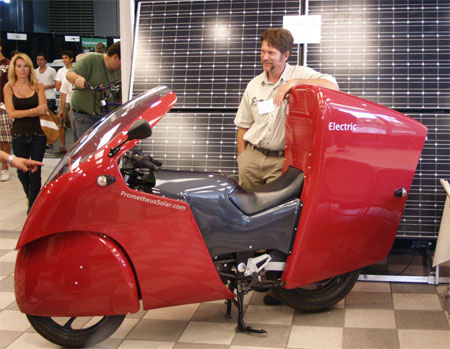
Prometheus Demonstrates Solar-Powered Electric Motorcycle
This past weekend, Prometheus Solar founder Jim Corning demonstrated his
proof-of-concept electric motorcycle at the Santa Monica AltCar Expo. The
motorcycle is a reconstructed Ninja 250 that uses four solar panels which
provide 800 watts of power.
The panels aren’t actually attached to the bike. Instead, they are left
out in the sun and connected to the bike’s 4.6 kW Thundersky lithium-ion
phosphate batteries for power storage. The front wheel cover and extended
back keep the motorcycle upright and aerodynamic.
And the bike isn’t exactly slow— Corning’s motorcycle can
go up to 70 MPH and has a range of 50 miles.
Corning currently has no plans to sell the bike, but perhaps interest in
the prototype will persuade him to look into mass production.
The Good News
Getting 70 mph on sun power is not too shabby. They need to work on that range,
of course, and the gimmick of having it come with its own solar panels is just
that. A more scalable solution will be an electric motorcycle that runs off
the grid, whether that power is solar, nuclear, hydrogen, whatever.
Still. Looks cool, doesn’t it?
Top
Item 9
Toy Robot Intended to Save Humans From Evil, Future Bots
When roboticist David Hanson thinks of the future, he fears that
man will accidentally create a super-sentient artificial intelligence that is
heartless and clinically insane.
So to save the world, he formed Hanson Robotics and built Zeno, a 17-inch
robot boy, who smiles, laughs, recognizes your face and remembers your name.
The Good News
We have written many times on the Speculist that one of the keys to a positive
future unfolding is the development of friendly artificial intelligence, not
only because of all the wonderful benefits that friendly AI will bring, but
because it is our best defense against unfriendly AI.
David Hanson puts it this way:
We want to be damn sure that by the time [robots] become as smart as we are,
they have a conscience and compassion and that we are friends. There’s no
guarantee. They could be psychotic.
Obviously, we need to take whatever steps are necessary to avoid that. Artificial
intelligence needs to be friendly. And if it’s cute, that’s just a bonus.

Top
Better All The Time was compiled by Phil Bowermaster. Live to see it!