Monthly Archives: May 2008

Reader’s Choice Video 2

Check out these modular robots. Reader Florian was impressed by their ability to reassemble when kicked apart.

Its not quite T2, but it’s a start. Harvey’s contribution this week only looks like it’s from another planet. But this is a journey through time, not space.

Animal Prosthetics

431_fujidolphin.jpg

This is Fuji the dolphin. Fuji lost her tail due to cancer. After two failed attempts, Bridgestone Tire Company was able to come up with this silicon rubber tail. Fuji accepted it and can swim almost as well as before. She lives in Okinawa.

And here’s CBS video coverage.

Fuji is not the only animal to receive a prosthetic. This is a Romanian stork named Uzonka:

uzonka.jpg

And the elephant Motola was injured by a land mine.

motola.jpg

Engineers have often taken animal designs for our own use. Now they can use their designs to aid animals. And the field of animal prosthetics is likely to increase our understanding of body mechanics more generally.

Ethanol: the Other Side

I was pleased to see (via InstaPundit) this favorable treatment of Robert Zubrin’s views on ethanol in Newsweek. I don’t think corn-based ethanol is a great way to go, especially with the heavy subsidies that seem to be required to make it happen, but at least we can have a little clarity on whether ethanol production is causing a food shortage.

It isn’t.

If we’re going to produce ethanol, there are much better ways to go than corn. Sugar beets would make more sense, as would organic waste. Or we might think about importing ethanol if we’re really serious about the stuff.


Probably a better fuel for humans than vehicles

The other day I heard a radio ad for a local auto dealer touting its leadership in providing flex fuel vehicles within the state of Colorado. That strikes me as progress. But I want to see pumps dispensing pure ethanol (from sources other than corn) and methanol. I would take both of those as significant signs of progress.

UPDATE: More on importing. This s about as political as I ever like to get. But even if, for whatever reason, you disagree about dropping the tariff on imported ethanol, at least here’s something more interesting to look at tan that tired corn photo, above.

Lines Through Time

[ I like dusting off some of these older posts from time to time, especially on more philosophical subjects that we haven't covered in a while. My life has taken some additional turns since I first published this piece. For example, we have already moved away from the house mentioned below as the "current" house.

Enjoy. ]

And you may find yourself living in a shotgun shack
And you may find yourself in another part of the world
And you may find yourself behind the wheel of a large automobile
And you may find yourself in a beautiful house, with a beautiful wife
And you may ask yourself-Well…How did I get here?

David Byrne, “Once in a Lifetime”
timelines.jpg

Practical Time Travel is the art of getting from the present to a future of
our own choosing. We do this by navigating possibility space and by realizing
favorable outcomes. So the big question is, how do we get to a particular outcome?
To answer that, let’s start by examining how we get to any outcome.

As I’m so fond of saying, the
present is the future relative to the past
. So here I am living in 21-year-old-me’s
future. Am I living the outcome that Young Phil was looking for? It’s hard to
say, for a couple of reasons:

  1. It’s difficult from this vantage point to get back inside the head of my
    younger self. Unless we’re really thinking about it, we tend to remember our
    past selves as being substantially similar to the people we are today. This
    is almost always wrong. We need to remember specific things we did and said
    in order to really come to grips with how different we used to be. Writing
    samples are tremendously helpful in this process.Unfortunately, even if we do remember what we wanted at an earlier
    point in our lives, it’s hard not to evaluate those desires in light of subsequent
    attitudes and experience. So I tend to say things like “I used to have
    this stupid idea about becoming a tree farmer.” Granted, I did once entertain
    that rather unlikely ambition and, in light of my subsequent career choices
    and what I’ve learned along the way about the kinds of things I’m suited to
    do — not to mention the business side of it, about which I then knew
    and still know absolutely nothing — it was a pretty stupid idea.By calling it stupid, I mitigate the embarrassment of being associated with
    such a harebrained idea, but I do so at the expense of truly remembering how
    appealing I used to find the idea. If we can’t empathize with our younger
    selves, we can’t get much of a handle on who they were or what they wanted.
  2. Young Phil had, at best, hazy notions as to what it was that he wanted out
    of life. And he tended to scrap what vague plans he did make every
    few weeks. So, for all I can recall, the life I’m now living is a precise
    match to one of my plans. But even if it is, it’s also a huge miss on several
    other plans.

But it doesn’t really matter whether I was following a plan or not. I was there; I’m now here. The process of how that happened is instructive whether it was carefully planned or totally random. One way to get a handle on that process is to examine a chain of cause and effect from the present to the past. I was thinking about this while looking out my bedroom window this morning. Our house overlooks a small park, and as I was enjoying the view of the rosy October sun on yellow leaves and green grass, I got to thinking about how it was that I happened to be sitting right there at that moment. Why was I there and not someplace else?

We bought this house in 2001 because my wife had taken a job with a telecommunications company located in the far south end of the metro Denver area. Commuting from where we were living in Boulder County was arduous for her, so we moved. If she hadn’t taken the job, we wouldn’t have moved there.

My wife found her job through the help of a friend who worked for the same company. If it weren’t for the help of her friend, she probably wouldn’t have taken that particular job.

She became acquainted with this friend when she visited Denver in the year 2000. If she hadn’t come to see me, she never would have met her friend.

She was visiting me because I had moved back to the Denver area in 1999. I had to leave Malaysia for economic reasons. If I hadn’t moved back, she wouldn’t have been here visiting me.

Prior to coming back, I had stayed in Malaysia for as long as I could, past the extension of my contract. If I had allowed the company to rotate me back in at the end of my contract, I would have taken a job in either Europe or California in 1997.

I stayed in Malaysia for as long as I could because I wanted to be near my (then) girlfriend. If I hadn’t met her, I wouldn’t have tried to stay longer.

In 1995, my original contract in Malaysia was for a few weeks. Then I was offered a one-year contract; then a second one-year contract. If I hadn’t taken both contracts, I would never have met my girlfriend.

I was originally brought down to Malaysia because of the experience I picked up in Russia. If I hadn’t done so much work in Russia, I would never have been called down to Malaysia.

My suggestion that we use process management tools from the total quality management system in rolling out new businesses was well received by management in Russia. If I hadn’t suggested this (or if they hadn’t liked the idea) I would not have made several trips to Russia in 1993 and 1994 helping to outline the business roll-out process.

My co-worker Cap got sick and had to take a leave of absence. He asked me to take over a project for him in his absence. The project was documenting processes for our joint venture companies in Russia. If Cap hadn’t gotten sick (or if he had asked someone else to cover this project for him) I would never have taken that first trip to Moscow.

In 1992, after I had been with the company for about a year, my boss became concerned that I was being underutilized in my position as a technical editor. When the position of Lead facilitator opened up for the Product Engineering and Development quality management program, she suggested that I take it. I did. If I hadn’t become lead facilitator, I would never have recommended using tools from the quality management system for the Russian start-ups

I was hired on a technical editor at U S WEST Advanced Technologies in 1991. If I hadn’t taken the job with US WEST, I would not have been able to take over Cap’s project for him.

My friend Mike started working at U S WEST a few months before I did. If Mike had not taken a job at US WEST, I would never have learned about the job opening there and would not have applied for it.

Mike and I met in grad school in 1986. If either of us had decided not work on that particular degree at that particular time, we would have never met.

I dropped out of law school a couple of years before starting my master’s. If I had stayed in law school, I would never have started my master’s.

After I graduated from college in Kentucky in 1983, I decided to move to Denver to go to law school. Had I not decided to go to law school, I might not have moved to Denver.

So there you have it: a straight causal line across 20 years from my ill-considered (and soon regretted) decision to go law school to my sitting in my current house. The items listed are not the only possibilities that had to be realized in order for me to be there, there are others. But if you take any one of them away, the sequence is destroyed and I almost certainly would have ended up someplace else.

So that’s how a particular outcome is accomplished—through conscious choices, happy accidents, and just plain dumb luck.
Originally published October 13, 2003.

FastForword Radio

Phil Bowermaster and Stephen Gordon discussed the future of money with special guest Ivan Kirigin.

ivanfuturemoney.jpg

Ivan recently left iRobot in Boston, where he worked as a software engineer for their Government & Industrial Division, to found Tipjoy. Tipjoy is a micropayment tipping sys that enables content creators to monetize what otherwise would have been free content.

How will micropayment systems change the way content creators are compensated? And how will the Web continue to transform our thinking about how value is created and transferred?


add_to_itunes.gif

Or download the MP3 for this show or other archived shows at:

Listen to FastForward Radio... on Blog Talk Radio


Click “Continue Reading” for the show notes:

Reader's Choice Video 1

Michael votes for this Ted Talk, in which physicist Brian Cox out lines the workings of the Large Hadron Collider. Amazing stuff:

Meanwhile, Harvey recommends this YouTube snippet concerning a shocking display from a recent college girl’s softball game:

That’s right — a shocking display of decency and sportsmanship. What is the world coming to, folks? Oh, wait — I think I have the answer to that. More on the story here.

We’ll try this out as a regular feature every Friday. If you have video recommendations, let me know.

Reader’s Choice Video 1

Michael votes for this Ted Talk, in which physicist Brian Cox out lines the workings of the Large Hadron Collider. Amazing stuff:

Meanwhile, Harvey recommends this YouTube snippet concerning a shocking display from a recent college girl’s softball game:

That’s right — a shocking display of decency and sportsmanship. What is the world coming to, folks? Oh, wait — I think I have the answer to that. More on the story here.

We’ll try this out as a regular feature every Friday. If you have video recommendations, let me know.

The (Solar) Singularity is Near

One of the reasons I don’t lose sleep over Peak Oil is that there is such a broad range of alternative energy sources under development. The list includes, but is not limited to, the following:

Nuclear Fission
Solar
Concentrated Solar
Ethanol — from switchgrass, cornstalks, etc.
Ethanol — from waste
Methanol — from coal
Synthfuel — from coal
Synthfuel — from shale
Synthfuel — from tar sands
Biodiesel — from waste
Biodiesel — from algae
Nuclear Fusion

Progress is being made on all of these fronts. And if oil shoots up to $200, $300, $400 per barrel over the next couple of years, we can expect interest in these (as well as funding applied to them) to skyrocket.

Let’s look at just the second and third items on the list, the two major forms of harnessing energy from the sun. What we normally think of as “solar energy” is the application of photovoltaic technology — turning the sun’s power directly into electricity. “Concentrated solar” power, AKA solar thermal energy, involves concentrating and capturing heat from the sun, which is then used to create steam and move an electricity-producing turbine.

We wrote about the tremendous promise of concentrated solar power just a few weeks ago, so I won’t rehash all that here. Suffice it to say that, even if photovoltaic technology had hit some kind of peak of its own, meaning that we wouldn’t expect much more from it than what we’re getting now, concentrated solar would remain as a major potential energy source that we have barely even begun to exploit.

But the truth is that photovoltaic solar energy is far from any peak. Ray Kurzweil has repeatedly stated his assessment that solar energy is on a Moore’s-Law-style trajectory of its own, and that all the worlds energy could be supplied by solar in as little as 20 years. So if Moore’s Law is leading us to The Singularity, is this acceleration of solar power capability leading us to a solar singularity?

Some probably wouldn’t like that term, seeing as it could make the whole question as to what exactly we mean by “singularity” even murkier than it currently is. But it has a ring to it, doesn’t it?

Solar Singularity.

Anyhow, if we are going to get to the point where solar really does (or even could) supply all the world’s power within a couple of decades, we are obviously going to have to see:

Accelerating progress in solar energy technology culminating in a fundamental shift in how the world’s energy needs are met.

And that, then, can be how we define the solar singularity. It seems unlikely that it could be confused with any other kind of singularity, doesn’t it?

We talked briefly on the most recent FastForward Radio about how we would know when we’ve reached the solar singularity. One suggestion was “when solar is cheaper than anything else.” Another was “when they don’t even bother to drill any more.” Those are both good candidates. But how could we ever get to that point?

When I Grow Up…

Karl Hallowell comments on Stephen’s review of Iron Man:

Hmmm, this is pretty pro-transhumanist. The hero has an awesome robot suit, an interesting gadget built in his chest, and a friendly AI. He also has an intriguing collection of modern and near future technology. All of this is portrayed in a mostly positive light.

One of the played-to-death tropes of future disappointment is the lack of flying cars. I used to trade in that one myself, but I got tired of it. Part of what we do at The Speculist is attempt to develop new future-related tropes. I like to think of myself as a memetician, but I will quickly admit that I don’t have any academic credentials in the field. Anyhow, one trope that Stephen and I have been developing for some time is that, in the future, we will all be super-heroes. This started way back in ’05 with our second FastForward Radio, wherein I suggested that — in the future, we will all be Batman.

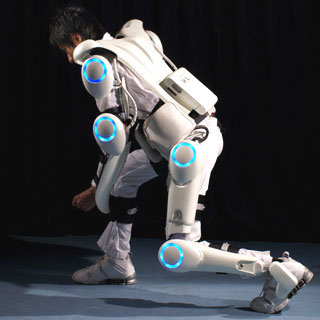
But it doesn’t stop there. As we noted in our most recent FFR, a Japanese company is now working to make us all Iron Man — or at least make those of us who want or need to be…

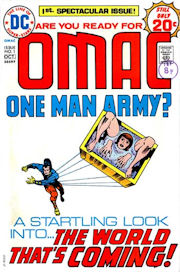
Nice! Now some will be happy to start at having a few gadgets (Batman) or maybe access to equipment that gives the impression of having advanced powers (Iron Man), but for others that won’t be enough. One of the more obscure comics that I enjoyed in my youth was OMAC: the One-Man Army Corps. Set in the “world thats coming,” OMAC definitely played with some transhumanist ideas, as detailed by Wikipedia:

One-Man Army Corps (OMAC) is a superhero comic book created by Jack Kirby and published by DC Comics. Set in the near future (“the world that’s coming”), OMAC is a corporate nobody named Buddy Blank who is changed by an A.I. satellite called Brother Eye into the super-powered OMAC.

OMAC works for the Global Peace Agency, a group of faceless people who police the entire world using pacifistic weapons. The world balance is too dangerous for large armies, so OMAC is used as the main field enforcement agent for the Global Peace Agency.

All kinda dumb, and it didn’t last, but one thing I remember Kirby writing in an editorial he provided in the first issue of OMAC was the idea that these kinds of things might really be on their way, that one day OMAC might be “just another Joe” and that Superman might be our ultimate dream come true.

omac.jpgSo in the future, will we all wear a cape with matching boots? Probably not. I’m not even sure I can see the path forward that would get us to OMAC (much less Superman-level) abilities. I mean, we could probably do some astounding stuff with utility fog, but that would make us more like Green Lantern and his power ring than it would Superman…not that there’s anything wrong with that! GL is very cool! But ultimately even the power ring is just an extension of Bruce Wayne’s gadgets or Tony Stark’s exoskeleton. It is technology external to the individual using it, not a reflection of innate physical ability.

If it is our destiny to be Superman, it is probably not going to happen in this substrate. It’s a lot easier to be Superman in a virtual world than it is in this one. And, in fact, in Second Life, everyone can fly — it is one of the chief means of transportation. It’s also interesting to note that in Second Life, there is a functioning Green Lantern Corps — acting as a kind of virtual Guardian Angels to protect some virtual activities from being disrupted by virtual bad-guys. Nice!

The problem with being superman in the virtual world — or even up here in meatspace assuming the technology to get us there shows up eventually — is that it isn’t as big a deal if everyone else is Superman.