Monthly Archives: April 2008

It's Hard to Believe…

…that it’s only been 15 years.

On this date in 1993, Cern made the Worldwide Web public domain and the rest, as they say, is history. Cern had actually developed the technology in the late 80′s.

I remember living in a pre-Web world. I used a Mac with a dial-up Internet connection. The service was called Delphi. I used it mostly for chatting, playing games, and accessing files. Gee, that sounds just like the Web! So what was the difference?

It was all 100% text-based.

Wow, what a difference Cern made in pushing the Web out free. I was an avid HyperCard scripter back in those days, and I knew that eventually the Internet would go in a hypertext direction.

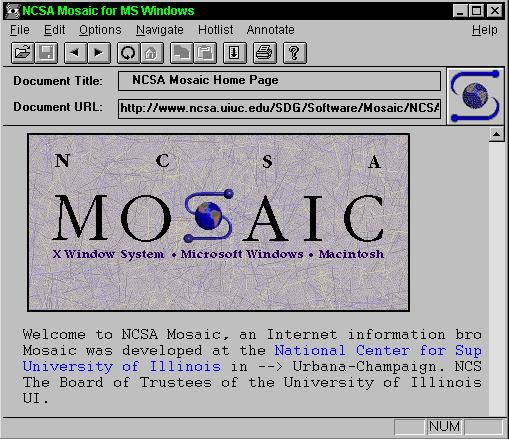
And then this thing showed up:

Mosaic.jpg

Nothing was ever the same after that!

It’s Hard to Believe…

…that it’s only been 15 years.

On this date in 1993, Cern made the Worldwide Web public domain and the rest, as they say, is history. Cern had actually developed the technology in the late 80′s.

I remember living in a pre-Web world. I used a Mac with a dial-up Internet connection. The service was called Delphi. I used it mostly for chatting, playing games, and accessing files. Gee, that sounds just like the Web! So what was the difference?

It was all 100% text-based.

Wow, what a difference Cern made in pushing the Web out free. I was an avid HyperCard scripter back in those days, and I knew that eventually the Internet would go in a hypertext direction.

And then this thing showed up:

Mosaic.jpg

Nothing was ever the same after that!

The Great Filter

AlphaCentauri_468x318.jpg

Via GeekPress, Nick Bostrom has a fascinating essay at Technology Review in which he lays out his case for hoping that we don’t find evidence that life ever existed on Mars or that it exists elsewhere in the universe. Why would we not want to find evidence of life?

According to Bostrom, the apparent silence of our galaxy — the lack of even one civilization which has advanced to the galactic colonization stage, which we ought to know about if it ever happened, because they would be here — is evidence either that there is no life out there or that life is in some way blocked from developing to that level. He talks in terms of a “great filter” that evolving life must pass through on the way to the galactic colonization stage. If life is evolving out there in the galaxy, and no aliens have ever shown up here, that suggests that no life anywhere has ever successfully made it through the filter. And if nobody else ever makes it through the filter, we have very little reason to hope that we ever will.

The filter could take many forms. It could be some stage in biological evolution that is just plain difficult to get through. For example, if life rarely makes it to the stage of producing multicellular organisms, and that’s the reason nobody is out there, then we’ve already passed through the filter and it would seem that we are in the clear.

Woo hoo! Let’s start colonizing the galaxy.

Plastic Blood

Freeze-Dried Blood.jpg

New Scientist reports:

Red blood cells travel through the bloodstream delivering vital oxygen to body tissues and taking away unwanted carbon dioxide – and they have to squeeze through blood vessels as thin as 3 micrometres across to do it. But in some diseases, such as malaria and sickle cell disease, red blood cells lose this ability to deform.

Because of the small size of red blood cells and the demanding work they do, nobody has succeeded in making artificial versions to help people with such conditions.

Now though Joseph DeSimone, a chemical engineer at the University of North Carolina at Chapel Hill, US, thinks he knows how.

He has created tiny sacks of the polymer polyethylene glycol just 8 micrometres across – in the range of human red blood cells – that are capable of deforming in a way that allows them to pass through the tiniest capillaries.

Polyethylene glycol is biologically benign, but binds easily with other substances, which makes it ideal for carrying cargo through the blood, says DeSimone.

Artificial blood replacement is likely to be a key biomedical enhancement technology in the near future. Ray Kurzweil frequently talks about the “respirocytes” which will act as supplemental mechanical red blood cells, 1000 times more efficient than their biological counterparts. Those who choose to replace even a small portion of their red blood cells with respiorocytes will be capable of what today could only be viewed as superhuman feats: running at sprinting speed for a quarter of an hour or more without breathing; sitting at the bottom of a swimming pool for hours at a time.

Of course, most of us don’t want or need to be able to do such outrageous things. Respirocytes will initially be implemented to address many of the same kinds of conditions that DeSimone’s polymer blood-cell substitutes are proposed for.They will also probably be used to give a much-needed boost to those recovering from serious illnesses or who have suffered some kind of major trauma. And speaking of illnesses and trauma, I can imagine respirocytes also serving as a delivery mechanism — one of many that nanotechnology will provide — for much more effective, and much less traumatic treatments for diseases such as cancer than anything currently available.

FastForward Radio

Sunday night Phil Bowermaster, Stephen Gordon, and Michael Darling spoke live with author and futurist Jim Elvidge. Elvidge is a Cornell-educated entrepreneur and inventor who holds four patents in digital signal processing. His love of music inspired him to develop one of the first PC-based digital music samplers and to co-found RadioAMP, which was the first private-label online streaming radio company. In recent years he has turned his attention to the ultimate question of existence and, drawing on a broad and eclectic base of knowledge and interests, has come up with a unique explanation for…pretty much everything.

elvidge.JPG

As you might imagine his book, The Universe – Solved, covers a lot of scientific and philosophical ground. A big topic of discussion was whether we live in a computer simulation. If so, are there Easter Eggs in the cosmos?

Click “Continue Reading” for listening options and the show notes:

LED Bulbs Getting Ready for Prime Time?

They certainly produce more visually pleasant light than compact fluorescents. And you don’t have that pesky toxic-cleanup issue if one breaks. But are LED-lightbulbs ready to take on the incandescent bulb?

Lighting Science Group says they are. And to back it up, they’re introducing a new line of LED-based lightbulbs that plug into a regular light socket. Check out the bulb shown here.

LEDbulb.jpg

Looks pretty neat. And as we can see from this page, it can be had for a mere $110.

What the…$110???

For a LIGHT BULB?

Well, hang on. LSG has an answer to that:

At $40 to $110 apiece, the LED “in-screw” bulbs may still seem too pricey for a lot of consumers. But Lighting Science Group’s pitch is that a 50 cent Edison bulb will last for 750 to 3,000 hours, while an LED has to be replaced only every 50,000 hours (or 10 to 30 years). The company says the cost savings is almost $740 over a lifetime due to much lower energy consumption.

That’s the same argument that’s made in favor of the compact fluorescents, but these bulbs last longer and are even easier on the old electric bill.

Plus, I think I already mentioned — no mercury.

Bring ‘em on, I say.

Meat Factory Update

Last week we wrote about the coming age of in vitro meat. Here’s a major step in that direction, People for the Ethical treatment of Animals (PETA) is offering a $1,000,000 push-prize for the development of vat meat:

PETA Offers $1 Million Reward to First to Make In Vitro Meat

Scientists around the world are researching or seeking the funds to research ways to produce meat in the laboratory—without killing any animals. In vitro meat production would use animal stem cells that would be placed in a medium to grow and reproduce. The result would mimic flesh and could be cooked and eaten. Some promising steps have been made toward this technology, but we’re still several years away from having in vitro meat be available to the general public.

PETA is now stepping in and offering a $1 million reward to the first scientist to produce and bring to market in vitro meat.

Why is PETA supporting this new technology? More than 40 billion chickens, fish, pigs, and cows are killed every year for food in the United States in horrific ways. Chickens are drugged to grow so large they often become crippled, mother pigs are confined to metal cages so small they can’t move, and fish are hacked apart while still conscious—all to feed America’s meat addiction. In vitro meat would spare animals from this suffering. In addition, in vitro meat would dramatically reduce the devastating effects the meat industry has on the environment.

Via InstaPundit, here’s a Popular Mechanics piece with more details on this emerging technology.

Whatever you might think about PETA (and I personally have never thought much), they are to be applauded for taking this step. All their accumulated shock messages, sanctimonious political posturing, and obnoxious, not to mention frequently dangerous, behavior over the years have probably had a net effect of making most people less sympathetic to the cause of animal rights (or at least animal well-being) than they would have been. But this is a positive step — a financial incentive to bring about a new technology that can eliminate animal suffering and end a lot of environmental damage associated with livestock farming.

Brace Yourselves

Here’s a shocker of a headline:

You Can’t Travel Back in Time, Scientists Say

That has a bit if dog-bites-man quality, doesn’t it? However, the same article links to a neat video that allows that time travel might be possible after all.

Traveling to the past sounds like it’s more trouble than it’s worth. I mean, don’t get me wrong — it would be great to go back and see how things were. And if you’re a little on the nutso side, maybe to go back and change things and then rush back ahead to see how things come out differently.

In any case, I doubt that there is really such a thing as traveling back to THE past. If you go back to the past (and your’e from a timeline where you didn’t) then it seems all you have really done is travel between parallel universes. You would be able to change “the present,” but not the one you came from.

On Sunday’s podcast, we talked a little about immersive virtual reality technology. I think that will eventually be a pretty good substitute for time travel. It will certainly be easier to achieve.

dinosaurs3d.gif

Congratulations on your recent purchase of a time machine.
Safety Tip #1 — choose your landing place carefully.