Since our FastForward Radio show Sunday night, I’ve been thinking over part of the conversation we had with our Nanotech panel.
On a couple of occasions Christine Peterson stated that some problems might not be worth the cost of developing nanotech solutions.
I’d be foolish to disagree. She is, afterall, the president of the Foresight Nanotech Institute, and she’s been in the nanotech industry since its infancy. But it seems to me that her answer is likely addressed to the present and near future.
[Editor: Phil has pointed out, correctly, that it was Dr. Pearl Chin, not Christine Peterson who argued that expensive nanotech solutions might not be economically feasible for some simple tasks.]
It’s not likely, for example, that anyone will spend billions to market a mouthwash manufactured to molecular precision anytime soon. Expensive solutions will be applied to important – which another way of saying well-funded – problems. Curing halitosis (and improving dental health) might seem pretty important before a hot date, but it won’t draw the same research dollars as curing cancer.
But long-term, this situation might change. And we have a good model to base this on – the development of computers.
The first microchip computer was designed by MIT in 1964. Here’s the specs:
ROM: 12K,
RAM: 1K,
Clock: 1.024 MHz,
Computing: 11 instructions, 16 bit word Logic: ~5000 ICs (3-input NOR gates, RTL logic)
Puny huh? Well, this was the Apollo Guidance Computer. It took us to the Moon and back. Back then we went to huge expense to create a very simple computer to accomplish great things.
Now we go to little expense to create complex computers to accomplish trivial things. A computer as powerful as the AGC is practically disposable now. We find them in Happy Meal toys or in singing birthday cards.
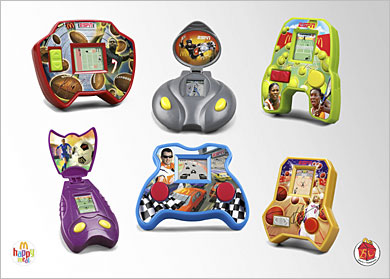
The year after MIT designed the Apollo Guidance Computer, Gordon Moore made his famous prediction about the development of integrated circuits. Even at that early date Moore was able to see that integrated circuits were being improved exponentially. The computer is an intelligence tool. Each step aids the development of the next step.
I suspect that nanotech will develop the same way. We’ll develop a simple set of nanotech-buiding tools that will help us develop better second generation tools and on and on – exponentially. Can we call this the “More Gordon Law?” No? Well… it was worth a shot.
President Kennedy was right about the Moon:
We choose to go to the moon in this decade and do the other things, not because they are easy, but because they are hard, because that goal will serve to organize and measure the best of our energies and skills…
Organizing “the best of our energies and skills” produced the world’s first microchip computer. Perhaps a similarly great and challenging undertaking will usher in the Nanotech Industrial Revolution.
And 20 years after that I’ll be gargling nanobots.


