One of the reasons I don’t lose sleep over Peak Oil is that there is such a broad range of alternative energy sources under development. The list includes, but is not limited to, the following:
Nuclear Fission
Solar
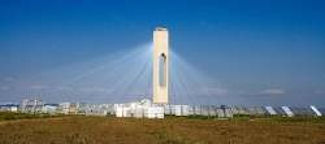
Concentrated Solar
Ethanol — from switchgrass, cornstalks, etc.
Ethanol — from waste
Methanol — from coal
Synthfuel — from coal
Synthfuel — from shale
Synthfuel — from tar sands
Biodiesel — from waste
Biodiesel — from algae
Nuclear Fusion
Progress is being made on all of these fronts. And if oil shoots up to $200, $300, $400 per barrel over the next couple of years, we can expect interest in these (as well as funding applied to them) to skyrocket.
Let’s look at just the second and third items on the list, the two major forms of harnessing energy from the sun. What we normally think of as “solar energy” is the application of photovoltaic technology — turning the sun’s power directly into electricity. “Concentrated solar” power, AKA solar thermal energy, involves concentrating and capturing heat from the sun, which is then used to create steam and move an electricity-producing turbine.
We wrote about the tremendous promise of concentrated solar power just a few weeks ago, so I won’t rehash all that here. Suffice it to say that, even if photovoltaic technology had hit some kind of peak of its own, meaning that we wouldn’t expect much more from it than what we’re getting now, concentrated solar would remain as a major potential energy source that we have barely even begun to exploit.
But the truth is that photovoltaic solar energy is far from any peak. Ray Kurzweil has repeatedly stated his assessment that solar energy is on a Moore’s-Law-style trajectory of its own, and that all the worlds energy could be supplied by solar in as little as 20 years. So if Moore’s Law is leading us to The Singularity, is this acceleration of solar power capability leading us to a solar singularity?
Some probably wouldn’t like that term, seeing as it could make the whole question as to what exactly we mean by “singularity” even murkier than it currently is. But it has a ring to it, doesn’t it?
Solar Singularity.
Anyhow, if we are going to get to the point where solar really does (or even could) supply all the world’s power within a couple of decades, we are obviously going to have to see:
Accelerating progress in solar energy technology culminating in a fundamental shift in how the world’s energy needs are met.
And that, then, can be how we define the solar singularity. It seems unlikely that it could be confused with any other kind of singularity, doesn’t it?
We talked briefly on the most recent FastForward Radio about how we would know when we’ve reached the solar singularity. One suggestion was “when solar is cheaper than anything else.” Another was “when they don’t even bother to drill any more.” Those are both good candidates. But how could we ever get to that point?