One of these days, nanotechnology is going to take a huge leap forward, when we start developing things like nano-tweezers and bi-pedal walking nanobots, especially if such items can be produced on a molecular assembly line.
Oh, wait. That’s right. We’re already doing all those things, using DNA:
As if the blueprint for life wasn’t busy enough, nanotech researchers are putting DNA to work in tiny mechanical devices and as templates for electronic circuits.
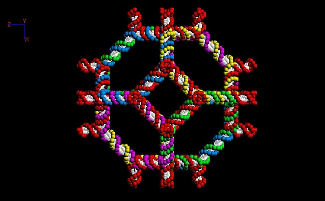
Recent DNA constructions include microscopic patterns, tiny gears and a molecular assembly line. Although still mostly at the demonstration level, DNA nanotech is a rapidly growing field.
In additon to all its other (myriad) applications, DNA-derived nanotech would seem to be the perfect medium for nano-medicine. Imagine how DNA nanotech might work in conjunction with these kinds of developments. Plus, seeing as the potential exists to develop electronic circuits, this technology would appear to be a frontrunner for wiring us up for whatever comes next.
BTW, the title of this entry is deliberately and self-consciously palindromic. Read the entire article to see why.
Via GeekPress.