Author Archives: Phil Bowermaster

In Other News…

K. Eric Drexler hates nanobots.

I know. That’s like saying that Santa hates reindeer, but this comes straight from the man himself. And he lists some pretty good reasons for feeling the way he does.

Moreover, he points out an unfortunate general tendency:

Some widespread ideas about research objectives

* are bad
* seem absurd to most scientists
* are inconsistent with my ideas and publications
* are nonetheless widely attributed to me

Drexler’s blog is a great read. When he’s not busy setting the record straight, he takes the time to explain things like how to understand everything.

Very useful!

Speeding up the Brain

What if we can start routing our thinking processes the way we route air travel?

The concept of a networked brain isn’t so different from the transportation grids used by cars and planes, says Martijn van den Heuvel, a neuroscientist at Utrecht University Medical Center who led the new study.

“If you’re flying from New York to Amsterdam, you can do it in a direct flight. It’s much more effective than going from New York, then to Washington, and then to Amsterdam. It’s exactly the same idea in the brain,” he says.

Per this model, intelligence is a factor not of the number of connections inside the brain, but the efficiency with which those connections are wired together. Apparently the arrangement of non-nueron-carrying white matter is also a major factor. Seeing as this basic plumbing ought to be reasonably reconfigurable — once we know how — this research begins to look like something that might push us towards greater than human intelligence in a fairly straightforward way.

But let’s not plan those The Singularity Is Here parties quite yet.

For one thing, as the article points out:

The first order of business will be to determine what physical and biochemical properties create more efficient brain network

Well, that’s a fairly tall first order of business, now isn’t it? First we have to figure out what those properties are, then we have to figure out how we can manipulate them. It may well all be doable, but a lot of heavy spade work lies ahead. And that’s not the only difficulty. Alvis Brigis argues pretty convincingly that we don’t yet have a precise and mutually agreed upon definition of what we mean by “intelligence.”

Back when I used to lead process improvement teams for the product engineering and development group at U S WEST Advanced Technologies, we had a saying — “You can’t improve what you can’t measure.” In retrospect, this is not entirely true. I believe something like “reliably” or “consistently” belongs in there between the “can’t” and the “improve.” And if we can’t reliably improve something that we can’t measure, it seems equally axiomatic that we can’t measure what we haven’t properly defined.

Not to be a buzzkill, I’m just saying that a little progress in this area is still a long way from any of us dropping by the clinic for a quick brain reconfiguration and an additional 60 IQ points. But still, it could very well be (early and embryonic) progress in exactly that direction.

Another Planet Discovered, Big Deal

Maybe it was kind a of a big deal, years ago, when the first extrasolar planets were discovered. But then we got to the point where hundreds of planets had been discovered outside of our solar system, and in fact to the point where it was hard to keep track of how many had been discovered.

And then came the day that we actually saw our first exoplanet, and that was kind of a big deal, but maybe not as big as we would have expected.

So now some astronomers in Italy have detected a planet with about six times the mass of Jupiter orbiting a distant star. At that mass, we can’t even be sure that it is, properly speaking, a planet and not a brown dwarf — making this discovery seem all the more uninteresting.

Pretty much a yawn, eh?

Oh, well, except for this one little thing. This particular planet is not in our galaxy:

Using a technique called Pixel-lensing, a group of astronomers in Italy may have detected a planet orbiting another star. But this planet is unique among the 300-plus exoplanets discovered so far, as it and its parent star are in another galaxy. The Andromeda Galaxy, to be exact. Technically, the star in M31 was found to have a companion about 6 times the mass of Jupiter, so it could be either a brown dwarf or a planet. But either way, this is a remarkable feat, to find an object of that size in another galaxy.

Pixel-lensing, or gravitational microlensing was developed to look for MAssive Compact Halo Objects MACHOs in the galactic halo of the Milky Way. Because light rays are bent when they pass close to a massive object, the gravity of a nearby star focuses the light from a distant star towards Earth. This method is sensitive to finding planets in our own galaxy, ranging is sizes from Jupiter-like planets to Earth-sized ones. And recently, astronomers used gravitational microlensing to be able to see about a dozen or so stars in M31, an extraordinary accomplishment in itself.

I hadn’t even heard that astronomers are now isolating individual stars in another galaxy, much less a planet. This is quite a feat! Seeing as the pixel-lensing technique works better at vast distances, is it possible that in the near future we will have cataloged as many planets in the Andromeda galaxy as the Mikly Way?

As we continue to hone our skills in detecing these distant objects, we need to find a way to distinguish planets from other large constructs. If we find something out there orbiting a star that has the mass of a planet but that isn’t spherical in shape, would that be evidence of advanced engineering? Or how about a technique for measuring Dyson Spheres? These should be more or less dark objects with the mass of a star. Actually, they should have the mass of a regular-sized star but the circumference of a really big star. But how would we ever detect one?

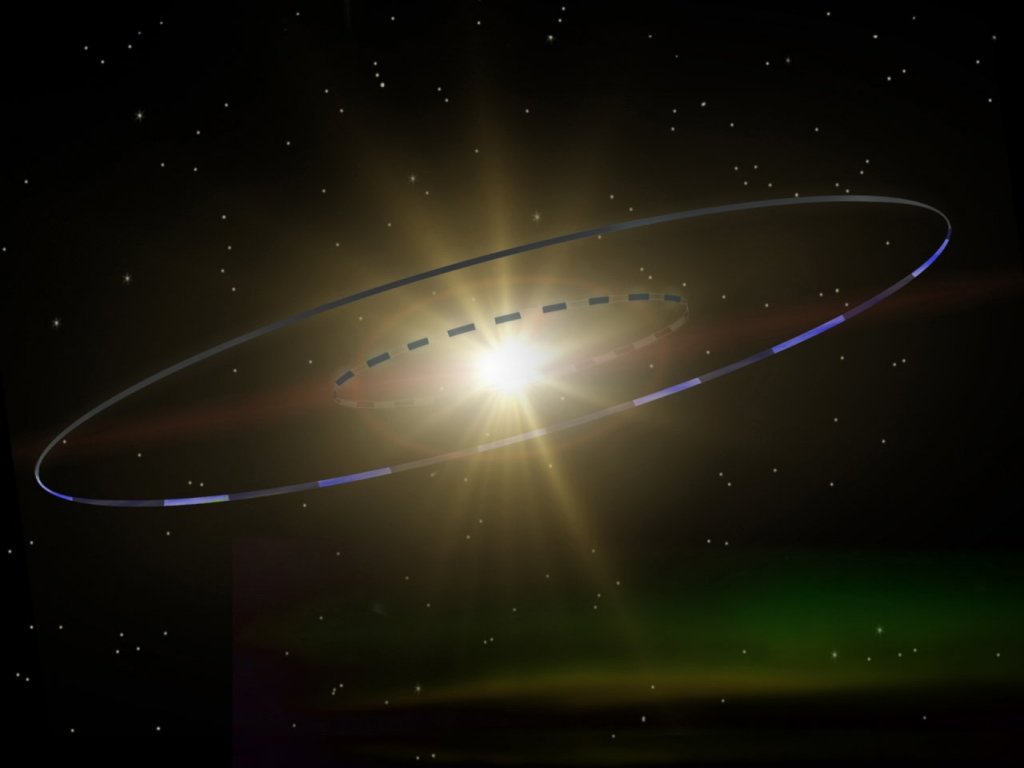
A ringworld would probably be easier to spot, but what are the chances that there are any of those out there?

ringworld.jpg

Michael Anissimov: Luddite

That’s right, it’s a throwdown. I’m calling him out. He may be one of my favorite people, but what else am I going to say when he writes something like this?

Another product called “Tesla”, Nvidia is selling supercomputers up to 250 times faster than standard PCs and workstations for just $10,000.

I’d prefer if this sort of product weren’t around.

See? Luddite. What else can I say when he approvingly publishes a quote that ends with this line?

Moore’s Law is the enemy.

Wow, what a drag. Maybe Michael and Leon Kass can start vacationing together or something. Sheesh. Sorry to have to take such a hard line, but what else can I say?

Well, okay, there’s one other thing I can say: Michael makes an excellent point. And, of course, he’s not a Luddite any more than he ever was. He’s merely an observant student of Moore’s Law for Mad Scientists.

To tell you the truth, I’m torn. I mean, on the one hand, we need for supercomputer capability to become commonplace if we’re going to get to a world where anybody who wants to can pretty much run his or her own space program. But we’ll never get there if, along the way, somebody using that same ubiquitous computing technology accidentally builds V’ger and Kirk and friends aren’t around to talk it out of wiping out all us “carbon based units.”

And it isn’t just the accidental stuff we need to be concerned about. As our need for virus protection software indicates, there are already plenty of folks out there in computerland with agressive and hostile agendas. Making super-fast, super-powerful computers more widely available can only empower such individuals.

On the other — wait, what am I on, like my third hand, now? — a rising tide raises all boats. Widespread supercomputers also enable careful AI reserachers and virus-fighters. Maybe the availability of the Nvidia is just part and parcel of a world in which friendly AI can be achieved.

Anyhow, here’s hoping.

Red Tape or Red Planet?

Is it time for NASA, ad for the government in general, to bow out and let the private sector take over the development of space? Some folks on the private side think so:

Private Space to the Government: “Get Out of the Way!”

As the private space industry comes of age, industry insiders say the U.S. government is stifling private money investment.

Private firms complain that the government owns too much of the space agenda and that it throws up too many roadblocks for launching communication satellites and performing important research in space.

I have mixed feelings about this debate. I think “What have you done for me lately?” is a question we can and should ask of NASA, and that, unfortunately, “lately” refers to the past 40 years or so. But you can’t argue that NASA gave us Apollo.

NASA gave us the moon.

But then, where did that get us, exactly? From the perspective of nearly half a century later, Apollo can be viewed many different ways: historical oddity, false dawn, dead end. Which was it? I tend to believe that it was a combination of the three, albeit above all a glorious achievement and one of humanity’s finest moments. That’s right: one of humanity’s finest moments, brought to you by the United States government.

But another fine moment, one that I hope is coming sooner rather than later, is when the first private expedition lands on the moon, or Mars, or takes its orbital position in the asteroid belt. When someone opens a bona fide business in space — collecting solar power in low earth orbit, manufacturing precision equipment in zero gravity, mining the moon for Helium 3 — then we’re truly on our way.

The question is: what role, if any, does the US government have to play in getting us towards those milestones? The irritated businessfolk quoted in the article linked above might argue that the government has little or no useful role to play. And maybe they’re right. But my hypothetical response to their positio is this:

How much of what is going on in space right now would be happening if Apollo had never happened?

I don’t pretend to have an authoritative answer to that question, but my suspicion is that, while Apollo didn’t lead directly to a mission to Mas or a permanent settlement on the moon, it opened up the universe for us by showing that it is possible to achieve great things in space. Yes, a program that showed us that and that ALSO led to a permanent moon settlement or mission to Mars would have been better. But opening up the universe is not a small achievement.

NASA seems to do best with a daring vision and a well-funded Big Project. Maybe 40 years in the wilderness is long enough. Maybe it’s time for NASA to take on something truly inspirational once again…though I’m not sure what that would be. But if a modern-day JFK were to declare that, before this or the next decade is out, we will send a crew on a multi-planet mission landing on Mars and several moons of Saturn and Jupiter and back again (or something of that ilk) it would get NASA out of the way of the new private developers wanting to make progress in local space, and it would open things up for generations of exploration and development yet to come.

All we need is a Big Project, an urgent driving force behind it (as the Cold War was for Apollo) and some means of funding the whole thing. (Perhaps someone will figure out how a project like that is the solution for climate change!) Failing that, the government no doubt still has a legitimate regulatory role to play vis a vis space development, but we’ll have to find our inspiration elsewhere.

Recognizing Objects

It’s a lot easier for us than it is for computers:

[W]hat we regard as the simple process of “recognition” would leave many computers stumped. Even something as apparently simple as recognising a birthday cake would normally require computers to be fed with information on what a cake generally looks like, the various shapes and sizes it comes in, the different forms and numbers of candles and other decorations you are likely to find adorning it, etc.

In brief, computers might be able to calculate pi to hundreds of decimal points and model complex weather patterns, but they may find it impossible, without complex and painstaking programming, to recognise a human whose grown their hair or realise that Chihuahuas and Dobermans belong to the same species.

One of the most intriguing scenarios for how robots will become a part of our everyday reality is their introduction as househhold assistants / servants — particularly for the elderly. But object recognition is crucial to performing household fucntions in a meaningful way. This little fellow can tell you that it isn’t as easy as it sounds:

Here are some things we would get awfully tired of saying to the house robot:

“No, the polo shirt — not the sweater vest.”

“Um, looks like some of the tomatoes you put in the spaghetti sauce were actually apples.”

“Thanks for folding and ironing the laundery, but it looks like we’re going to need a new cat.”

Luckily, some top people are on the case:

[Belgian researcher Luc] Van Gool is involved in a project, Cognitive-Level Annotation Using Latent Statistical Structure (CLASS — http://class.inrialpes.fr/), which is developing technologies to recognise visually specific objects, such as your car, or classes of object, such as a random car on the street.

“The recognition of an object as belonging to a particular group is a harder problem for a computer than the recognition of a specific object. The reason is that object classes show large variability among their members,” Van Gool points out.

The 3.5-year, EU-funded project managed to achieve technological improvements compared with previous efforts. It developed a system in which the description of the objects is based on the appearance of many separate, small patches. Such localised features give the necessary robustness to deal with the massive variations mentioned earlier. In addition, CLASS created special mechanisms – known as efficient approximate neighbourhood searches – for the comparison of an image or an object with huge numbers of reference images.

Sounds like an excellent start. But I think we’ll still have to be awfully careful if we don’t want our cats to end up ironed and folded.

Time Travel Destinations

Here are are 15 recommended time travel destinations.

Call me a purist, but I think a time machine should be used only for visiting the past. All you have to do to see any particular future event is…now what’s that phrase, again?

In my view, time travel to the future is a last-ditch effort (not requiring a time machine per se) to be used only if the other stuff doesn’t work out. Besides, if we adopt that modest and reasonable restriction, we’re able to add more interesting past events to our time travel itinerary, such as:

Fall of Troy — not just checking Helen out for hotness, to see if the Horse thing really happened

Wright Brothers’ first flight

Hannibal crossing Alps with elephants

The Big Whack — You’d want a spaceship in addition to a time machine in order to have the right perspective on this one; plus it might be a tad dangerous if viewed from the earth’s surface.

JFK assassination — Time travelers would keep going back and watch this from every possible angle.

Cleopatra — Gives us a point of comparison with Helen.

D-Day

Biblical miracles — Granted, more of a category than an event. My guess is that, as with the JFK assassination, both enthusiasts and skeptics would go back and see exactly what they expect to see.

I’m sure there are others…what am I missing?

hannibalelephants.jpg