Monthly Archives: August 2013

The Shocking Truth — Answers and Sources

Here we have the quiz plus answers and sources from last week’s show about The Shocking Truth.

  1. Due to out-of-control residential and commercial real estate development, total
    U. S. forest acreage is the smallest it has been in a century.

  2. Driven by economic injustice and environmental deterioration, infant and child mortality rates are surging in the developing world.

  3. Globalization is taking its toll on the world’s poorest people, with the poverty rate spiraling out of control over the past two decades.

  4. Cost analysis for standard grocery items (including eggs, meat, butter, coffee, etc.), when weighed against average wages, shows these items to be six times more affordable today than a century ago.

  5. As the overall rate of US violent crime continues to grow, women stand a greater risk than ever of being sexually assaulted.

  6. Toxins in the environment are believed to be the primary cause of the rapidly growing US mortality rates associated with cancer.

  7. The current acceleration of population growth will lead to a doubling of the planet’s total population within a century if left unchecked.

  8. Studies throughout the developed world, but in the U.S. in particular, show a rapid global drop in intelligence correlated with more hours spent watching TV and playing video games.

  9. Sub-Saharan Africa has been experiencing an economic boom for the past two decades, and is estimated to provide the best return on investment of any developing region in the world.

  10. We live in the most violent period in human history.

1. False.

There are a lot more trees than there were 100 years ago. US forests grew 380% between 1920 and 1997.

http://www.mnn.com/earth-matters/wilderness-resources/stories/more-trees-than-there-were-100-years-ago-its-true

2.  False

Children are 1/3 less likely to die before age five than they were in 1990.


3. False

The percentage of people in the world living on less than $1.25 per day has been cut in half since 1990, ahead of the schedule of the Millennium Development Goals which hoped to reach this target by 2015.

4. True

 While the price of food has skyrocketed, the percentage of the average wage required to purchase these items has plummeted.

The Affordability of Food

http://jerrykhachoyan.com/the-affordability-of-food/

In 1913 (according to multiple sources), the average wage was around $0.21/hour (or $750/year). Below is a chart of the above food items, as a percent of the average wage in 1913 (in blue) and 2013 (in orange). As you can see, all items are more affordable now than they were in 1913 (and most items to a major degree).

5. False

U.S. violent crime down for fifth straight year

http://www.cnn.com/2012/10/29/justice/us-violent-crime

(CNN) — Violent crime in the United States fell for the fifth consecutive year in 2011 with murder, rape and robbery all going down, although crime remains a serious problem in many urban areas, the FBI said on Monday.

The report of all crimes reported to police nationwide showed slightly more than 1.2 million violent incidents nationwide, while property crimes hit a nine-year low.

Compared with 2010, the new figures show violent crime down 3.8 percent overall. Property crime was down 0.5 percent.

—-

The dramatic decline of rapes and sexual assaults

http://mattbruenig.com/2013/03/23/the-dramatic-decline-of-rapes-and-sexual-assaults/

I stumbled upon this post from Angus Johnston about the significant decline in the incidence of rape. He claims that the incidence of rape has declined 88% since 1973. I do not doubt his figures, but the resource he linked to has been moved. In my search, I could not quickly find numbers prior to 1994, but the 1994-2010 numbers will suffice here.

According to National Crime Victimization Survey — an annual survey that samples the population directly — the rate of female rape or sexual assault victimizations has declined by 58% between 1994 and 2010. In 1994, 5 in 1000 females above the age of 12 answered that they had been raped or sexually assaulted that year. In 2010, the number was 2.1 in 1000, or 0.21%. These figures include completed, threatened, and attempted rapes and sexual assaults.

6. False

Cancer death rate falling at the rate of 1.8% per year.

From the National Cancer Institute:

http://www.cancer.gov/ncicancerbulletin/010813/page5

U.S. Cancer Deaths Continue Long-Term Decline

According to the latest national data, overall death rates from cancer declined from 2000 through 2009 in the United States, maintaining a trend seen since the early 1990s. Mortality fell for most cancer types, including the four most common types of cancer in the United States (lung, colon and rectum,breast, and prostate), although the trend varied by cancer type and across racial and ethnic groups. The complete “Annual Report to the Nation on the Status of Cancer, 1975–2009″ appeared January 7 in the Journal of the National Cancer Institute.

The report also includes a special section on cancers associated with the human papillomavirus (HPV) that shows that, from 2008 through 2010, incidence rates rose for HPV-associated oropharyngeal,anal, and vulvar cancers. HPV vaccination rates in 2010 remained low among the target population of adolescent girls in the United States.

7. False

About That Overpopulation Problem

Research suggests we may actually face a declining world population in the coming years.

http://www.slate.com/articles/technology/future_tense/2013/01/world_population_may_actually_start_declining_not_exploding.html

The world’s seemingly relentless march toward overpopulation achieved a notable milestone in 2012: Somewhere on the planet, according to U.S. Census Bureau estimates, the 7 billionth living person came into existence.

Lucky No. 7,000,000,000 probably celebrated his or her birthday sometime in March and added to a population that’s already stressing the planet’s limited supplies of food, energy, and clean water. Should this trend continue, as the Los Angeles Times noted in a five-part series marking the occasion, by midcentury, “living conditions are likely to be bleak for much of humanity.”

A somewhat more arcane milestone, meanwhile, generated no media coverage at all: It took humankind 13 years to add its 7 billionth. That’s longer than the 12 years it took to add the 6 billionth—the first time in human history that interval had grown. (The 2 billionth, 3 billionth, 4 billionth, and 5 billionth took 123, 33, 14, and 13 years, respectively.) In other words, the rate of global population growth has slowed. And it’s expected to keep slowing. Indeed, according to experts’ best estimates, the total population of Earth will stop growing within the lifespan of people alive today.

And then it will fall.

8. False

Are We Really Getting Smarter?

http://online.wsj.com/article/SB10000872396390444032404578006612858486012.html

Advanced nations like the U.S. have experienced massive IQ gains over time (a phenomenon that I first noted in a 1984 study and is now known as the “Flynn Effect”). From the early 1900s to today, Americans have gained three IQ points per decade on both the Stanford-Binet Intelligence Scales and the Wechsler Intelligence Scales. These tests have been around since the early 20th century in some form, though they have been updated over time. Another test, Raven’s Progressive Matrices, was invented in 1938, but there are scores for people whose birth dates go back to 1872. It shows gains of five points per decade.

In 1910, scored against today’s norms, our ancestors would have had an average IQ of 70 (or 50 if we tested with Raven’s). By comparison, our mean IQ today is 130 to 150, depending on the test.

9. True

And Now For Some Unexpectedly Good News

http://techcrunch.com/2011/06/13/and-now-for-some-unexpectedly-good-news/

Don’t look now, but sub-Saharan Africa is booming. Since 2003 its growth has been skyrocketing, and, to quote none other than McKinsey, “today the rate of return on foreign investment in Africa is higher than in any other developing region.” There are several reasons: commodity prices, Chinese investment, diaspora remittances… and, I would argue, the GSM revolution that has swept the entire continent, in some places famously taking communications straight from talking drums to cell phones, leapfrogging land lines entirely.

 McKinsey quote source:

http://www.mckinsey.com/insights/africa/lions_on_the_move

10. False

You are less likely to die a violent death today than at any other time in human history.

The homicide records go back in many parts of Europe to the 1200s. And they all show an astonishing trend. Namely, that the rates of homicide have plummeted, from anywhere from 30 to 100 per 100,000 per year down to the [current] European average, which is between one and two per 100,000 per year.

Forensic archaeology (“CSI Paleolithic”) reveals that 15 percent of prehistoric skeletons show signs of violent trauma. Ethnographic vital statistics of surviving non-state societies and pockets of anarchy show, on average, 524 war deaths per 100,000 people per year.

Germany in the 20th century, wracked by two world wars, had 144 war deaths per 100,000 per year. Russia had 135. Japan had 27. The US in the 20th century had 5.7. In this 21st century the whole world has a war death rate of 0.3 per 100,000 people per year. In primitive societies 15 percent of people died violently; now 0.03 percent do. Violence is 1/500th of what it used to be.


Driverless Future Approaches

From Science Daily:

First Driverless Vehicle to Hit the Roads

Singapore’s first clean and green driverless shuttle transportation system will soon see passengers shuttling between Nanyang Technological University (NTU) and JTC Corporation’s (JTC) CleanTech Park.

In a partnership between NTU, JTC and Induct Technologies, and supported by the Singapore Economic Development Board (EDB), an autonomous electric shuttle manufactured by Induct is expected to ply the two kilometre route providing a safe, reliable and environmentally-friendly alternative mode of transportation.

This is a pretty limited implementation of driverless vehicles — servicing a closed area and a small one at that — but it’s worthy of note because it isn’t just an experiment or a stunt. It looks like these vehicles are being introduced to serve a purpose, not simply to prove that cars get around without anyone behind the wheel.

That’s kind of a big deal.

Background on the Men Who Sold the Moon

Related to this week’s The World Transformed — here is some background on the billionaires we’ll be discussing as well as their achievements.

Technology: Vanity or visionary?

As the son of an angel investor who had made his fortune during the industrial revolution, the younger Darwin was the beneficiary of a similar fount of personal patronage, says Bill Janeway, a veteran start-up investor and economic historian.

Yet even if it has a long history, some argue that dependence on personal generosity may not be the best way to organise important scientific research. Such work is often better left to governments or established corporate research labs rather than individual benefactors, Mr Janeway says, since there is a risk that ambitious individuals will brush aside established scientific disciplines, such as peer review, in the race for high-profile achievements.

Others, however, argue that a breakout from the old forms of scientific research may be in order.

In periods of very rapid technological change, the biggest opportunities often lie on the fringes of science research where little work has been done before, making traditional approaches to peer review less useful, says Mr Seely Brown, a former head of Xerox’s Palo Alto Research Center.

Elon Musk

1. Hyperloop

High-speed alternative to rail line to be developed between LA and San Francisco

800 mph — LA to San Francisco in 30 minutes

http://www.businessweek.com/articles/2013-08-12/revealed-elon-musk-explains-the-hyperloop#p2

Now Musk argues that the Hyperloop represents a type of middle ground that other people have yet to consider. Instead of being a complete vacuum or running at normal conditions, the Hyperloop tubes would be under low pressure. “I think a lot of people tended to gravitate to one idea or the other as opposed to thinking about lower pressure,” Musk says. “I have never seen that idea anywhere.”

Inside the tubes, the pods would be mounted on thin skis made out of inconel, a trusted alloy of SpaceX that can withstand high pressure and heat. Air gets pumped through little holes in the skis to make an air cushion, Musk says. The front of the pod would have a pair of air jet inlets—sort of like the Concorde. An electric turbo compressor would compress the air from the nose and route it to the skis and to the cabin. Magnets on the skis, plus an electromagnetic pulse, would give the pod its initial thrust; reboosting motors along the route would keep the pod moving. And: no sonic boom. With warm air inside the tubes and high tailwinds, the pods could travel at high speeds without crossing the sound barrier. “The pod can go just below the speed of sound relative to the air,” Musk says.

http://www.npr.org/blogs/alltechconsidered/2013/08/15/211386439/a-closer-look-at-elon-musks-much-hyped-hyperloop

Originally, Musk didn’t want to even develop or finance the Hyperloop, since Tesla and SpaceX are his top priorities. On a conference call to explain his design Monday, he signaled a change of heart.

“It would be cool to see a new form of transport happen,” Musk says. “I think it might help if I made a prototype and sort of helped get things going in that way.”

2. SpaceX and Mars

http://en.wikipedia.org/wiki/SpaceX#Falcon_launch_vehicles

SpaceX has flown, or is in development on, several orbital launch vehicles: the Falcon 1, Falcon 9, and Falcon Heavy. As of 2012, the Falcon 9 is currently in active usage and the Falcon Heavy is under development with a large manifest of flights after 2013.

Daragon — It is a conventional blunt-cone ballistic capsule, which is capable of carrying 7 people or a mixture of personnel and cargo to and from low Earth orbit.[90] It is launched atop a Falcon 9 launch vehicle, the spacecraft’s nosecone is jettisoned shortly after launch.


http://www.theguardian.com/technology/2013/jul/17/elon-musk-mission-mars-spacex

“The key thing for me,” he begins, “is to develop the technology to transport large numbers of people and cargo to Mars. That’s the ultimate awesome thing.” Musk envisages a colony with 80,000 people on the red planet. “But of course we must pay the bills along the way. So that means serving important customers like Nasa, launching commercial broadcasting communication satellites, GPS satellites, mapping, science experiments. “There’s no rush in the sense that humanity’s doom is imminent; I don’t think the end is nigh. But I do think we face some small risk of calamitous events. It’s sort of like why you buy car or life insurance. It’s not because you think you’ll die tomorrow, but because you might.”


Musk: Humans on Mars Before SpaceX Goes Public

Investors eager to own a piece of Space Exploration Technologies Corp. (SpaceX) could face a very long wait. According to a recent tweet from the Hawthorne, Calif.-based company’s founder and chief executive, Elon Musk, there will be no initial public offering (IPO) of SpaceX stock before humans have begun to settle Mars.

“No near term plans to IPO SpaceX,” Musk wrote in a short message posted to Twitter June 6. “Only possible in very long term when Mars Colonial Transporter is flying regularly.”


Sergey Brin

1. Vat Meat

http://www.valuewalk.com/2013/08/google-co-founder-sergey-brin-finances-vat-grown-beef/

In the video, Brin says that his investment came partly out of concern for animal rights, because he considers modern industrial farming to be cruel, but there are plenty of other reasons to want an alternative to livestock. Meat production takes up about 70 percent of the Earth’s arable land, which is a terribly inefficient way to feed the planet’s rapidly growing population. Livestock also produce 18 percent of all greenhouse gases, and trading them in for vat-grown meat would be a huge stride towards reducing human emissions.


http://articles.washingtonpost.com/2013-08-05/national/41081437_1_stem-cells-lab-grown-meat-burger

Lab-grown beef taste test: ‘Almost’ like a burger

It looked like a burger. It smelled like a burger. It tasted, well, almost like a burger.

The first lab-grown beef hamburger was cooked and eaten in London on Monday. “We proved it’s possible,” said scientist Mark Post, who created the cultured minced meat in his lab at Maastricht University in the Netherlands. He said his hope is to come up with a new and environmentally friendly way to feed the world.


2. Self-Driving Cars

http://www.businessinsider.com/googles-vision-for-self-driving-cars-2013-5

Autonomous cars may seem like a gimmick, he begins, but when you consider all the time that people won’t be devoting to their rear view mirrors, and all the efficiencies that come from cars that could be zipping between errands rather than idling in parking lots, the world looks like a very different place. Car ownership would be unnecessary, because your car (maybe shared with your neighbors) will act like a taxi that’s summoned when needed. The elderly and the blind could be thoroughly integrated into society. Traffic deaths could be eradicated. Every person could gain lost hours back for working, reading, talking, or searching the Internet.

Peter Diamandis

1. Asteroid Mining

http://www.planetaryresources.com/

What if the greatest discovery of natural resources didn’t take place on Earth?

 There are near-limitless numbers of asteroids and more being discovered every year. More than 1,500 are as easy to reach as the Moon and are in similar orbits as Earth. Asteroids are filled with precious resources, everything from water to platinum. Harnessing valuable minerals from a practically infinite source will provide stability on Earth, increase humanity’s prosperity, and help establish and maintain human presence in space.

Asteroids are the low-hanging fruit of the Solar System. There are close to 9,000 near-Earth asteroids, and nearly 1,000 more are discovered every year.

Low cost commercial robotic spacecraft will explore asteroids and determine their position, composition, and accessibility of resources.

Asteroid mining will allow the delivery of resources to the point of need, be it a fuel depot orbiting the Earth, or elsewhere in the Solar System.


http://www.planetaryresources.com/2013/07/planetary-resources-surpasses-us-1-5-million-to-launch-worlds-first-crowdfunded-space-telescope/

Bellevue, Washington – July 1, 2013 – Planetary Resources, Inc., the asteroid mining company, successfully completed its crowdfunding campaign yesterday to launch ARKYD – the world’s first public space telescope. Over the course of the 33-day campaign, the company generated support from more than 17,600 backers who pledged US$1,505,366 for the cause. This marks the most successful crowdfunding effort for a space project and ranks the ARKYD campaign among the top 25 projects in Kickstarter history.

“Some of these asteroids are worth trillions of dollars in assets. Will it happen? Absolutely.”


Jeff Bezos Amazon

1. Private Space Development

http://www.blueorigin.com/

Blue Origin, LLC is developing technologies to enable private human access to space at dramatically lower cost and increased reliability. We’ve adopted an incremental approach, with each development step building on the prior development. We are currently focused on developing rocket-powered Vertical Takeoff and Vertical Landing (VTVL) vehicles for access to suborbital and orbital space.

A Question for Patternists

On last week’s World Transformed, we talked about parallel universes in their various theoretical permutations. (This piece on Better All the Time walks through the various levels that we discussed on the show.) The discussion followed the news that evidence for universes outside our own may have been found.

Thinking over the discussion, a question occurred to me for my friends who describe themselves as “patternists” — those who uphold the idea their identity is nothing more or less than a replicable pattern of information. In principle, I agree with that proposition, although it leads to some sticky implications. For example, a pure patternist is okay with stepping into the transporter from Star Trek even if it works by destroying your body on one side and creating a perfect copy on the other. Likewise, a patternist will tell you that all that is need to survive death is a copy of the information in your brain. Freeze your brain at the moment of death; later they will figure out how to extract the information from it. If the pattern survives, the individual survives.

So my question is — if parallel universes were to be conclusively proved to exist, would you even need to make a copy? Max Tegmark, quoted extensively in the BATT piece linked above, offer estimates as to how many light years we are from our nearest perfect duplicate. If the multiverse is overflowing with perfect copies of us, and one copy is as good as another — why make any more copies?

Infinite Universes

New findings suggest that our universe is not the only one. It may be one of many, or one of an infinite number of universes. Phil and Stephen discuss the implications. Does it matter if there’s more than universe? If so, how? And why?

Check it out.

Seven Questions About the Future

Ten years ago, in the early primordial days of The Speculist, I came up with a list of 7 questions that I thought could help us shape an ongoing conversation about the future. Whenever I did a Speculist interview, it would include these seven questions. (A shortened version of these questions were later used in our two World Transformed special series before that became the permanent name of the weekly podcast.)

So let’s look at them again, 10 years later. I’m guessing my answers have changed a bit over the past decade…

  1. The present is the future relative to the past. What’s the best thing about living here in the future? The best thing about living in the future is the incredible connectedness we have to information, to other people, and to possibilities — both for ourselves and for the world as a whole. This is the age of capability and the age of possibility. As a group, our possibilities always tended to increase over time, while as individuals they tended to decrease as we get older. Now we have so many possibilities emerging for what our lives can be that we are (to some extent) outpacing aging. We are gaining possibilities as we get older.
    -
  2. What’s the biggest disappointment? Time was I would have said that the biggest disappointment is the lack of progress in making some possibilities come true. I mean, what’s taking us so long? But now I am a little more respectful of the process that we go through in making the future happen. There is always something happening, even when (especially when) is seems like things have slowed down. And things do slow down. We made huge strides forward in aviation and space technology in the previous century; that rate of progress has dropped significantly. But meanwhile, the world has busied itself with going digital, with going social, with becoming connected. That’s a big effort, one that couldn’t help but take a little of the momentum away from aviation and space.So I think our future in space is as bright as ever. And I’m not disappointed that true nanotechnology or strong AI or life extension haven’t “happened yet.” Those things are happening around right now, and that is terribly exciting.My biggest disappointment is that there is still so little awareness of how radically different the near future is likely to be, although to be fair such awareness has grown significantly. I think people are going to be pleasantly surprised by the way things (eventually) work out, but I believe we could get to those positive outcomes much sooner if people were aware of them and working on making them happen.
    -
  3. Assuming you die at the age of 100, what will be the biggest difference be between the world you were born into and the world you leave? If I died right now, at age 50, the answer would be the Internet. If I make it to 100, it’s possible that the Technological Singularity will occur between now and then. My answer is not “The Singularity” but rather “whatever we do after that.” As rapidly as things may be changing now, they will change unimaginably faster after the Singularity. So the biggest change will come then, even if it’s only a few months or days before I turn 100 / dies.I’ll add that 10 years later, I don’t like the phrasing of this question. Just ask people how different the world will be if they make it to 100, for crying out loud. Why bring dying into it?
    -
  4. What future development that you consider likely (or inevitable) do you look forward to with the most anticipation? The first bona fide, yes-it-really-works life extension treatment. It doesn’t have to be the sexiest or most dramatic development in the world, just something that without question delays or halts aging. When we see that actually happen it is going to create huge demand for more of the same. It’s going to be very exciting.
    -
  5. What future development that you consider likely (or inevitable) do you dread the most?
    …and what are you going to do about it? I dread seeing people become more polarized. I dislike the fact all public discourse, particularly political rhetoric, has degenerated into something not unlike a nasty Youtube discussion thread. The technology that can connect us also makes it easy for us to split off into tribes. Technology makes it easy to lash out at others without any significant consequences.
    What I am going to do about it is to continue bringing it up and to encourage people not to let powerful us vs. them memes take hold of their lives. I am going to continue to promote alternative ways of thinking about these issues. I’ll do my best.
    -
  6. Assuming you have the ability to determine (or at least influence) the future, what future development that you consider unlikely (or are uncertain about) would you most like to help bring about?If I can count it all as one development, I want Cory Doctorow’s Bitchin’ Society: post-scarcity, post-illness, post-aging, post-war, post-death. I want to live to see a world where the most powerful and frightening limits we have always faced are eliminated — or so vastly reduced in scale  that they are unrecognizable.If I could just  pick one of those “posts”  it would be post-scarcity — which will get us to the others, anyway
    -
  7. Why is it that in the year 2013 I still don’t have a flying car? When do you think I’ll be able to get one?On the one hand, this is a dumb question and it doesn’t belong on this list. My old argument was that this isn’t just about flying cars about all the cool stuff that was supposed to show up but hasn’t. Whatever.On the other hand, people do think about stuff like this. When do I get my flying car? When do I get my jet pack? When do I get my replicator? When do I get to go into VR and spend the rest of my natural lifespan blowing up aliens and getting down with supermodels?If the evolution of the mobile phone over the lifetime of the Speculist has anything to tell us, it’s that a lot can happen in 10 years. So my answer to all of those questions is, “I don’t know. Maybe in 10 years? Maybe 20? Beats me.”Bad answer? Maybe. But again, I think it’s a dumb question.

I’ve been looking for my old answers to these questions from 10 years ago, but haven’t been able to find them. That’s too bad. I kind of wanted to debate myself.

Anyway, these are my answers to these questions in the year 2013. What are yours?

Evidence of Other Universes

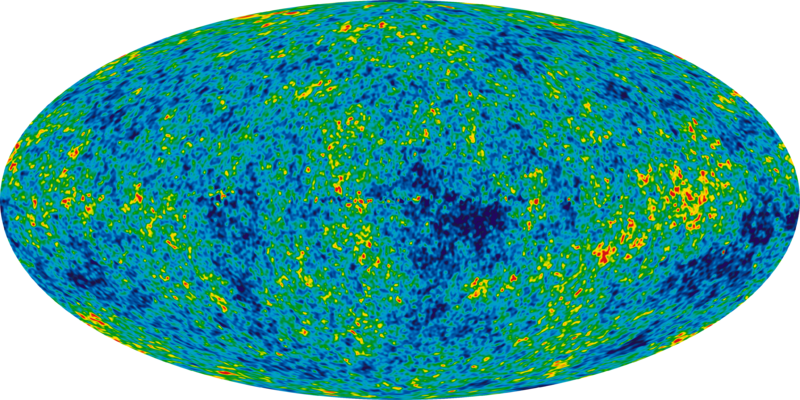
The Planck space observatory has provided us the clearest and most complete picture of the early universe we have ever had, a composite picture of the background radiation of the entire sky. Interestingly, that picture doesn’t look quite like what we were expecting:

Cosmologists studying a map of the universe from data gathered by the Planck spacecraft have concluded that it shows anomalies that can only have been caused by the gravitational pull of other universes.

The map shows radiation from the Big Bang 13.8billion years ago that is still detectable in the universe – known as cosmic microwave radiation.

Scientists had predicted that it should be evenly distributed, but the map shows a stronger concentration in the south half of the sky and a ‘cold spot’ that cannot be explained by current understanding of physics.

Okay, well something has to have caused those anomalies. And I suppose other universes are as good an explanation as any.

One question, though: where are those universes now? They should be right where they always were and — and am I missing something, here? — no nearer to or farther from this universe than they were back in those days. Yes, our universe is bigger now, but it hasn’t moved relative to those other universes. So shouldn’t there be ways to confirm this hypothesis by looking for their present-day influence on our universe?

Or maybe it has moved. Or maybe those other universes are moving away from us. (I’m speaking in very simple terms, here. What would actually be happening would involve more spatial dimensions than most of us are comfortable thinking about.)

In any case, if this truly is evidence of universes other than our own, this is a big deal. The idea that they not only exist, but can exert influence on this universe makes it even a bigger deal.

Doctors and Travel Agents

Nick Van Terheyden has some interesting speculation about the future of health care in a piece written for fast Company with the title Could The Future Of Health Care Mean No Waits In Hospitals?

He has some interesting ideas. In one scenario, a conversational user interface and SIRI-like assistants help doctors to focus on the patient rather than spending all their time taking notes. In another, empowered and self-monitoring patients begin to play a much more active role in the provision of their own health care. In the third scenario, distance care and automation make it possible for fewer and fewer patients ever to have to show up at the hospital.

These are all viable scenarios, although I’m not sure they go quite as far as they could. Eventually self-care and automation will make it possible to eliminate all but the most serious and complicated treatment scenarios. For most people, most of the time, a doctor will be about as relevant to their medical care as a travel agent is to their travel plans.

For my younger readers, a “travel agent” is an individual who helps you plan a trip, who actually makes a number of the arrangements for you. A travel agent would get you booked on the right flight, get you into the the best hotel for your budget, and make sure that there was a rental car waiting for you when you arrived at your destination.  These days we tend to think of these as tasks that we do for ourselves. In fact, we still use a mediator often as not, but it is usually a set of web tools rather than a human agent. We only have to deal with a human being when things get particularly complicated.

A new generation of technology came along and pushed travel agents out of the loop. Before long, that’s how it will be with doctors. When online systems can assess and diagnose symptoms more reliably than most doctors can, they will. The primary venue for medical care will once again become the home. We will look on the days of driving across town and sitting around a crowded waiting room as a curiosity from the past, one that we will have no desire to bring back.


Photo © Copyright David Hawgood and licensed for reuse under this Creative Commons Licence

And We’re back

We just passed the the 10th anniversary of The Speculist, and I think I know how I want to mark the occasion.

This is too good a site to let it go fallow. I’m bringing the Speculist back.

Speculist Media publishes three blogs — this one, The World Transformed, and Better All the Time. I intend to continue contributing to the other two, and to get this one back up and running as well. What are we going to talk about?

Live to see it.

The Future of ISMs

The future isn’t just about technological change. Some of the biggest changes we have ever seen and can expect ever to see occur in the realm of ideas.

With that in mind, hosts Phil and Stephen contemplate the future of some of the mostly dearly held and hotly debated of all ideas.

Which isms will be more relevant in the future, which less? Which isms will be confirmed? And which have no future at all?

It’s all right here.