Monthly Archives: April 2009

Brain Bugs and Brain Features


Dispatches from a rapidly changing, rapidly improving
world


Special
Dispatch
April
15, 2009

It’s tax day here in the good old US of A: as good a time as any to remember
that, whether your take is that it’s happening because of massive government
spending or in spite of massive government spending, life in this country
— and pretty much everywhere else — is improving.

Item:
Doctors confirm woman’s imaginary third arm

A 64-year-old woman has reported to doctors at Geneva University Hospital
the presence of a pale, milky-white and translucent third arm.

After examining the case, the woman’s neurologist, Asaid Khateb of the hospital’s
experimental neurophysiology laboratory, called the rare phenomenon credible.

The arm appeared to the woman a few days after suffering a stroke, doctors
said.

But this case of what is known as a supernumerary phantom limb (SPL) is a
genuine head-scratcher.

The upshot is that the woman can use the apparitional extremity to relieve
very real itches on the cheek. It cannot penetrate solid objects.

Khateb and his colleagues examined the patient’s brain using functional magnetic
resonance imaging (fMRI), a tool that allows doctors to see whether the brain
is truly stimulated, and to pinpoint where. In this case, the investigations
revealed that the woman actually experienced what she described.

Researchers instructed the woman to move her right hand. As expected, the
motor cortex and visual processing areas in the left side of her brain became
mobilised.

The same effects were observed to a lesser extent when the woman simply imagined
moving her right hand. Imaginary movements of the woman’s paralysed left hand
prompted the same activity in the brain, but on the right side.

But when doctors asked her to move her phantom arm, her brain reacted as
though the arm really existed and could be moved. In addition, the patient’s
visual cortex was also activated, indicating the she actually saw the imaginary
limb.

And when she was instructed to scratch her cheek, regions of the brain relating
to touch were activated

The Good News

Yes, this item is Better All the Time, not Astounding Science Facts (or Tales
of the Paranormal.)

Here’s why: it is extremely significant that the doctors treating this woman
were able to use an MRI to take a peek at what’s happening inside her brain
and confirm that it is sending signals that mean move the arm and receiving
signals that mean the hand is feeling something. Mapping brain activity
to physiological phenomena is one of the biggest breakthroughs of the past few
decades, and its promise is already being realized in a number of different
prevention and treatment options.

Consider this: earlier this week, my newborn
daughter
was subjected to her first-ever hearing test. The pediatrician
hooked her up to an electroencephalograph, put headphones on her, and started
piping in sounds. In a matter of minutes, the brainwave scan confirmed that
she is hearing everything she should be hearing in each ear. Great news for
new parents when there is no problem, and extremely useful in the unfortunate
cases where there is a problem. Rather than waiting months or years for
a child’s behavior to reveal that something is amiss, these parents know what
they are up against from the very beginning.

Mapping the motions and sensations of a real limb to brain activity makes
it possible to treat paralysis by overriding existing damaged nerve connections
in order to return mobility to a paralyzed limb. Such mapping is also crucial
to developing a direct interface between the brain and electronically controlled
prosthetic limbs when there is no possibility of reviving the lost function,
as in the case of amputation. These kinds of treatments are already
under
development.

But that’s just the beginning. Understanding how a phantom limb is represented
within the brain gives us a glimpse of how one day — probably not that far
in the future — we will be able to have very real experiences in virtual worlds.
The woman described is experiencing something that seems perfectly real to her,
as real as the actual experience of her actual arms. Essentially, her brain
has written and is executing a "program" for a virtual arm. Seeing
as this came about as the result of a stroke, and the woman probably wasn’t
looking for an extra limb, we tend to view this new bit of mental software as
a bug. But that bit of spontaneous buggy "software code" embeds some
powerful capabilities. That her doctors are able to watch it in action is a
very good sign. In time, it’s reasonable to expect that someone will figure
out how to reverse engineer this program, and begin to improve on it.

vitruvian.jpg


Live to see it!

Coming Soon: The Ultimate Hybrid


Dispatches from a rapidly changing, rapidly improving
world


Special
Dispatch
April
12, 2009

I don’t know how much time I’ll have for blogging while I’m on paternity
leave from work, but it’all going to be good news stories. Let’s get this
party started.

Item:

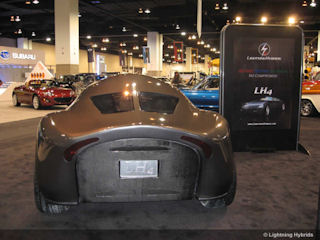
Lightning Hybrids Develops Biodiesel-Hydraulic Hybrid

The LH4 was designed by a company called Lightning hybrids and as stated
above, is powered by a Biodiesel engine. Only 3 cylinders are needed to get
the vehicle moving and power the hydraulic pump that takes the place of a
traditional electric motor. Combined, the system is good for 100mpg, which
will do very well in the race for the Automotive X Prize.

The Biodiesel-Hydraulic combination is also a wonderful choice in terms of
performance. When the need arises, the LH4 can launch to 60mph in just under
6 seconds, which is nothing to sneeze at given the high fuel economy number
it is able to return. The looks of the LH4 aren’t bad either.

The Good News

When I first read about hybrid automobiles 20 years or so ago, two models were
on the table: electric and hydraulic. With the advent of the Prius a few years
back, and the rush of other car companies to follow suit, the term "hybrid"
has become almost synonymous with "electric hybrid." There were a
few announcements early on that some automakers were looking at the hydraulic
approach, but announcements have been few and far between and production vehicles
available to the consumer or commercial markets have been non-existent.

Please correct me if I’m wrong on this; if anyone is selling hydraulic hybrids
I’d like to hear about it. Plus I’d be very interested to know how they’re doing…

I always liked the elegance of the hydraulic model for hybrid automobiles:
capture the forward momentum you normally lose every time you brake in the form
of hydraulic compression. Then turn around and unleash that pressure next time
you want to acelerate. This approach may provide a better fuel savings than
electric hybrids can — it certainly will for larger vehicles whose greater
mass will pump massive amounts of force into the hydraulics system. You’ve got
to love that 0 to 60 in six seconds. That’s some pretty nice acceleration for
a car that gets 100 MPG. Plus, the expectation is that hydraulics systems are
more economical than the battery systems used in electric hybrids — giving
the hybrid shopper less sticker shock.

Perhaps most imortantly, having two working models for how to deploy a hybrid
vehicle means competition. Hydraulic hybrids will drive improvements to electric
hybrid systems and vice-versa. And one day, these two models might meet to provide
the ultimate hybrid. Get that fossil-fuel-burning engine out of the loop and
provide your primary power with an electric engine. Then use hydraulic brakes
to capture your lost forward momentum. Now that would be an efficient model.

lightninghybrid.jpg

Live to see it!

Meet the Future of Humanity

Her name is Sefra Rose Bowermaster. She arrived on the scene this morning at 7:41 Am MDT. Weighing an impressive 8 lbs. 14 oz and measuring 19 3/4 inches long, she is an American / Malaysian hybrid and clearly destined for greatness. What a future she will see! The pictures tell the whole story.

themom.jpg
The Mother

thedad.jpg
The Father

thebaby.jpg
The Baby

momdadandbaby.jpg
First Ever Group Shot

thebigsis.jpg
Spending Time with Big Sister

I, for one, welcome our new adorable baby overlord.

Computer Program Self-Discovers Laws of Physics

I can’t remember if this one was the same article mentioned by Michael D. on FastForward Radio, but I find it fitting to post this right after my last entry. Imagine this capability combined with Wolfram/Alpha. Imagine the trends and tendencies in nature and in human society it will be able to deduce that we can’t possibly grasp because we can’t possibly master the avalanche of data involved.

In just over a day, a powerful computer program accomplished a feat that took physicists centuries to complete: extrapolating the laws of motion from a pendulum’s swings.

Developed by Cornell researchers, the program deduced the natural laws without a shred of knowledge about physics or geometry.

The research is being heralded as a potential breakthrough for science in the Petabyte Age, where computers try to find regularities in massive datasets that are too big and complex for the human mind

Making the World Computable

Stephen Wolfram announced that his new “not a search engine,” Wolfram/Alpha, will premiere in May. This software package will enable users to query it, like Google, but instead of running a search for lists of appropriate web pages, it will calculate the answer to a query using information extracted from web pages.

I’ve written an essay giving background on Wolfram and his career. In it, I discussed the possibility that the development of Wolfram/Alpha may speed up the development of true AI. It is posted on ScribD.

Here is Wolfram’s official announcement on his blog, including his own description of Wolfram/Alpha.

The Nano Song

And now, Speculists, it’s time to stand up and sing our nanotechnology national anthem.

This very cute and clever song features a soprano with a very happy voice, puppets that look and talk a lot like muppets, and a song with a very bouncy tune with lyrics that explain nanotechnology with surprising clarity. Showing this video to children and to adults who have little knowledge of nanotechnology would be an excellent way to introduce them to the concept.

Nanotubes and space elevators are mentioned. And so is the iPod Nano, “That’s not nano!” “The Nano Song” won a contest for the best song about nanotechnology.

Why ET's genetic code could be just like ours

Do you remember being very dubious of all those aliens and humans mating and having children on Star Trek? Now wait a minute, didn’t you say? How could beings from totally different planets with different histories of genetic descent possibly do that?

Some researchers are hinting at an answer. Seems that 10 of our 20 amino acids are very likely to form in the cosmos. Hmmmmm. Maybe Klingon-Human hybrids are possible after all. Check out the hot action here.

We know that amino acids are common in our solar system and beyond. Various first experiments to recreate the conditions in the Earth’s early atmosphere have produced 10 of the amino acids found in proteins. Curiously, analyses of meteorite samples have found exactly these same 10 amino acids. Various researchers have noted this link but none have explained it.

Now we know why, say Higgs and Pudritz. They have ranked the amino acids found in proteins according to the thermodynamic likelihood of them forming. This turns out to match the observed abundances in meteorites and in early Earth simulations, more or less exactly.

That’s a neat piece of work. They go on to argue that the first genetic codes must have evolved to exploit these 10 prebiotic amino acids. The other amino acids which are all bigger and generally more difficult to synthesise must have been incorporated later. At any rate, Nature had settled on the full 20 we see today by the time the earliest common ancestor of all organisms on the planet first emerged, at least 3.5 billion years ago.

Introduction

Hi, I’m the new kid on the Speculist block, SallyJM.

Over the years I’ve written on science fiction, space development, science, and the Singularity. Which, BTW, I do believe will happen sometime in the next few decades.

I’ll start out with a few links to some of my essays.

Will Technology Take Over the World answers the question with a resounding YES. This is actually an introductory essay to the concept of the technological Singularity: link

Here is an introductory essay to the concept of nanotechnology: link

And here is my answer to Joseph Jackson’s interview in a recent FastForward Radio show: link

I’ll have lots more to say on Speculist topics in upcoming blog entries.

I’m glad to be aboard.

FastForward Radio

Phil Bowermaster, Stephen Gordon, and Michael Darling brought their own futurist-related topics – unknown to the others – for a fast, free-wheeling discussion.

Listening Options:

Stream our latest shows:


Or:

add_to_itunes.gif

Or download MP3′s for all the archived shows at:

Listen to FastForward Radio... on Blog Talk Radio