Monthly Archives: May 2008

Phoenix Finds Ice

maybe. It sure likes like ice to me:

martianice.jpg

It’s pretty cool if the spacecraft we were hoping would find ice landed right on a patch. That wouldn’t necessarily indicate anything about the abundance of the stuff on the Mars, but then again it can’t be a bad sign.

NASA says they need to do some tests — take a color photo, for example — in order to confirm whether this is really ice. And even if it is, it might be dry ice: CO2 rather than H2O. The real test will be involve chipping some off and seeing how it mixes with a beverage.

Or something like that. I’m not sure exactly what the test is. Anyhow, stay tuned.

Reader's Choice Video 4

Harvey’s contribution this week is somehow reminiscent of Waiting for Godot (until the young ladies start getting somewhere), set to Lucinda Williams’ I Lost It:

Michael Darling votes for these amazing images of the kinetic sculpture of artist Theo Jansen:

Another example here.

Finally, I really enjoyed this quick trip through the Panama Canal on GeekPress the other day, so I recommended it for this feature. (Thats right, I’m a reader, too!)


Through Panama Canal In 75 SecondsThe most popular videos are here

Reader’s Choice Video 4

Harvey’s contribution this week is somehow reminiscent of Waiting for Godot (until the young ladies start getting somewhere), set to Lucinda Williams’ I Lost It:

Michael Darling votes for these amazing images of the kinetic sculpture of artist Theo Jansen:

Another example here.

Finally, I really enjoyed this quick trip through the Panama Canal on GeekPress the other day, so I recommended it for this feature. (Thats right, I’m a reader, too!)


Through Panama Canal In 75 SecondsThe most popular videos are here

Day Job Encroaches

Since Stephen has seen fit to put a picture with a big Brand X logo on the blog for which I shell out monthly hosting fees using money earned in the employ a far superior company, I think it only appropriate that we listen in on some exciting developments from the The Data Warehouse Institute, a couple of weeks ago in Chicago.

I’ll warn you ahead of time — since this interview was not with Claudia Imhoff, it does not end with my standard “rock on!” tagline. Nor do I tell anyone to live to see it.

But if you’re reading this, hey, live to see it. I mean that.


TDWI Podcast.

Go-Grease Lightening

If there’s anyone who doubts that higher gas prices will encourage people to adopt alternatives, consider this:

grease gone.jpg

Used cooking oil stolen — by biodiesel pirates

SAN FRANCISCO – A few years ago, drums of used french fry grease were only of interest to a small network of underground biofuel brewers, who would use the slimy oil to power their souped-up antique Mercedes.

Now, restaurants from Berkeley, Calif., to Sedgwick, Kan., are reporting thefts of old cooking oil worth thousands of dollars by rustlers who are refining it into barrels of biofuel in backyard stills.

Who says we aren’t building more refineries? They’ve just been forced underground.

When gas was a $1.00 a gallon used cooking oil went to the dump. It just wasn’t worth the work of collecting it and processing it into diesel (or, alternatively, altering a diesel engine to run on cooking oil). Legitimate grease collectors are understandably upset about thievery, but it’s a sign that the stuff they’re collecting has real value now.

A possible answer to this problem is to start paying the restaurants for the amount of grease they provide. Once the cost of theft is pushed to the restaurants, they’ll keep the grease under lock-and-key until the collection truck comes by.

Used cooking oil is helping some individuals motor around, but it isn’t a national answer. We don’t eat that many french fries. We really do need to build some new commercial refineries and drill more domestically. But also, this story provides proof that as the price of crude rises the opportunity for a profitable alternative fuel industry opens up. Funding the expensive R&D for new battery technology suddenly looks sensible. As does exploring the possibility of algae biofuels.

- H/T Michael Sargent

On to Mars

Should we be heading towards Mars? Rand Simberg notes that the Phoenix’s triumphant landing on Mars this past Sunday occurred on the 47th anniversary of President Kennedy’s appearance before a joint session of Congress to propose an American mission to the moon “before this decade is out.” He comments on the possible significance of what Phoenix finds — or doesn’t find — to an eventual manned mission to the red planet:

This mission, like all Mars missions, is not just to answer pure science questions. It is also ostensibly a precursor to eventual human trips to Mars. The discovery that water is available in large quantities at the poles was encouraging to those who plan to “live off the land” there. But perhaps those who hope to one day be Martians themselves should also hope that Phoenix doesn’t find signs of life, at least current life. If it does, it’s not at all inconceivable that the planet would be put under quarantine from humanity so that we don’t contaminate it with our own life forms (this is a concern even for the robotic envoys, such as Phoenix, to the point that they are scrupulously sterilized prior to launch). Beyond that, for reasons having nothing to do with Mars, some say that we should hope that we are alone because to learn otherwise might be a bad omen for the human race.

The Human Imperative

We walk in shadows towards the light.

From before the beginning, we have faced a world that has filled us with fear, a world fraught with danger, deprivation, disease, destruction, and death.

From before the beginning, we have faced a world that has inspired us to hope, a world that freely offers us pleasure, abundance, meaning, accomplishment, and joy.

Alone among the creatures of the earth, we have conceived in the present day an image of the coming day. We have imagined a world in which the shadows recede and the light shines ever brighter. We have imagined ourselves in the coming day to be freer, more intelligent, more capable, more creative, and more filled with joy than we are in the present day. Alone among the creatures of the earth, we change ourselves, our circumstances, and the world itself in order to realize that vision.

We walk in shadows towards the light, but we do so falteringly — tripping and stumbling as we go. The path that leads from the shadows to the light is not an obvious one; it is a winding and deceptive and sometimes treacherous route from which we stray quite easily. We have not followed the path perfectly, and many times we have stepped off it willfully — declaring the journey to be finished or even moving deliberately back towards shadows, claiming them as our true home. But we have never strayed so far from that path that we could not, upon remembering ourselves, find our way back to it. And so we have proceeded, slowly and painstakingly, from darkness into brighter and brighter light.

The journey is one that spans many generations.

Throughout human and pre-human history, we have directed ourselves towards an increasingly beneficial future. Beginning with primitive circumstances and limited choices, we envisioned outcomes that would increase our intelligence and capability, and therefore the number of choices we would have when driving toward subsequent outcomes.

The Human Imperative is working. We have consistently achieved outcomes in which our intelligence and capability are expanded, and have continuously broadened the possibility space from which we can select and work towards subsequent improved circumstances.

With new circumstances come new problems and challenges, many of these unanticipated at the time we envisioned the change. However, the improvements to the human condition are additive, and we can combine them in creative ways to provide unexpected benefits. Improvements have tended to outpace new problems.

Throughout human history, we have carried out the Human Imperative using two basic strategies:

1. Solving problems / mitigating risks

2. Pursuing happiness

The first strategy has always taken priority, as the primary ongoing problem we have had to solve is how to achieve our survival (or prevent our extinction.) But we now stand on the threshold of a new era in human history. Improvements and potential improvements are increasing exponentially; we are moving rapidly towards a critical mass of human intelligence and capability.

Our achievable future is one that transcends the expectations, hopes, or even dreams of most of humanity.

We can achieve that future only by recognizing that we are at a transitional point in carrying out the Human Imperative. We must transform our thinking about the future and, for the first time, change the order of our priorities. We must recognize that focusing on problems and risks is no longer our optimal strategy for achieving our survival. Our survival lies within the realization of our achievable good.

The Human Imperative is now to recognize that transcendent good as possible, to communicate and share a vision of it, and to work towards its fulfillment.

The Future Is Thin

twinkies.jpg

Dean’s World has hosted a spontaneous blogwave over the past few days on the subject of whether the traditional recommended course of diet and exercise is an effective long-term cure for obesity. Like Battlestar Galactica and the question of whether “bible-thumpers” should be considered “true Protestants,” this is one of those topics that comes up from time to time on DW: obviously a subject of interest to host Dean Esmay. In arguing that diet and exercise have not been shown to constitute an effective long-term cure for obesity, Dean is challenging mainstream thinking (something that regular readers of his blog know that he likes to do.) Whether I agree with him or not, anyone willing to take on the overwhelming consensus opinion in the face of a large body of established research gets a few points from me for chutzpah if for nothing else.

But here’s the rub: in this case, the overwhelming consensus opinion and the body of established research are at odds with one another. Or as Dean likes to put it:

No study has ever shown that human beings can drop more than 5-40 pounds or so of excess weight through diet and exercise alone. Not long-term anyway. Those who can do so are so rare they barely qualify as statistical anomalies.

I added italics to the third sentence because it is an integral part of the argument. If you read the first two sentences on their own, you might take Dean to be saying that it is impossible for an obese person to lose more than 40 pounds of excess weight and keep it off for more than five years, or that no one has ever done so. And, in fact, several commenters and at least one of the co-bloggers at DW have read it that way, and have responded by linking to research that tracks the progress of obese people who have demonstrated that “impossible” level of success.

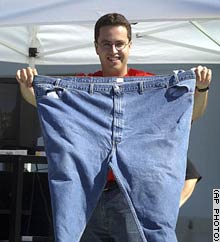
But Dean isn’t arguing that it’s impossible. Rather, after reading over the literature, he has found that — in study after study over the course of the past century — the number of clinical trial subjects who have kept more than 40 pounds off for a period of five or more years is vanishingly rare. The number that’s thrown around on DW is 0.1%, although I haven’t seen where Dean specifically raised this number, only where people arguing with him have. So if we can name people who have met the criteria — Jared comes to mind — we have only found an example of that 0.1% of the population for whom diet and exercise is an effective long-term obesity cure. Likewise, the participants in the National Weight Control Registry (NWCR) study (linked above) asked to participate if they had already achieved a certain level of long-term weight loss, is just another example of this same selection bias.

It’s like “proving” that the lottery is a smart bet because somebody won!

jared.jpg

But let’s say that the 0.1% number is off by a factor of 10. Could be. In fact, let’s say it’s off by a factor of 100. I doubt that Dean has misread the literature that severely, but even if he has, diet and exercise has only been shown to be an effective long-term cure for obesity for about 10% of the population — assuming that dozens of trials performed over many years have produced results representative of the population as a whole.

Just for a moment, set aside the question of why this approach doesn’t work. Can we all agree that, for any other condition, a treatment with a 10% success rate would be considered a pretty crappy excuse for a cure?

FastForward Radio

Time travel… is it possible? Phil Bowermaster and Stephen Gordon talk about the latest theories.

timetravel_wormhole.jpg

And, as we are travel forward through time the old fashioned way (by living it), what likely near-future inventions will change our world?


Stream the show:

Or:

add_to_itunes.gif

Or download the MP3 for this show or other archived shows at:

Listen to FastForward Radio... on Blog Talk Radio


Click “Continue Reading” for the show notes:

Dramatic Climate Change

It’s happening faster than anyone would have guessed — with average temperatures rising 15-20 degrees Fahrenheit. One of the results of the spike in temperature is unprecedented violent storm activity, unlike anything that has ever been witnessed in several centuries of observation.

And it’s all happening on Jupiter. The Hubble provides this gorgeous image, showing what are now the three red spots of Jupiter — each one a massive storm system.

threeredspots.jpg

The original Great Red Spot is bigger than Earth, and may have been observed as early as the 17th or 18th century. The other two are recent arrivals. It’s interesting that, on Jupiter, intensified storm activity is correlated with an increase in average temperature. Here on earth, some experts have recently come to a rather different conclusion.

It’s also interesting that such climate change is even taking place on Jupiter and, as we have observed, elsewhere in the solar system. How can this be happening on planets where there are no SUVs, and where George W. Bush was never president?

It just doesn’t add up.