
The Future Is Thin

By | May 27, 2008

twinkies.jpg

Dean’s World has hosted a spontaneous blogwave over the past few days on the subject of whether the traditional recommended course of diet and exercise is an effective long-term cure for obesity. Like Battlestar Galactica and the question of whether “bible-thumpers” should be considered “true Protestants,” this is one of those topics that comes up from time to time on DW: obviously a subject of interest to host Dean Esmay. In arguing that diet and exercise have not been shown to constitute an effective long-term cure for obesity, Dean is challenging mainstream thinking (something that regular readers of his blog know that he likes to do.) Whether I agree with him or not, anyone willing to take on the overwhelming consensus opinion in the face of a large body of established research gets a few points from me for chutzpah if for nothing else.

But here’s the rub: in this case, the overwhelming consensus opinion and the body of established research are at odds with one another. Or as Dean likes to put it:

No study has ever shown that human beings can drop more than 5-40 pounds or so of excess weight through diet and exercise alone. Not long-term anyway. Those who can do so are so rare they barely qualify as statistical anomalies.

I added italics to the third sentence because it is an integral part of the argument. If you read the first two sentences on their own, you might take Dean to be saying that it is impossible for an obese person to lose more than 40 pounds of excess weight and keep it off for more than five years, or that no one has ever done so. And, in fact, several commenters and at least one of the co-bloggers at DW have read it that way, and have responded by linking to research that tracks the progress of obese people who have demonstrated that “impossible” level of success.

But Dean isn’t arguing that it’s impossible. Rather, after reading over the literature, he has found that — in study after study over the course of the past century — the number of clinical trial subjects who have kept more than 40 pounds off for a period of five or more years is vanishingly rare. The number that’s thrown around on DW is 0.1%, although I haven’t seen where Dean specifically raised this number, only where people arguing with him have. So if we can name people who have met the criteria — Jared comes to mind — we have only found an example of that 0.1% of the population for whom diet and exercise is an effective long-term obesity cure. Likewise, the participants in the National Weight Control Registry (NWCR) study (linked above) asked to participate if they had already achieved a certain level of long-term weight loss, is just another example of this same selection bias.

It’s like “proving” that the lottery is a smart bet because somebody won!
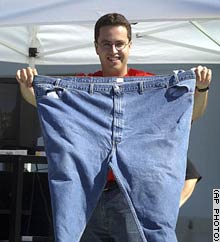
jared.jpg

But let’s say that the 0.1% number is off by a factor of 10. Could be. In fact, let’s say it’s off by a factor of 100. I doubt that Dean has misread the literature that severely, but even if he has, diet and exercise has only been shown to be an effective long-term cure for obesity for about 10% of the population — assuming that dozens of trials performed over many years have produced results representative of the population as a whole.

Just for a moment, set aside the question of why this approach doesn’t work. Can we all agree that, for any other condition, a treatment with a 10% success rate would be considered a pretty crappy excuse for a cure?

  • Stephen Gordon

    It seems like a safe and effective treatment for obesity has to be right around the corner.

    Ten years ago Pfizer stumbled on a certain blockbuster drug called Viagra. That success would be nothing compared to a safe and effective thin pill.

  • Phil Bowermaster

    I hadn’t even thought of that angle. You’re right. Somebody is going to make a fortune.

    If I were a betting man, I’d say that the most likely winner will be a drug that inhibits the insulin receptor gene.

  • http://nextbigfuture.com advancednano

    I believe one of the pathways to successful weight control will be increasing lean muscle mass myostatin inhibition by boosting follistatin. This can boost lean muscle mass a lot (30-50%). It makes exercise far more effective.

    Myostatin article

    Each pound of lean body mass, which includes skeletal muscle, burns a bit over 13 calories a day at rest. 910 calories from body fat in a week for an extra 10 pounds of muscle. It will take about 27 days to lose a pound of body fat (12 pounds per year, IF the person does not increase food/calorie intake). So with some cardio exercise it would be a substantial help for weight control.

    I believe myostatin/follistatin control will be the safe and more effective version of steroids.

    It would definitely make the TNT diet more effective. Any health risks like possible increase in tendon injuries needs to be offset against health gains from weight control.

  • Phil Bowermaster

    Brian –

    Good point. I should have mentioned myostatin inhibitors. I said I wouldn’t want to take any of those “weight-loss” drugs, but I would sign up for follistatin or another established myostatin inhibitor as soon as it become available. Per Stephen’s point, this is another line of research with a huge commercial upside — “the Viagra of muscles.”

  • http://www.deanesmay.com Dean Esmay

    A very good and fair take on all of this. Although for the record, the number I’ve used is “less than 1%” and not any precise number and not something quite as low as 0.1%. The number I use is based on review articles that have been published in scientific journals on obesity. The number isn’t quite as dire as it sounds, as people who lose some weight and maintain it (like you, Phil, and as it happens, me, although I’m not relevant) are substantially more common–probably closer to your 10% figure.

    I would agree with you that treatments are getting better and more sophisticated all the time. This is in part because overweight and obesity rates have been skyrocketing for decades and the health problems it causes are enormous.

    What you might find interesting is that Metformin is now being used as a weight loss drug, as you mention in your list. What you may not know is that it’s been around for a long, long time as a treatment for Type II Diabetes. Its exact mechanisms are not fully understood, however, it’s not an appetite suppressant or a stimulant or a nutrient-blocker, which is what most diet drugs do. It was simply noticed that diabetics on the drug tended to lose weight fairly spontaneously. In the last 20 years it’s become increasingly evident that most obese people are diabetic or at least pre-diabetic, so doctors who treat obesity began trying it on their patients, even those without formal diabetes diagnoses, and guess what? A lot of obese people respond very well to it.

    What it seems to do is give people with insulin control problems better insulin control. Insulin is linked to appetite, but its main function appears to be to cause the body’s fat cells to store energy. Better insulin control would tend, therefore, to reduce fat storage in fat people.

    This all goes back to the “thought experiment” I posted a couple of days ago; if your fat cells work abnormally hard to store energy, and/or are abnormally reluctant to release energy, then, you’re going to have a much easier time gaining weight and a much harder time losing it.

    Insulin’s not the only key of course, but it’s clearly got a role here, as do a lot of other things, some of which we almost certainly don’t really know about.

    I’m pretty sure by the 2020s we’ll have the problem solved, as the medical and scientific community is working hard on solutions that go beyond the 3000 year old advice of “just watch what you eat and exercise more.”

  • http://www.deanesmay.com Dean Esmay

    By the way, don’t be too reluctant on gastric bypass surgery, especially if you’re starting to get some of the other symptoms of chronic obesity like high blood pressure and diabetes. Once those start to manifest, your battle with obesity will become a life-and-death matter, literally. And, the surgeries are getting increasingly sophisciated and less invasive. They can often do it laparoscopically now, which greatly reduces risks, as well as pain and recovery time. It’s clearly not for everybody, but long-term, if your battle continues and the weight continues to creep up, you should definitely think hard about it. It could, literally, save your life.

  • Owen

    What about liposuction? Does physical removal of fat cells have any influence on set point or is it a false lead?

  • steviek2000

    The problem with fat storage is that it costs the body very little to keep fat around.

    The trick to losing weight is you have to trick the body into ‘thinking’ that excess fat is costing it alot. They way to do this is climbing exercies like walking up stairs for a long period of time, doing lots of leg exercies like squats, biking up hills. The body then starts to think that ‘hey it is costing me alot of calories to keep carrying this fat’ up the hill and it will start to adjust the amount of fat it has.

    http://abcnews.go.com/Technology/DyeHard/Story?id=3922069&page=1

  • http://www.mfoundation.org da55id

    February of last year I gave up sugar and sugar substitutes from all sources except fruit . Over the course of 6 months I lost 15 pounds. I have kept to that regime without difficulty, but have gained back more than half of that weight. In reviewing my life style changes that might explain this increase (if indeed it IS a result of LS change), I noted that I ceased commuting to work which involved a total of one mile or so walk getting to and from subway transportation in favor of full telecommuting. My current plan is to try out deskwalking – combining a high drafting table – where I’ll use my laptop – with a motorized one mile per hour treadmill where instead of sitting at the computer, I’ll be slowly walking or at least standing much of the time.

    On another note, I am in awe of how efficient our bodies are. We are obviously programmed to walk all day long, and all the interventions listed above either fight that program or attempt to use it.

    Cheers,
    Dave