Say, did you hear the one about the clever German kid who gave a hand to the hapless, math-challenged American scientists?
A 13-year-old German schoolboy corrected NASA’s estimates on the chances of an asteroid colliding with Earth, a German newspaper reported Tuesday, after spotting the boffins had miscalculated.
Chances are you did. It’s all over the web. I saw it on both GeekPress and InstaPundit this morning (although Glenn did provide some very important follow-up information) and I note that it was the number one story on Digg Science this morning (having moved down to number three as of this writing.) Rest assured that we will hear about this in the late-night monologues this evening, especially if Leno’s staff is tracking the story. And those people, whoever they are, who compose the e-mails that get forwarded to a long line of people which eventually leads to your mother/cousin/former-coworker-who-for-some-reason-keeps-sending-you-stuff, and then finds its way on to you, are working feverishly on several different versions of the story, which you will see many times over the next 15 years or so.
And, hey — why not? It’s a great story. So what if it’s wrong…
Widespread media reports claim that a German schoolboy has recalculated the likelihood of a deadly planet-smasher asteroid hitting the Earth, and found the catastrophe is enormously more likely than NASA thought. The boy’s sums were said to have been checked by both NASA and the European Space Agency (ESA), and found to be correct.
There’s only one problem with the story: the kid’s sums are in fact wrong, NASA’s are right, and the ESA swear blind they never said any different. An ESA spokesman in Germany told the Reg this morning: “A small boy did do these calculations, but he made a mistake… NASA’s figures are correct.”
So why does the original story get so much more attention than the retraction? For one thing, as Glenn points out in his follow-up, sometimes a dog really does bit a man. In fact, most of the time that’s the way it happens. And it’s just not that interesting. So NASA’s math is better than this kid’s. Big deal. I think their math was better than mine when I was 13, too.
But I think the difference in interest levels goes beyond the man-bites-dog angle. This story plays into a powerful and cherished meme shared by virtually all the peoples of the world: Americans are stupid*.
Since many of us know (or at least believe) that Americans are, in fact, stupid — and since NASA has been plagued by some pretty significant gaffes in the past — maybe this isn’t a man-bites-dog story at all. Like any powerful meme, “Americans are stupid” seeks regular confirmation. Once it takes hold, its carriers are alert to any incoming information that might be relevant, and particularly that might add credence to the meme.
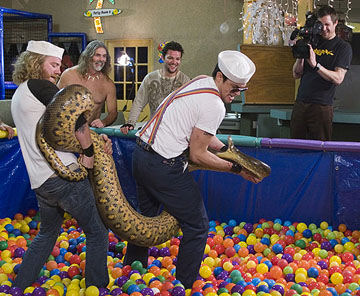
Typical Americans, doing their thing