Monthly Archives: March 2008

FastForward Radio

Sunday night Phil Bowermaster and Stephen Gordon visited live with futurist Wayne Radinsky. Wayne became a futurist in 1997 when he was working as a software developer and asked the question, “Why does Moore’s Law happen?”

Wayne Radinsky.JPG

Wayne was part of the Bay Area Future Salon in Silicon Valley for five years before moving to Colorado and starting the Boulder Future Salon. He is also a director of the Global Futures Network.

We talked about how groups such as GFN and futures salons can help us to shape both our understanding of and expectations for the future.

Click “Continue Reading” for listening options and the show notes:

"They Could Be Made Out of Water"

With so much futurific goodness to get through in 60 short minutes, we probably won’t have time for a “Tales of the Paranormal” segment on this week’s FFR, so I wanted to share this video (hat-tip: Harvey) of an earnest young man articulating his views on ex-tra-terr-est-ri-als.

Man, that’s hard to say!


“They Could Be Made Out of Water”

With so much futurific goodness to get through in 60 short minutes, we probably won’t have time for a “Tales of the Paranormal” segment on this week’s FFR, so I wanted to share this video (hat-tip: Harvey) of an earnest young man articulating his views on ex-tra-terr-est-ri-als.

Man, that’s hard to say!


Plateaus of Despair

Following up on a discussion we had on FFR a couple of weeks ago, I wrote recently on the subject of technology relinquishment, exploring the question of whether technology adoption has been forced upon those who don’t want it and whether this will continue to be the case. I believe that we, as a society, make some accommodation to those who don’t want to accept new technologies, and that we are perhaps a bit more tolerant of those who seem to reject new technologies along a nice clean break line, what I described as a “plateau of completeness.”

The standard example is the Amish, who see the world as being pretty much technology sufficient as of the 18th century — no new developments sought or required. I also suggested that human augmentation technologies might be another coming break line, and that non-augmented humanity will be the Amish of the age of augmentation.

Another example of a technology that seems to represent some kind of break line is genetically modified foods. (I don’t suppose I need to reiterate my own views on what relinquishment of this articular technological development means.) What’s interesting about the relinquishment of this technology is that many people who are doing without this development –who would probably want it f given a clear choice in the matter — have no say in the decision to reject it.

Kerry Howley writes at Reason.com:

In May 2002, in the midst of a severe food shortage in sub-Saharan Africa, the government of Zimbabwe turned away 10,000 tons of corn from the World Food Program (WFP). The WFP then diverted the food to other countries, including Zambia, where 2.5 million people were in need. The Zambian government locked away the corn, banned its distribution, and stopped another shipment on its way to the country. “Simply because my people are hungry,” President Levy Mwanawasa later said, “is no justification to give them poison.”

Rejecting GM crop technology in the form of food aid is only a small part of the problem, however. The real damage is done by the fact that growing GM crops is banned throughout almost all of Africa by authoritarian African governments, acting in collusion with Western governments and NGOs. Regressive agricultural standards and practices in Africa are driven by a romanticized Western idea of what “natural” farming should be about — forcing Africans to struggle to feed themselves while the rest of the world benefits from the technological developments we deny them. Robert Paarlberg describes life on the typical African farm:

It would be a woman and her children primarily, and they would plant not a hybrid maize, but a traditional openly pollinated variety, and they would time the preparation of the soil and planting as best they could for when they thought the rains would come. But the rains might not come in time, or they might be too heavy and wash the seeds out of the ground. It’s a risky endeavor. They can’t afford fertilizer, and it’s too risky to use fertilizer because in a drought the maize would shrivel up and the fertilizer would be wasted. They don’t have any irrigation. As a consequence, even in a good year their yields per hectare will be only about one third as high as in Asian countries, 1/10 as high as in the United States.

This goes well beyond genetically modified crops. Basically, African have been denied access to almost all major advances in agricultural production from the past century or so. In our discussion of technology relinquishment on FFR, we were all quick to agree that it would be wrong to force iPods and Priuses on the Amish. No one should be required to adopt a technology they don’t want. But what are we to make of governments and other groups who force others not to use technology that they might want and would almost certainly benefit from?

The hypocrisy of Western organizations — coming from countries whose economies have benefited tremendously from these developments — is palpable. Read the entire article, which ends on the hopeful note that at least one Western group is trying to make inroads on introducing drought-resistant crops into Africa. That alone would be an enormous step forward.

Oldest Recorded Sound

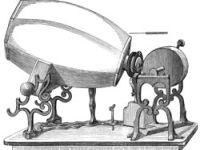
Apparently, Edison wasn’t first. You can go here to listen to a woman singing a French folk song, recorded in 1860 — a full 17 ears before Edison’s first audio recording. The recording technology employed was crude to say the least. Apparently there wasn’t even an option for playback:

American audio historian David Giovannoni recently discovered a phonautogram, captured using a phonautograph, a device created by Parisian inventor Edouard-Leon Scott de Martinville that created visual recordings of sound waves, the Associated Press reports. The phonautograph could not play them back.

grmautophone.jpg

De Martinville was quite a visionary: recording sounds in anticipation of a future in which the technology would exist to play them back. And here we are, nearly 150 years later, living in that future.

Finally, Some Practical Advice

George Dvorsky gives us:

Seven ways to control the Galaxy with self-replicating probes

When you think about it, that’s a pretty modest title. “Controlling the galaxy” just sounds a lot folksier than “ruling the universe,” doesn’t it?”

Anyway, seeing as I expect that most of the galaxy will be explored by self-replicating probes while I’m off on my retirement cruise, this topic is of personal interest to me. Of course, if technology advances the way it ought to, and no retirement cruise is necessary, I hope to participate in the exploration and settlement of the galaxy in uploaded form. That would fall under item 4 on George’s list:

1. Exploration
2. Communication
3. Working
4. Colonization
5. Uplifting
6. Berserking
7. Policing

This is good reading, especially the analysis of that nagging question “Where are all the probes?”

Replaceable Parts

UPDATE: Instalanche! Thanks for the links, Glenn, both here and on the new Better All the Time, which features a roundup of good news related to that most irreplaceable of parts — the human brain.

This really got my attention:

In his lab at Wake Forest University, a lab he calls a medical factory, Dr. Anthony Atala is growing body parts.

Atala and his team have built, from the cell level up, 18 different types of tissue so far, including muscle tissue, whole organs and the pulsing heart valve of a sheep.

“And is it growing?”…

“Absolutely,” Atala said, showing him, “All this white material is new tissue.”

“When people ask me ‘what do you do,’ we grow tissues and organs,” he said. “We are making body parts that we can implant right back into patients.”

Dr. Atala, one of the pioneers of regeneration, believes every type of tissue already has cells ready to regenerate if only researchers can prod them into action. Sometimes that prodding can look like science fiction.

Emerging from an everyday ink jet printer is the heart of a mouse. Mouse heart cells go into the ink cartridge and are then sprayed down in a heart shaped pattern layer by layer.

Dr. Atala believes it’s a matter of time before someone grows a human heart.

How big a deal is this? Consider this analysis, found on Dr. Atala’s site at Wake Forest University:

The Joint Commission for Health Care Organizations (JCAHO) recently declared the shortage of transplantable organs and tissues a public health crisis. There is about one death every 30 seconds due to organ failure, and complications and rejection are still significant problems. The national cost of caring for persons who might benefit from engineered tissues or organs has reached $600 billion annually.

regeneration.gif

If this research leads to the ability to grow new kidneys, patients with severe kidney disease will be able to get replacement kidneys without a healthy person having to give one of theirs up. If this research leads to the ability to grow new hearts, patients with severe heart disease will be able to get replacement hearts without someone having to die.

Call me easily excited, but that strikes me as a distinct improvement.

Plus the patients will benefit from the elimination of all the complications associated with organ rejection. I don’t think there will be much of a problem with people’s bodies rejecting their own organs.

Additionally, this research seems likely to lead to some breakthroughs in life extension — at least a stop-gap version of life extension wherein patients can replace parts as they go and keep the overall system functioning. Moreover, there may be some key parts of the body which, if replaced with new versions, can “trick” the body into thinking its younger than it really is. Clearly a new heart or kidney won’t have that effect, but what would a brand new pituitary gland do? Also, could regeneration techniques help mitigate damage to the brain cause by Alzheimer’s or Parkinson’s?

Stay tuned.

FastForward Radio

Tonight Stephen Gordon and Michael Darling talked about the human brain…

brain- computer chip.jpg

…it’s original purpose, how we use it, and the possibilities of augmenting it.

Click “Continue Reading” for listening options and the show notes:

Better All the Time #33

If the beginning of Spring (in this hemisphere, anyhow) wasn’t enough good news for you this week, here are nine more news stories guaranteed to warm your heart and, perhaps more importantly, do something nice for your brain as well.