Author Archives: Stephen Gordon
The Space Elevator is Feasible
That according to Sander Olson’s interview of space elevator expert Dr. Brad Edwards (H/T Brian Wang). Highlights of the interview:
Small quantities of some nanotubes have been made that are sufficiently strong to be used in a space elevator. We would obviously need to produce hundreds of tons of such nanotubes to build a space elevator. With sufficient funding, we could create a nanotube-based material appropriate for a space elevator within a couple of years.
…
Nanotubes of lengths up to an inch can already be created. These materials can be bundled together to form arbitrarily long lengths of cable that would be appropriate for a space elevator. So the primary problems at this point are not technical but rather economic and political.
…
For a 20 ton climber, a 20 megawatt laser would be needed. Boeing has already demonstrated thin-disk solid state lasers that are 50% efficient, and Boeing is capable of bundling these lasers together to create a megawatt laser today. So by employing 20 of those megawatt lasers in concert we would have the requisite laser power.
…
The initial stage would require 4 launches of a heavy lift, Saturn V class rocket. After that it would take several years of sending up climbers. The initial rocket launches would put up two 10 centimeter ribbons. The climbers would attach additional ribbons, like a spider spinning its web. There are scenarios for 8 launches, but the general concept is similar.
…
The entire process of building and deploying could be done within a decade. Initial estimates are that it would cost $10 billion to build. Even assuming cost overruns and delays, the project could be built in a dozen years for not more than $20 billion.
…
Given sufficient funding, I am confident that the space elevator could be up and running within 15 years. There are no insurmountable technical issues to the concept. The show stoppers at this point are funding and support. This is unfortunate given that the space elevator has the potential to reduce the cost of getting to orbit to perhaps $20 per pound, including human passengers. The space elevator, more than any other project or concept, has the capacity to quickly open up the field of space and create a massive space-based industry.
Keeping up with Nanotech
In our latest FastForward Radio show I said “Nanotech is one of these things that you have to be up-to-the-minute on. Everyday is something new in this field you have to watch for.”
Well, to prove that, here’s one development that was announced the day of our show – cancer-killing “Biofunctionalized magnetic-vortex microdiscs.” These 60 nanometer metallic discs are paired with biological molecules that apparently help the discs find the cancer. When a magnetic field is applied, the disc spin oscillates. This assaults the cancer cell in an entirely new way – not by heat or mechanically, but electrically.
We [the research team] show that the spin-vortex-mediated stimulus creates two dramatic effects: compromised integrity of the cellular membrane, and initiation of programmed cell death. A low-frequency field of a few tens of hertz applied for only ten minutes was sufficient to achieve 90% cancer-cell destruction in vitro.
The fact that the magnetic field required is “low-frequency” is important. The idea of using magnetic fields to kill cancer is not new to this team. But in the past the frequency required to kill cancer caused problems with nearby healthy tissue.
Cleaning up Space
Bob Cringely proposes launching a space garbage scow to clean up the 18,000 pieces of space junk that have collected in Earth orbit.
Cringely thinks that a single garbage scow could clean up all of it – provided no more junk is added – in four decades. Because time to completion is important (and we will continue to add junk), two or three of these robo-collectors would be a good idea.
I’m afraid that, like adding gates at a dangerous rail crossing or a control light at an intersection, this might be the sort of project that gets launched only after a disaster. That would be a shame. Orbital space junk is so obviously dangerous that being proactive with this problem seems like a no-brainer.
Especially if we are predicting a near future with more humans in space.
UPDATE:
I agree with Cringely that the problem is important and needs attention. I disagree with his proposed solution. Instead of moving a very heavy vehicle around trying to intercept each individual piece of debris, why not use a shotgun approach? We should engineer tiny spacebots that can be programmed to intercept junk, and then push it into the atmosphere.
The downside, of course, is that you are literally put more stuff out into space. The best failsafe – if the bot misses its intended target, it throws itself into the atmosphere.
Mindfiles, Mindware and Mindclones
A friend on Facebook posted a link to this site. This is a must-see for Singulatarians. Martine Rothblatt posts one answer to one interesting question on issues familiar to Singulatarians every few weeks. These are in-depth answers. There is real meat here.
Here are some of the questions: How can consciousness be created in software? What is cyberconsciousness. Why worry about this sci-fi stuff now?
The sub-title of the site expresses her goal for the site: “One hundred questions answered about the coming age of our own cyberconsciousness and techno-immortality.” She is now up to number 8: What is techno-immortality? Here is part of her answer:
Therefore, by techno-immortal, we do not literally mean living until the sun explodes and the stars disappear. Such eschatological timeframes are beyond our consideration. Techno-immortality means living so long that death (other than by suicide) is not thought of as a factor in one’s life. This uber-revolutionary development in human affairs is the inevitable consequence of mindfiles, mindware and mindclones. Our souls will now be able to outlast our bodies — not only in religion, but also on earth.
Techno-immortality need not imply an eternity of life in a box. Broadband connectivity to audio and video, and to tactile, taste and scent enabled future websites, will make life much more enjoyable than the ‘in a box’ phrase suggests. The outputs of our fingertips, taste buds and olfactory nerves are electronic signals that can be interpreted by software in the same manner as are sound waves and light signals. Nevertheless, it is hard to beat a real flesh body for mind-blowing experiences. Within a few score years for an optimist, and not more than a few centuries for a pessimist, current rates of technology development will result in replacement bodies grown outside of a womb. Such spare bodies, or “sleeves†as novelist Richard Morgan calls them , will be compatibly matched with mindclones. To make the sleeve be the same person as the mindclone either:
(a) the sleeve’s neural patterns will need to be grown ectogenetically to reflect those of the mindclone’s software patterns; or
(b) the sleeve’s naturally grown neural patterns will need to be interfaced and subordinated to a very small computer implanted in the cranium that contains a copy of the mindclone’s software.Once these feats of neuro-technology are accomplished, techno-immortality will then also extend into the walkabout world of swimming in real water and skiing on real snow. In addition, mechanical bodies, including ones with flesh-like skin, are rapidly being developed to enable robotic help with elder care in countries like Japan (where the ratio of young to old people is getting too small). Such robot bodies will also be outfitted with mindclone minds to provide for escapes from virtual reality.
Check out the site for more of that answer and the other answers she provides. Then check to see when she answers another question.
This site rates two thumbs up from me.
One More Friday Video…
What comes after the computer mouse? Perhaps a multi-touch GUI like this:
America's Tricentennial
While going through old SF magazines, I found mention of Atlantic Richfield’s ad campaign requesting vision statements from Americans of what life might be like in the Tricentennial. ARCO received some 60,000 responses and in 1977 published an 80-page booklet summarizing those visions.
The SF reviewer stated that most of the visions listed therein would have seemed old-hat to SF fans in the ‘70s. As in 20 to 30 years out of date. He figured these visions were “borrowed†from old-time SF books and movies. Or, more likely were (at the very least) slow extrapolations of life as lived in Bicentennial America towards Tricentennial America. A linear progression was foreseen for America, and presumably for the world.
Here are some of those visions: We will have early retirement. Education will stress careers, quality of life, liberal arts, and culture. There will be less government at all levels, with more relative power in local governments’ hands (well, we could always hope). There will be more interest in religion and spirituality. There will be universal health care (Obama, call your office). Labor unions will exist. The family as we now know it will exist. Marriage as we now know it will exist. Issues will include environmentalism, attempting to slow down the pace of modern life, restricting individual credit, and an array of even more prosaic concerns.
In short, life would be like 1976 in 2076, only more so.
No hint of the telecommunications revolution that was already well underway in 1976. No hint of the things young men named Gates and Jobs were up to. Nor any discussion about what that then newfangled computer network, the Arpanet, might grow into.
Curiously enough, when discussing the idea of a Technological Singularity on most public discussion boards today, I find most participants wear the same blinders the American people did 1/3 of a century ago. We’ll suffer from pollution, lack of jobs, poor education, traffic jams, health care rationing… The future will look an awful lot like now, only more so.
In the last few decades, we’ve had the advantage of seeing giant firms grow up out of what were then the garage firms of cutting edge computer technologies. We’ve witnessed the Internet explode with billions of web pages of content. We’ve seen a young grad student revive and expand the late ‘50s concept of von Neumann machines into the late ‘80s concept of nanotechnology. And we’ve seen master inventor Kurzweil analyze the history of human technology and detect what we all should have noticed, at least since 1976, that its development is indeed accelerating.
And yet, we (or most of us) have yet to put 2 and 2 together and come up with the accelerating technological answer: At least 16.
With the concept of the Singularity staring at us out of Moore’s Law and numerous other accelerating trends that are telling us emphatically that things really are changing faster and faster, will we do better than our younger selves did during the Bicentennial? I hope we will, but I suspect mostly we won’t.
The Singularity will sweep over us like a tsunami well before the Tricentennial and we will be stunned as the future proves to be far, far more than “2009, only more so.â€
Nobel Prizes for Anti-Aging Research
Popsci.com noted the convergence of two very interesting events for Singulatarians: The annual Singularity Summit and the awarding of Nobel Prizes to researchers working in the area of telemeres, the proteins at the end of each strand of chromosome that permits orderly replication of said chromosomes.
The Nobel Committee has today honored three U.S. scientists for discovering the genetic code that regulates aging in cells.
The announcement comes as researchers race to develop anti-aging medicine or technology that can make humans immortal. PopSci recently covered the Singularity Summit 2009 where none other than visionary Ray Kurzweil spoke of a future when a computer could simulate the human brain.
Merging humans with artificial intelligence remains some ways off, but there’s also plenty of focus on extending the natural human lifespan. The latest Nobel Prize winners helped illuminate the aging process by discovering the repetitive genetic sequences on the ends of chromosomes known as telomeres. The telomeres serve as protective caps that gradually shorten as genetic material is copied many times over during cell division — a process that parallels human aging, even if other factors also come into play.
The researchers who will receive this year’s Nobel Prize in Physiology or Medicine and share $1.4 million are: Elizabeth Blackburn, a biologist at the University of California in San Francisco; Carol Greider, a molecular biologist at Johns Hopkins University in Baltimore; and Jack Szostak, a geneticist at Massachusetts General Hospital in Boston. This is the first time that the Nobel Prize in medicine has gone to more than one woman in a single year.
Every time I find articles like this, I think the Singularity is getting nearer than even Kurzweil expects.
Calling All Transhumanists
Transhumanism received a major tip of the hat from one of the biggest players in business news, Forbes.com.
In his articleCalling All Transhumanists, reporter Courtney Boyd Meyers describes the fourth annual Singularity Summit happening in New York this weekend. Here are some outtakes from the article:
Singularists fall into optimist and pessimist camps. Optimists, such as Kurzweil, look forward to living in an age in which human intelligence is enhanced by brain implants that extend our memories, enhance our senses and allow us to solve problems faster and with greater accuracy.
Some skeptics were quoted, along with some who fear a Matrix-like Singularity. But, read on…
But the Singularity continues to pique the curiosity of the layman. Over the next 12 months, Hollywood will release several movies with trans-humanist themes, such as Jonathan Mostow’s Surrogates, James Cameron’s Avatar, Barry Ptolemy’s Transcendent Man and The Singularity is Near, with a script by Ray Kurzweil. In a time when the publishing industry is struggling, Better Humans LLC has just launched a new magazine called H+ covering the trans-humanism scene for fans of radical technological change.
It’s possible that because the Singularity is a relatively new idea, it’s embraced mostly by the youth and dismissed as a counter-cultural trend by an older generation of professors and scientists. “I’m the older side of the Singularists,” says Vassar, who is 30 years old.
Vassar makes me feel SO OLD. :O
More seriously, the Singularity Summit folks were hoping for big publicity when they scheduled this year’s event in New York. I think they’ve achieved their goal.
Storage Without End
When I was preparing to go to college back in 1987 my father bought me a computer that lacked a hard drive. That’s right kids, we loaded our programs with 5.25 inch floppies back then.
But it was a pain. So, with a little cajoling (and throwing in my some of my own money) I got my Dad to purchase a 40 megabyte hard drive for $400.
That, of course, was all the space in the world. My OS was an early DOS – 2-point-something – that took up two or three floppies. My biggest program was WordPerfect 5.1. After loading everything I had like 35 megabytes left. I was set for life, man! To give you an idea of how much space that was – the Bible is about 4 megabytes. There was no way I would fill that hard drive even after four years of undergrad typing.
Fast forward to yesterday when I bought a contemporary hard drive – 2 Terabytes – for $230. That’s 2,097,152 megabytes (2 x 1024 gb x 1024 mb). The price per megabyte of storage has dropped from $10 per megabyte ($400/40 mb) to $.000109 per megabyte ($230/2097152 mb) in 22 years. That’s 91,743 times cheaper. At that rate, if you could still find a 40 megabyte hard drive for sale, a penny would buy you two and they’d owe you change.
Thinking back its clear why we didn’t have electronic books when I was in college. Sure we didn’t have electronic paper technology and those screens were hard to read. Computers were bulky. But there was also the price for storage. That 4 gigabyte Bible would have occupied $40 worth of storage. A paper book was better in every way – except for searching. Now storage costs are miniscule (2 Terabytes would hold 524,288 Bible-sized books), computers are tiny, and we have electronic paper. So finally, after many false starts, we are getting eBooks.
Of course I’m not going to be using this hard drive for books or text of any kind. As hard drives have increased in size the nature of what we do with them has changed. In the 90′s we started storing music and pictures. Now its video.
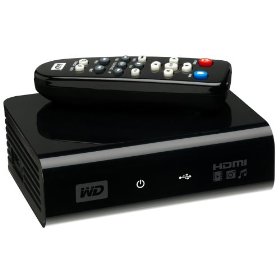
An uncompressed commercial DVD stores about 8 gigabytes of data. That means I’ll be able to back up about 250 DVD’s. This is solving a major problem in my house. Little kids are rough on DVD’s. I’ll be able to back up my entire DVD library so that their lovable, grubby mits never touch a DVD. They’ll select the movie they want to watch with the device shown above, and launch it.
Things are getting better all the time.