I wonder if there’s a connection? The obvious link would be if bats feed on bees (or honey), which I suppose some do, but I doubt that’s it.
Author Archives: Phil Bowermaster
Replaceable Parts
UPDATE: Instalanche! Thanks for the links, Glenn, both here and on the new Better All the Time, which features a roundup of good news related to that most irreplaceable of parts — the human brain.
This really got my attention:
In his lab at Wake Forest University, a lab he calls a medical factory, Dr. Anthony Atala is growing body parts.
Atala and his team have built, from the cell level up, 18 different types of tissue so far, including muscle tissue, whole organs and the pulsing heart valve of a sheep.
“And is it growing?”…
“Absolutely,” Atala said, showing him, “All this white material is new tissue.”
“When people ask me ‘what do you do,’ we grow tissues and organs,” he said. “We are making body parts that we can implant right back into patients.”
Dr. Atala, one of the pioneers of regeneration, believes every type of tissue already has cells ready to regenerate if only researchers can prod them into action. Sometimes that prodding can look like science fiction.
Emerging from an everyday ink jet printer is the heart of a mouse. Mouse heart cells go into the ink cartridge and are then sprayed down in a heart shaped pattern layer by layer.
Dr. Atala believes it’s a matter of time before someone grows a human heart.
How big a deal is this? Consider this analysis, found on Dr. Atala’s site at Wake Forest University:
The Joint Commission for Health Care Organizations (JCAHO) recently declared the shortage of transplantable organs and tissues a public health crisis. There is about one death every 30 seconds due to organ failure, and complications and rejection are still significant problems. The national cost of caring for persons who might benefit from engineered tissues or organs has reached $600 billion annually.

If this research leads to the ability to grow new kidneys, patients with severe kidney disease will be able to get replacement kidneys without a healthy person having to give one of theirs up. If this research leads to the ability to grow new hearts, patients with severe heart disease will be able to get replacement hearts without someone having to die.
Call me easily excited, but that strikes me as a distinct improvement.
Plus the patients will benefit from the elimination of all the complications associated with organ rejection. I don’t think there will be much of a problem with people’s bodies rejecting their own organs.
Additionally, this research seems likely to lead to some breakthroughs in life extension — at least a stop-gap version of life extension wherein patients can replace parts as they go and keep the overall system functioning. Moreover, there may be some key parts of the body which, if replaced with new versions, can “trick” the body into thinking its younger than it really is. Clearly a new heart or kidney won’t have that effect, but what would a brand new pituitary gland do? Also, could regeneration techniques help mitigate damage to the brain cause by Alzheimer’s or Parkinson’s?
Stay tuned.
Better All the Time #33
If the beginning of Spring (in this hemisphere, anyhow) wasn’t enough good news for you this week, here are nine more news stories guaranteed to warm your heart and, perhaps more importantly, do something nice for your brain as well.
Before and After the Singularity
Our friend Harvey, who puts modesty aside to claim that Ed Wood himself “never made anything as terrible” as what you’re about to see, gives us a glimpse into a plausible future where crusty old guys play cards with robots — I’m wondering if the robot is some kind of in-home care-giver. We know the moment the Singularity occurs because the robot helpfully announces the fact, but what’s really interesting is what happens next. What if posthuman intelligence uses our own obnoxiousness (and I’m using that word in a fairly literal sense) against us?
Chilling.
Also, doesn’t it seem to shed some light on the scenario described here? (Warning: language.)
Adds an ironic twist to the whole “poisonous gases” thing, doesn’t it?
Plateaus of Completeness
Some interesting comments from reader Nato Welch in the discussion thread of the most recent FastForward Radio:
Take by way of example California’s recent law prohibiting employers from requiring their employees to take RFID implants. If jobs are scarce, and competition among workers necessitates taking on modifications in order to compete effectively, then a form of distributed //duress// (Dale’s term) accomplishes an effective circumvention of self-determination even where direct coercion may not.
So our commitment to morphological liberty, if it is to be practical, demands a bit more than simply enjoining direct forms of coercion, but also the creation and maintenance of societies where relinquishment of technological interventions is not only permitted, but actually practicable; not only allowed, but accommodated.
Excellent point. What Nato is describing as “morphological liberty” begins with non-coercion; it can’t end there. But where does market pressure end and out-and-out coercion begin? This is a tricky question.
Let’s step back from human augmentation and look at some more mundane forms of technological adoption. On a recent Frontier Airlines flight, I was surprised to hear the flight attendant announce that Frontier Airlines “no longer accepts cash.” Anyone wanting to use the DirecTV service or purchase a cocktail now has to use a credit card. Okay, granted, credit card “technology” is so ingrained in modern commerce — especially travel-related commerce — that the expectation that passengers on a commercial flight would have access to it seems pretty reasonable. The number of passengers who purchase their tickets via cash or check (is that even possible any more?) is no doubt vanishingly rare.
Farewell to a Great Visionary
As a science fiction writer, he was one of the big three — along with Isaac Asimov and Robert Heinlein. He is no doubt most famous for 2001: A Space Odyssey, but my personal favorites are “The Nine Billion Names of God” and Rendezvous with Rama (just the first one; the sequels didn’t live up.) As a scientist, he will be best remembered for his contribution to the idea of placing communication satellites into geostationary orbit.
In futurist circles, he will long be remembered for his three laws of prediction:
-
When a distinguished but elderly scientist states that something is possible, he is almost certainly right. When he states that something is impossible, he is very probably wrong.
-
The only way of discovering the limits of the possible is to venture a little way past them into the impossible.
-
Any sufficiently advanced technology is indistinguishable from magic.
I am especially fond of the second one. I hope to live to see the third.
Excuses for Dying
Retirement Cruise
Well now how about this development:
Scientists in California carried out computer simulations that suggest Earth-like planets may be orbiting Alpha Centauri B.
At least some are likely to be in the so-called “habitable zone” at just the right distance from their parent star to allow oceans, lakes and rivers to form without freezing or boiling away. Such planets are the best candidates for supporting life as we know it.
Anyone standing on a planet orbiting Alpha Centauri B would see two “suns” in the sky, a bright “primary” sun and a “secondary” sun which would be much weaker but still many times brighter than the full moon as seen from Earth.
The astronomers hope to carry out intensive studies of the Alpha Centauri system using the 1.5 metre telescope at the Cerro Tololo Inter-American Observatory in Chile.
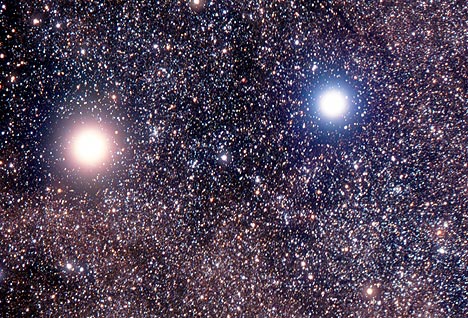
Over the next few years, we’ll have new telescopes coming on line that will give us a clear idea of what’s really orbiting Alpha Centauri B and other nearby stars. I don’t expect we’ll find unambiguous proof of a technological civilizations out there anywhere — eyeballing it isn’t really how you look for that — but maybe we’ll find a few planets showing some signs of life.
Any that show promise we can put on the itinerary for what I’m calling my retirement cruise. It’s Plan C for what I want to do with my golden years, some 40-50 years from now. Here are all three plans in order.
Plan A
Effective life extension technology kicks in and I just keep on keeping on with whatever I happen to be doing by then. The Speculist and FastForward Radio will probably not exist in their current form, but that only means they will be replaced by something even more fun.
Plan B
The Singularity kicks in and I get uploaded into a posthuman state of techno-nirvana of which I am literally incapable of providing an adequate — or even inadequate — description. Some might recoil at this techno-Utopian / techno- eschatological vision, but please note. This is only Plan B.
Plan C
Still shy of the Singularity and adequate life extension, but living in a world in which nanotechnology and computer technology have continued to put more and more capability into the hands of the common individual, at about age 90 some like-minded individuals and I set out for interstellar space in a fusion-powered craft designed to accelerate at about 1G, approaching — but obviously not quite achieving — the speed of light. We cruise along for 10 years or so, elapsed ship time, visiting a planet or two along the way. We then return to earth where, depending on how much time we spent accelerating and decelerating, hundreds or thousands of years will have passed.
(I suppose plan D would be death and cryonic suspension, but that doesn’t really appeal to me.)
Anyhow, by the time I get back from my retirement cruise, the whole life extension and / or Singularity thing should have happened, so I can carry on with Plan A or B. Of course, as a living archaeological relic, I will have a lot of catching up to do before I will have much credibility as a Speculist.
But that’s fine.
Give me a century or two and I’ll be all caught up.
What Changes? What Remains the Same?
In response to the video I made last year asking attendees at a library conference how much change they will see if they live to be 100, a filmmaker, visionary, and old high-school buddy of mine offers this compelling scenario:
So take that, grandma!
For your reference, here’s the original video:
Something that caught my attention on a recent viewing of this video was Bob Treadway’s (second) answer to the question: “maybe what’s more interesting is what won’t change.” Being a Speculist and all, that struck me as a kind of contrarian answer. So it’s interesting to note that in starting to read John Naisbitt’s Mind Set!, his first and establishing mindset is as follows:
While many things change, most things remain constant.
What’s great about this idea is that it is infinitely arguable. Of course, bear in mind that if you take the “more things change than don’t” position, you aren’t just arguing with Bob Treadway; you’re arguing with the Megatrends guy.
So let’s hear it, folks. Do more things change or do more things stay the same?
Global Warming Estimation Methodology Challenged
This is very interesting:
Researcher: Basic Greenhouse Equations “Totally Wrong”
New derivation of equations governing the greenhouse effect reveals “runaway warming” impossible
Miklós Zágoni isn’t just a physicist and environmental researcher. He is also a global warming activist and Hungary’s most outspoken supporter of the Kyoto Protocol. Or was.
That was until he learned the details of a new theory of the greenhouse effect, one that not only gave far more accurate climate predictions here on Earth, but Mars too. The theory was developed by another Hungarian scientist, Ferenc Miskolczi, an atmospheric physicist with 30 years of experience and a former researcher with NASA’s Ames Research Center.
After studying it, Zágoni stopped calling global warming a crisis, and has instead focused on presenting the new theory to other climatologists. The data fit extremely well. “I fell in love,” he stated at the International Climate Change Conference this week.
“Runaway greenhouse theories contradict energy balance equations,” Miskolczi states. Just as the theory of relativity sets an upper limit on velocity, his theory sets an upper limit on the greenhouse effect, a limit which prevents it from warming the Earth more than a certain amount.
How did modern researchers make such a mistake? They relied upon equations derived over 80 years ago, equations which left off one term from the final solution.
Miskolczi’s story reads like a book. Looking at a series of differential equations for the greenhouse effect, he noticed the solution — originally done in 1922 by Arthur Milne, but still used by climate researchers today — ignored boundary conditions by assuming an “infinitely thick” atmosphere. Similar assumptions are common when solving differential equations; they simplify the calculations and often result in a result that still very closely matches reality. But not always.
Don’t know if Miskolczi is is right — the math goes over my head pretty quickly on this stuff — but I find it interesting that his model accurately models climate change on Mars as well as Earth. One of the questions we’ve had about global warming is why are other planets in the solar system — where they don’t have a greenhouse gas problem — warming up at about the same rate as Earth? Miskolczi may have the answer.
I should point out that I found this story following the very interesting discussion about Global Cooling over at Jerry Pournelle’s site. The discussion follows this original item.
Anecdotally, based on the last two Colorado winters, global cooling feels a lot more likely to me. But then, we don’t really want to come to conclusions about this stuff based on anecdotal data points.
This, on the other hand, wasn’t just anecdotal.