Via GeekPress.
Author Archives: Phil Bowermaster
Things We'll Never Understand
Although it’s difficult to choose among absolutes, perhaps the most silly and annoying moments in this summer’s M. Night Shyamalan mega-flop occur very near the beginning and end of the film. In one of the opening scenes, a high-school science teacher asks his class to suggest theories as to why bees have been dying off. The kids dutifully suggest disease, climate, and other plausible causes — all of which the teacher (Mark Walberg) refutes. None of the explanations the students come up with seem to fit the facts.
So far, so good. But then one boy raises his hand and gives Walberg the answer he’s looking for:
“Maybe it was an act of nature that we’ll never understand.”

The kid is moved to the head of the class and given the proverbial gold star. Later, towards the end of the film, a “scientist” on a news show says almost exactly the same thing. So according to Shyamalan’s view of science, the following would be all-too-typical of a scene:
Eureka! I’ve got it now, ladies and gentlemen. At last. What we’re observing here is an act of nature that we’ll never understand. You get those in science sometimes, and that’s when you know it’s time to pack it in. I’m closing down this entire operation as of right now — you can pick up your paychecks on the way out.
Things We’ll Never Understand
Although it’s difficult to choose among absolutes, perhaps the most silly and annoying moments in this summer’s M. Night Shyamalan mega-flop occur very near the beginning and end of the film. In one of the opening scenes, a high-school science teacher asks his class to suggest theories as to why bees have been dying off. The kids dutifully suggest disease, climate, and other plausible causes — all of which the teacher (Mark Walberg) refutes. None of the explanations the students come up with seem to fit the facts.
So far, so good. But then one boy raises his hand and gives Walberg the answer he’s looking for:
“Maybe it was an act of nature that we’ll never understand.”
The kid is moved to the head of the class and given the proverbial gold star. Later, towards the end of the film, a “scientist” on a news show says almost exactly the same thing. So according to Shyamalan’s view of science, the following would be all-too-typical of a scene:
Eureka! I’ve got it now, ladies and gentlemen. At last. What we’re observing here is an act of nature that we’ll never understand. You get those in science sometimes, and that’s when you know it’s time to pack it in. I’m closing down this entire operation as of right now — you can pick up your paychecks on the way out.
Yesterday in History
Sunday was the 39th anniversary of the Apollo 11 moon landing. July 20, 1969 — for the first time, two human beings stepped onto the surface of a world other than the Earth.
It was a glorious day in human history, one of the most glorious ever. July 20 should be a worldwide holiday.
Sadly, most people don’t seem to appreciate the significance. (We even failed to mention it on our podcast yesterday!)
Much more sadly, the discussion thread on Youtube that accompanies the above clip is all about whether the moon landings were a hoax.
It's 'The Godfather' of Superhero Movies
This concludes my review of The Dark Knight.
Freaking go see it already.

UPDATE FROM STEPHEN:
…but leave the kids at home. The Joker is one of the most deeply creepy characters I’ve seen on film – well – ever. He’s Hannibal Lector with face paint.
Batman Begins was great – in a fun way. The Dark Knight is genius in a punch-you-in-the-gut sort of way. This film will be with me forever. But its not one that I’ll want to watch regularly. This will never be a background-noise movie. Every few years will be good enough.
The movie Unbreakable asked us to take the superhero genre seriously. It suggested that superheros are our mythology – Greek gods repackaged for a secular, monotheistic culture. And there’s always been the possibility of that. There was Frank Miller’s The Dark Knight Returns, and Watchmen graphic novels (and others). But the superhero story as literature has never made it to the screen before. There have been attempts – Unbreakable, Spiderman 2, that first Hulk movie – they all had their moments. But they all suffer badly by comparison to The Dark Knight.
A whole other group of films suffer similarly – films that have tried to deal with terrorism and evil in the post 9/11 world. What must we do to defeat evil? How far are we willing to go? What are the consequences for us individually? For the people we love? For society?
In the 60′s Star Trek was able to deal with issues that straight dramas couldn’t get away with. Maybe that’s why The Dark Knight succeeds where other efforts at dealing with 9/11 issues has failed. Some things are too raw to just put up there on the screen. We need the metaphor.
It’s ‘The Godfather’ of Superhero Movies
This concludes my review of The Dark Knight.
Freaking go see it already.
UPDATE FROM STEPHEN:
…but leave the kids at home. The Joker is one of the most deeply creepy characters I’ve seen on film – well – ever. He’s Hannibal Lector with face paint.
Batman Begins was great – in a fun way. The Dark Knight is genius in a punch-you-in-the-gut sort of way. This film will be with me forever. But its not one that I’ll want to watch regularly. This will never be a background-noise movie. Every few years will be good enough.
The movie Unbreakable asked us to take the superhero genre seriously. It suggested that superheros are our mythology – Greek gods repackaged for a secular, monotheistic culture. And there’s always been the possibility of that. There was Frank Miller’s The Dark Knight Returns, and Watchmen graphic novels (and others). But the superhero story as literature has never made it to the screen before. There have been attempts – Unbreakable, Spiderman 2, that first Hulk movie – they all had their moments. But they all suffer badly by comparison to The Dark Knight.
A whole other group of films suffer similarly – films that have tried to deal with terrorism and evil in the post 9/11 world. What must we do to defeat evil? How far are we willing to go? What are the consequences for us individually? For the people we love? For society?
In the 60′s Star Trek was able to deal with issues that straight dramas couldn’t get away with. Maybe that’s why The Dark Knight succeeds where other efforts at dealing with 9/11 issues has failed. Some things are too raw to just put up there on the screen. We need the metaphor.
Right out of a Michael Crichton Novel
…circa 1985 or so. This looks like a good set-up for a tehcno- thriller, doesn’t it?
S.F. officials locked out of computer network
A disgruntled city computer engineer has virtually commandeered San Francisco’s new multimillion-dollar computer network, altering it to deny access to top administrators even as he sits in jail on $5 million bail, authorities said Monday.
Terry Childs, a 43-year-old computer network administrator who lives in Pittsburg, has been charged with four counts of computer tampering and is scheduled to be arraigned today.
Prosecutors say Childs, who works in the Department of Technology at a base salary of just over $126,000, tampered with the city’s new FiberWAN (Wide Area Network), where records such as officials’ e-mails, city payroll files, confidential law enforcement documents and jail inmates’ bookings are stored.
Childs created a password that granted him exclusive access to the system, authorities said. He initially gave pass codes to police, but they didn’t work. When pressed, Childs refused to divulge the real code even when threatened with arrest, they said.
Granted, to make an effective thriller out of this, you would need for the computer system in question to be vital to national defense. Being down, it would open us up to attack by terrorists or the Soviets (1985, remember.) Or maybe it would just be a system controlling a dam — with humans completely locked out of control — with a devastating flood likely if the authorities can’t regain control. Or, come to think of it, maybe it would be a security system protecting people from dinosaurs.

In any case, the warning inherent in this kind of story would be that technology allows some individuals to disproportionately empower themselves, with potentially devastating results if the individuals in question are criminal or sociopath types. This is undoubtedly true. But while an effective theme for a techno-thriller, I don’t think it’s the right lesson to take away from a real-life incident such as this one.
I would prefer we learn something like this:
Technology can allow some individuals to disproportionately empower themselves if it isn’t managed correctly. So whatever we do, let’s make sure that no one individual is ever holding all the marbles.
Granted, this approach will require those sourcing and managing technology projects to understand, if not the technologies themselves, at least the risks involved. No doubt it’s a lot easier just to hand the keys to the kingdom over to the first geek who comes along who persuades you that he or she can solve all your problems, but the ease of that decision comes at the cost of entrusting that individual with an awful lot of power.
So instead of wringing our hands and saying, “Oh my, technology makes bad people too powerful,” how about if we hitch up or trousers and say, “Oh my, technology requires good people to be smarter?”
Just a thought.
(Hat-tip: GeekPress.)
Economic Inevitability
I’m all for fresh oil drilling, for getting shale up and running, for converting coal to methanol and trash to ethanol that we can burn in our flex fuel vehicles. I like the idea of diesel sourced from algae and bacteria that excretes crude oil. I’d be proud to drive around fueled by used french-fry grease, and I think converting atmospheric CO2 into gasoline is a swell idea.
Those are all great ideas and I think we should pursue each and every one of them enthusiastically. But I’m starting to think that the real future of automotive transportation has little if anything to do with liquid fuel (or even natural gas.) Here’s why.
I drive one of these and I love it.
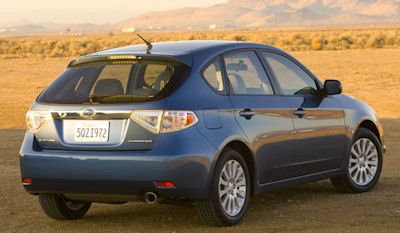
With my Impreza, I get between 22-32 MPG. With gas anywhere from $3.90 – $4.35 a gallon, let’s just round everything off and say that I’m paying about $4 for every 25 miles I drive. That doesn’t sound like such a bad deal until you consider what it ought to cost to drive something that looks like this:
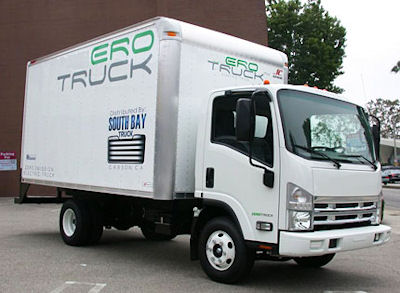
Take one of these Ero trucks, load it up with freight, drive it 50 miles to its destintation and then 50 miles back home, how much would you expect to shell out? Keep in mind that such a trip will run you about $16 in my moderately fuel efficient Subaru. At least twice as much, right? Call it $30 at the barest minimum
Would you believe 10% of that? How does $3 sound for a 100-mile trip?
The’s because our “Ero truck” is really a Zero truck, an Isuzu modified to run on expensive-to-buy-but-oh-so-inexpensive-to-operate lithium batteries. Go back and read over all those fuel options I listed at the beginning of this post. Do any of them promise to deliver 100 miles of driving for three dollars?
I didn’t think so.
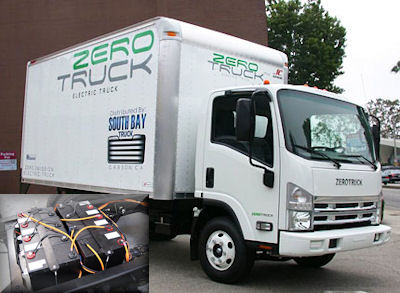
Electric cars are the way this thing is going to work out, folks. Yes, there are major issues to be resolved around developing more efficient batteries, extending the range these things can drive, figuring out a way to charge up quickly, etc. And of course, the biggest issue — how do we source all that electricity?
Mr. Pickens’ continent-sized wind farm is one idea. Getting serious about nuclear is another.
But it’s simple economics in the end. That 13 extra bucks I’m paying for every 100 miles of driving could be better spent on — so many things. Multiply that by the 20,000 miles I’m likely to put on my car in a year, and that’s $2600. Multiply that by the five years I’m taking to pay off my car and we’re looking at a break even point of an all-electric Subaru Impreza — with a sufficient range to get me from Highlands Ranch to Boulder and back, slightly more than the 100 miles that the Zero truck delivers — costing about $13,000 more than what I paid for mine.
Faster, please.
Imagine, Intend, Insist

On our most recent FastForward Radio, we talked about defining the Singularity not so much in terms of the achievement of greater-than-human intelligence as the fundamental and radical transformation of the world around us. If the Singularity is about transforming the world around us, then achieving greater-than-human intelligence, or atomically precise manufacturing, or an other major technological leap, becomes a means to that end, but not necessarily the end itself.
This discussion reminded me of a series of interviews I did with various futurists a while back, asking each of them a standard set of questions about the Singularity. One of those questions was:
Do you believe that you have a role to play in the unfolding Singularity and, if so, what is it?
I conducted most of those interviews at the Singularity Summit, so it’s not surprising that my interview subjects by and large answered in the affirmative and were able to articulate how they saw themselves fitting into the coming Singularity. I wonder, though, what kind of response this question would get from a non-Singularity aware audience, other than the obvious:
“The unfolding what?“
So we might have to phrase the question differently, and maybe our expanded definition of the Singularity helps us to do that:
Do you believe that you have a role to play in the fundamental transformation of the world and, if so, what is it?”
It becomes a pretty daunting question. (Note that we’ve skipped the more fundamental question as to whether one believes the world is going to be transformed. One should ask that first, but we’re taking it as a given for this discussion.) There’s a hint of the audacious, some would even argue the delusional, in answering that question in the affirmative. And yet what a feeling of impotence, if not helplessness, would accompany answering in the negative.
However, I think there are three things that everybody can do to help bring this transformation about.
The first is to imagine the world transformed. All intentional accomplishment begins in the imagination. This is not to say that everything that happens begins in the imagination. Many things occur that we never imagined. Nor is it to say that all accomplishment begins in the imagination — sometimes we stumble on new things that we never imagined while trying to do something else. But when we get it right — when the future that we make happen is the one we were trying to make happen — our circumstances become the fruit of our imagination.
Beyond imagining, the next step is to intend for the world to be transformed. The ideas to which we apply intention are a very small subset of everything we imagine. There are any number of possible future scenarios that we like to think about, but have no intention of pursuing. Moreover, we fantasize about a wide variety of outcomes that we dread, fear, or just generally don’t want — we call this worrying. We actually do attach intention to some of our worries by deciding to take steps to prevent or avoid them. And then there are a few positive images of the future that we form first in our imaginations and then direct towards fulfillment by way of our intentions.
Finally, we can all insist that the world be transformed. When we imagine, we trade in what could be; when we intend, we deal with those things that should be; when we insist, we have narrowed it down to those things that must be.
Interestingly, I think this formula applies equally well to the researchers working on the cutting edge of friendly AI or atomically precise manufacturing as it does the non-technically trained layperson. Whether we’re trying to bring about a mundane or spooky technological Singularity, or simply trying to fix one broken part of our world, we have to see that change for ourselves, we have to direct ourselves towards that change, and we have to be ready to do whatever it takes to make that change real. Whoever we are, whatever transformation we want to effect, we have to imagine, intend, and insist.
Solving Games

We observed last year that the game of checkers was solved by a computer. That is, researchers mapped out every possible play in every possible game and determined that perfect play by two players will always result in a draw. A number of games have been solved over the years, but checkers is to date the most complex of these.
Chess has been partially solved, meaning that some variations on the game with a smaller board and / or fewer pieces have been solved, although the full game remains unsolved. There is a big difference, however, between a computer fully solving a game and the same computer being able to beat a human being at that game. For chess, the former is still somewhere in the future, while the latter is a done deal.
There is some debate as to whether machine mastery of games is indicative of any kind of forward progress in artificial intelligence. Heres what the author of the wikipedia general article on chess has to say about the above-linked chess match between Gary Kasparov and Deep Blue:
Garry Kasparov, then ranked number one in the world, lost a match against IBM’s Deep Blue in 1997.[62] Nevertheless, from the point of view of artificial intelligence, chess-playing programs are relatively simple: they essentially explore huge numbers of potential future moves by both players and apply an evaluation function to the resulting positions, an approach described as “brute force” because it relies on the sheer speed of the computer.