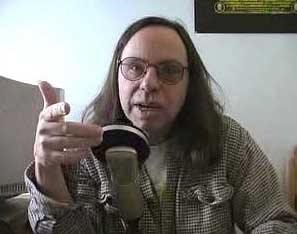
Author Archives: Phil Bowermaster

Singularity Summit 10 Mid-Day

12:30 Ben Goertzel

Ben introduced as the “badass” of the AI community.

The human body is like machine. Body produces and processes a huge amount of data. Hard to address the complexity. A drug typically goes after one target, not all the interrelationships. SENS for example may fall short grasping the complexity.

Move mitochondrial DNA into the nucleus — prevents damage, but what else results?

Genescient’s flies live 5x normal fruit flies. Got there by intensive breeding, focused on longevity. Superflies! Stronger, more sex, better immune systems. Sexy immortal billionaire insects.

Isolated genes that express differently in superflies — hundreds of them. Many of these have analogs to human genes. Traditional statistics revealed a lot about superfly data. How can AI tools reveal more? One day AGI biologists will put humans out of existence. Meanwhile, narrow AI can help. Text analysis — can map and reveal relationships.

Certain genes have been identified as key. Mapped supplements which trigger proteins related to this key genes. Includes zinc, vitamin E, reverstrol.

But current AI tech just scratches the surface.

Combine early stage AGI with powerful narrow AI to get the artificial biologist.

12:00 Ray Kurzweil

The Mind and How to Build One

(Ray is “here” via video conference.)

The brain is not magic. The complexity of the brain is not inherently beyond our measn to comprehend.

Speech recognition, visual proecessing, many limited Ai applications have had a big boost from emulating the appropriate

brain functions. Take the basic principles and focus them, amplify them.

Exponential progression shows that we will be able to get to 10-14th / 10-16th calculations per second. Justin Rattiner of

Intel says 3D chips will take off where stand silicon chips leave off. Moore’s Law will continue. The exponential growth will get us to human levels.

These ideas are highly contested by mainstream thinkers / media.

Singularitarian — someone who understands or accepts the fact that information technology progresses exponentially, which

ultimately leads to something transformative. Education, experience, qualifications — none of these are necessarily indicators of the likeliehood that someone will be a Singularitarian.

Intelligence is the most progound phenomenon in biology. We have already amplified intelligence with our technology. Homo

sapiens were a big step forward with our big heads. But now we don’t need a bigger brain case — we can move to a new substrate where the old limitations don’t apply.

Shows the Moore’s Law chart — his expanded take on it — updated from the Singularity Is Near. The progress is very smooth.

One transistor for a dollar in 1968, a billion for a dollar today. Different technologies — eg, biotech — now growing exponentially because of information technology. Exponential trends start out slow and then produce huge returns unexpectedly.

We literally create our brains by the thoughts we have. Thoughts seem ephemeral but they create the physical structure of the brain.

A perfect simulation of the brain won’t do anything until it learns something.

The cortex is the only region that allows us to think in hierarchies. A symbol for and idea can be combines with a symbol for another idea to create a new idea with its own symbol. This sums up to what we call knowledge.

Complex concepts are organized as individual lists in a particular order. LISP mania in the 70′s and early 80′s was a foreshadowing of the dot-com bubble. Bust cycles are precursors to profound developments. Dot-comm bubble leads to multi-billion dollars companies (Google.) Our understanding of the cerebral cortex shows us now that it is a LISP processor. As was asserted in the 70′s and 80′s, this is how the mind works — generating one-dimension lists that can be embedded to encode any level of sophistication.

It’s hard to have a serious discussion about consciousness becasue of a conceptual gap between the objective and the subjective. There’s no evidence provided that consciousness lies anywhere that it is speculated to be. You can’t do a falsifiable experiment to isolate consciousness. Ultimately it’s a lep of faith.

But, “if it qaucks like a duck…”

Singularity Summit 10 Morning

10:45 Attendee Feedback

A guy stopped to tell me he listens to the podcast. Said he wanted to keep his criticism positive. Finds it too “folksy and rambling.” Half of that is by design, of course.

10:30 Gregory Stock

Evolution of Post-Human Intelligence

Exuberance doesn’t necessarily pan out. Lots of great visions of how things will be but we don’t get there in the time frames we expect. We are suffering from a data Tsunami.

Kurzweil’s vision as seen in his new film is the triumph of love / human values.
Stock sees the Singularity as the extinction of humanity.
“A journey into we know not where.”
We have no idea what will be on the other side — no reason to think our values will survive.

We need a macroevolutionary perspective.

We are animating the inanimate world — breathing complexity that rivals life into the sand beneath our feet.

Genomic revolution — we are beginning to take control of our own evolutionary process.

A transformation is underway. Won’t we be transcended?

Evolution isn’t static. Evolution itself is evolving. (Accompanied by several amusing photos of animals having sex.)
Social evolution — ideas can compete and evolve in the abstract now — rapidly accelerating the process. Traditional Darwinian evolution is being replaced. No exponentials in Darwinian evolution — other things are happening faster by orders of magnitude.

Past evolutionary breakthroughs:

First — life out of non-life. Blue green alage 3.5 billion years ago.
Next — complex cells, symbiosis of bacteria into more complex organisms
Next — mutlicellular organisms
Next — to planetary superorgnism (Accompanied by images of the US at night, internet connections, city skylines.)

This is not a metaphor — it’s a real organism with its own nervous, digestive, and cisulatiry systems. Internal processes. Internal competition. Requires no external membrane.

Simple biology took simple nonbiology (calcium phosphate) to create bone. This led to the sophsiticate orgganisms we have today. Now complex biology is manipulating complex nonbiology.

New levels of complexity subsume old ones. We are going to no longer be “free range.” We’re going to be left behind.

What does an amydala cell know about fear? Very little. What do we know about what’s happening with the superorganism? Very little.

The Singularity — the future is going to get very weird very quickly. What does it mean for us?

Human ehtics and values are not unique to us — they are critical to primate social strategy. Chimps have the basic building blocks — sharing, empathy, loyalty (images of chimps grieving a lost fellow, a chimp trying to comfort a crying child.)

Why would we expect these values to persist? They cyber world is all about speed, boundaries are weak, competition is intense. Different reality will require different values. Uploading — humans will disappear through the skylight. The only way to preserve human values is to stop evolution.

Singleton rule might be one way to do this
Superorganism communities is another possibility

If top-down control is the only way to preserve humanity, humanity is over.

Current debates — cloning, designer kids, genetic engineering, human enhancement, AI — are just symbolic. And thay are all the same argument. Brings a lot of angst. But people SHOULD be worried — the line between the natural and technological is being permanently blurred / eliminated.

Change will come from the nimble, the bold. “Notwithstanding

Sigma Bio Sciences CEO and founder.
Managed Alzheimer’s research — the posetr child for unment medical need.
Very prevalent — if you make it to 85, you have a 50% chance of getting it.

Sigma looks at proteins.PP2A may be key — started looking for things to activate it. Coffee — 4 cups or more per day reduces incidence of diabetes and Parkinsons. (Yay!) Coffee bean extract (SIG1012) administered to mice, extends life, delays motor problems.

On to human trials. Coffee is generally recognized as being safe to consume.

9:45 Michael Vassar

The singularity — is it a rational thing to discuss?

Some things are rational but not scientific — building the Roman aqueducts, building a Gothic cathedral. Civilizations have been around for thousands of years — in the 17th century two new things came along science and capitalism.

There were precursors to science, eg Archimedes. rational, mathematiical, useful but not science.
–Didn’t test a hypothesis
–No organized literature/publication standards
–Archimedes’ method works but requires honest geniuses

Scholarship works because it is basically pattern recognition with built-in correction. Scholarship is a scaled up version of how children learn. Society has more resources than a child — scholars are “superchildren” who learn for society.

There is no innate human drive to keep learning, to keep changing one’s view of the world. Scholarship fails because of correlated errors, bias against unexpected claims, inaccessibility for outsiders, and standard biases of human cognition.

What changed in the 17th century — radical skepticism

Enlightenment Science
Build on long chains of reasoning from solid foundations
Look for surprising conclusions
Test conclusions
Doesn’t require geniuses!

Enlightenment science was a good start
Seemingly necessary assumptions may be false
Its form can be imitated to aid justification of what you want to believe

Darwin and Wallace — working independently came to the same conclusion.

The Singularity

Independent origination of similar hypothesis (Von Neumann, Vinge)
Logical argument — the intelligence explosion
Massive data analysis — Kurzweil
Nominal buy-in by credible non-experts

Therefore the Singularity is rational and scientific.

9:15 AM Looks like the live feed is not happening — Sorry,Sally

Three Conversations

Back from the reception. In addition to chatting with old friends Michael Anissimov, Christine Peterson, Brad Templeton, and Ben Goertzel, I was introduced to (or introduced myself to) a number of really interesting people:

One of them heads up a group devoted to Seasteding, or as Christine put it — “start-up countries.”

One of them is the managing director for technology equities research for a New York-based securities firm, scouting opportunities just a tad outside of the scope of what the typical Wall Street firm is looking for.

And speaking of money, one of them invented a computer immune system that IBM took a shine to and bought from him for $45 million. He is now using that money to fund a little pet project — creating a hardware replica of the human brain.

Lots more to come both on these folks and the actual Summit sessions. Stay tuned.

I'm Here

Palace of Fine Arts

Image via Wikipedia

Singularity Summit coverage starts bright and early tomorrow morning, unless something interesting happens tonight that demands my attention.

I’m headed over to the Palace of Fine Arts — which is where the Summit was held last time I managed to attend. There’s a reception over in that neighborhood, and I’m hoping to bump into some old friends and maybe make a few new ones,

I’ll be collecting audio snippets if possible (no video this time.) I brought my good camera but forgot the cable. So either I’ll take photos with iPhone and publish them right away or take higher quality photos and publish them later.

Or maybe just let Zemanta illustrate my posts… 

Enhanced by Zemanta

I’m Here

Palace of Fine Arts

Image via Wikipedia

Singularity Summit coverage starts bright and early tomorrow morning, unless something interesting happens tonight that demands my attention.

I’m headed over to the Palace of Fine Arts — which is where the Summit was held last time I managed to attend. There’s a reception over in that neighborhood, and I’m hoping to bump into some old friends and maybe make a few new ones,

I’ll be collecting audio snippets if possible (no video this time.) I brought my good camera but forgot the cable. So either I’ll take photos with iPhone and publish them right away or take higher quality photos and publish them later.

Or maybe just let Zemanta illustrate my posts… 

Enhanced by Zemanta

Fast Forward Radio — Humanity Plus, R.U. Sirius?

Phil and Stephen welcome publisher, author, and counterculture icon R.U. Sirius back to FastForward Radio to discuss the rebirth of H+ Magazine.


FFRNewLogo9J.jpg

Listen to internet radio with The Speculist on Blog Talk Radio

About our guest:

ru.sirius.jpgR.U. Sirius is editor-in-chief of the online transhumanist publication, H+ Magazine. He is former Editor-in-chief of Mondo 2000, a technoculture magazine that was legendary during the 1990s. Books authored or co-authored by Sirius include A User’s Guide to the New Edge, True Mutations, Counterculture Through The Ages, and Design For Dying with Timothy Leary. In addition to editing H+ Magazine, Sirius is organizing the Mondo 2000 History Project, an open source memoir.

If you’re interested in helping out as part of the H+ community, contact R. U. Sirius:
ru-at-hplusmagazine.com.

Enhanced by Zemanta

Speaking of Starting this Blog Today

Happy Birthday Candles on Angel Foods Cake

Image by Rob J Brooks via Flickr

Sometimes we’re so busy hurtling headlong into an astounding future that we miss the little things. The dashed-off ending to my previous entry reminded me that we just passed quite a landmark. On Sunday, the Speculist turned seven.

How appropriate that a flying car post should remind me of that!

Well a great big Happy Birthday to us!

Enhanced by Zemanta

Aw, You Shouldn't Have

Will Brown reports on a major development that apparently came about specifically with Stephen and me in mind.

You know, there’s flying cars and then there’s flying cars. This one has a lot going for it, for sure. In fact, its very similar to an idea we discussed on a recent FFR. But I’m holding out for the full Jetson…

BTW, I think “the full Jetson” should be a thing. If I were starting this blog today I think that would be a good name for it.

Aw, You Shouldn’t Have

Will Brown reports on a major development that apparently came about specifically with Stephen and me in mind.

You know, there’s flying cars and then there’s flying cars. This one has a lot going for it, for sure. In fact, its very similar to an idea we discussed on a recent FFR. But I’m holding out for the full Jetson…

BTW, I think “the full Jetson” should be a thing. If I were starting this blog today I think that would be a good name for it.