Author Archives: Phil Bowermaster

FastForward Radio — The Age of Empathy

PJ Manney Week continues on FastForward radio with a discussion of how empathy may prove a critical factor in determining what sort of future we experience.

Topics include:

  • What to make of recent findings concerning the physiological nature of empahty
  • Why empathy exists in so many animals, including humans
  • Why as the world becomes more complex, we may need it more and more
  • Empathy and Geek Culture — Is there hope? 


Listen to internet radio with The Speculist on Blog Talk Radio


About our guest:

As a frequent guest and occasional co-host — not to mention our official Hollywood correspondent – PJ Manney brings a unique perspective to FastForward Radio. She is a writer and futurist, and a leading voice in the Humanity+ movement. She has written extensively on H+ topics, having previously been involved in motion picture development (Hook, It Could Happen to YouUniversal Soldier) and writing for television (Hercules: the Legendary JourneysXena: Warrior Princess). pjlittle.jpg
Enhanced by Zemanta

Leveraging Superpowers


As a generally geeky person futurist, I am highly interested in the subject of superpowers. I believe that our descendants, or our future selves if you like, will be possessed of amazing abilities. They will casually, as a matter of course, and without giving it a second thought, do things that would absolutely astound us if we saw someone do them today.

Does that strike you as unlikely?

Perhaps, but let’s listen in on a conversation between a futurist and a skeptic discussing the very same scenario — 500 years or so ago.

Futurist: People in the future will be possessed of amazing abilities. They will casually, as a matter of course, and without giving it a second thought, do things that would asbolutely astound us if we saw someone do them today.

Skeptic: Nonsense. People don’t change that much.

Futurist: Oh don’t they? Let me ask you something. If you have something you need to say to someone 1000 miles away, how long does it take to deliver that message?

Skeptic: It might arrive in a month.

Futurist:If you’re lucky. And if your friend responds immediately, how long until you get your answer?

Skeptic: Another month.

Futurist:If you’re lucky. So what if I told you that, in the future, two friends 1000 miles apart will be able to converse with each other the same as you and I are doing right now?

Skeptic: I’d say that’s nonsense.

Futurist: Very well. Suppose you want to go see your friend who lives 1000 miles away? How long will it take to make that trip?

Skeptic: That would probably take another month or so.

Futurist:If you’re lucky! What if I told you that people in the future will be able to make a 1000-mile journey — and journeys much longer than that — in less than a day?

Skeptic: More nonsense! You’re saying that people in the future will be all be sorcerers!

We do things every day that would look like witchcraft to our ancestors. What I’m doing right now would seem uncanny to them — creating words made out of light in a magic window that then shows those words to as many others who care to look at them in their own magic windows. I can also use my magic window to play music and to see pictures, moving pictures, of people and objects far, far away. Tomorrow I’m going to fly through the air faster than any bird as I return from Boston to Denver.

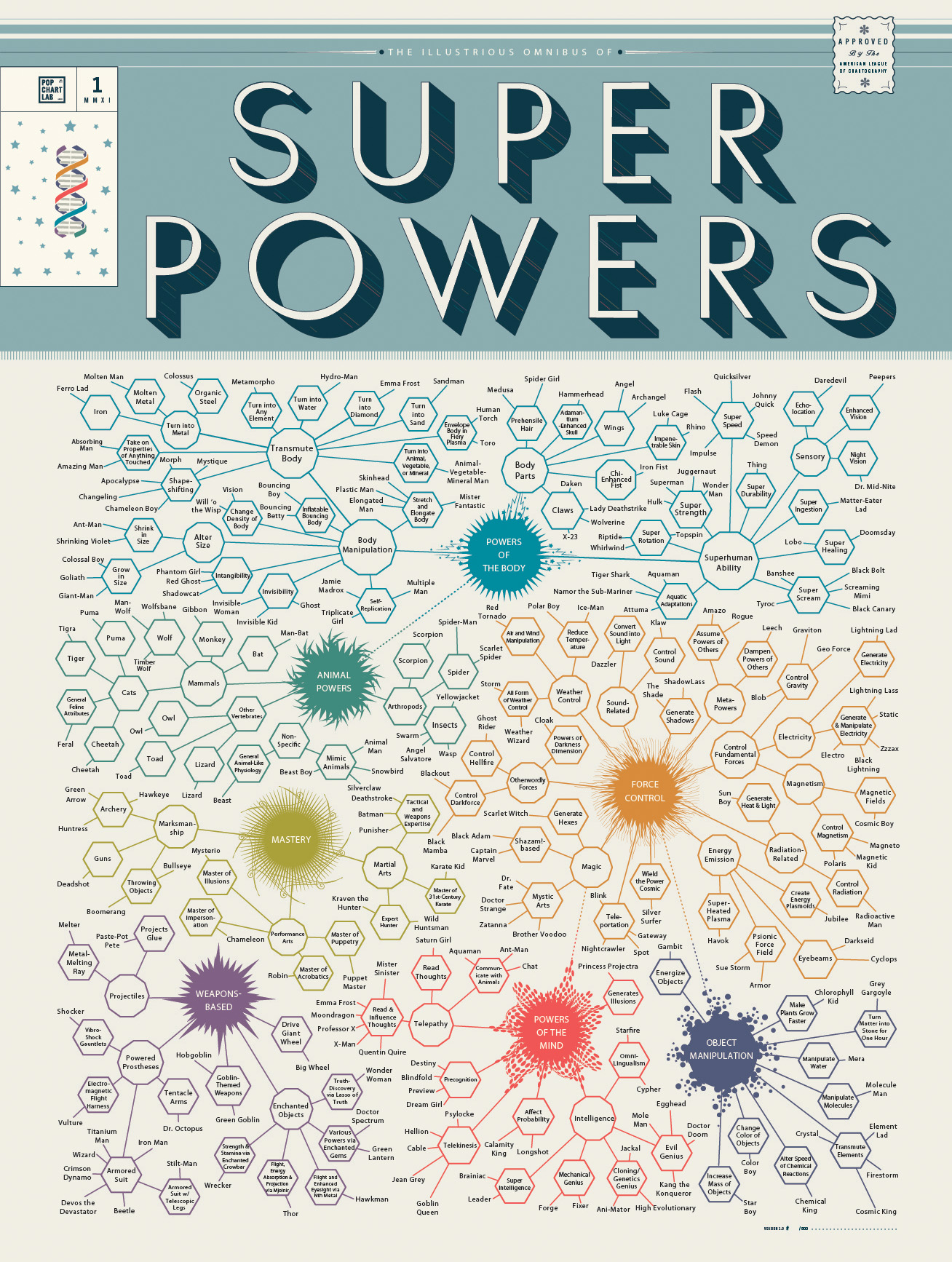
There is no question that our descendants will do things that will be equally astounding to us. Will they be possessed of the kinds of powers listed in this wonderfully detailed map of superpowers provided by Fast Company?

I think the only reasonable answer to that question is…yes, of course they will.

There are so many superpowers listed here that maker had to use members not only of the Legion of Superheroes but the lesser-known Legion of Substitute Heroes in order to complete the map. I’m quite pleased that I am old nerdy well-read enough to recognize most of the superheroes named on the map.

This map of superpowers makes me look at my own superpower map somewhat differently. I write frequently about Zapoint’s ongoing efforts to create skills maps for entire organizations — online interactive tools that enable managers to see and analyze the skill sets that are available within their organizations. Perhaps this chart of superpowers can help remind us how extraordinary the skillsets available to most organizations really are. After all, to someone from a century or two back, the skills listed in one of our modern day skills maps might look almost as outlandish as these superpowers look to us.

Cross-posted from the Transparency Revolution.

Blogging for Dollars

The class-action lawsuit being brought against the Huffington Post on behalf of unpaid bloggers demonstrates that not all organizational problems can be solved through transparency alone. The facts in the case are not in dispute:

  • Arianna Huffington’s eponymous news aggregation and blogging site relies on a network of some 9000 bloggers to produce the bulk of its content, very few of whom are ever paid in any way for their contributions.
  • America Online acquired the Huffington Post for $315 million.

The damages sought in the lawsuit are $105 million on behalf of the unpaid bloggers, 1/3 of the purchase price of HuffPo. More facts not in dispute:

  • The non-premium (unpaid) bloggers account for less than 1/3 of the HuffPo’s traffic
  • These bloggers understood they would not be paid when they signed on

It’s helpful that all parties are looking at the same set of facts. This would be a very different story if there was any indication that the sale price had been obscured, that bloggers had been misled, or if the relative traffic contributions were unknown.

However, even with a common set of undisputed facts, this case will come down to an assessment of what is fair and what is reasonable — which facts on their own can’t provide. The HuffPo argument is that these bloggers provide this content as a way of getting their names out there, likening writing blogs for theHuffington Post to being interviewed (unpaid) by a TV show. The bloggers argue the site has become a hugely profitable business at least in part because of their contribution, and that they deserve a share.

While I sympathize with the bloggers, I don’t think they have much of a case. To knowingly agree to do something for free and then come back later and complain that you weren’t paid for it…

On the other hand, if the current set-up strikes them as unfair, there are certainly within their rights to refuse to write anything more for the Huffington Post, perhaps until the blogger compensation plan is updated. Then the HuffPo will have some decisions to make concerning the value of these particular bloggers, their options for getting content elsewhere, and the potential damage to a noted progressive site’s reputation when it is portrayed as exploiting workers — a charge that is central to the lawsuit.

In the end, a common set of facts won’t solve these problems. But there is a chance that it will help expedite coming to a common understanding of what’s fair and what’s reasonable.

Cross-posted from Transparency Revolution. Please join the discussion there.


Enhanced by Zemanta

Limitless: The Case for Open Source Development

I just saw the movie Limitless over the weekend, having previously read the book on which it is based (The Dark Fields, by Alan Glynn). The premise of the story is that you can take a pill which greatly amplifies and enhances your memory and mental processing–instantly providing what is essentially greater than human intelligence. The movie does a great job of trying to visually convey what this would be like. Of course, for the sake of a good story, there are some drawbacks:

1. It’s temporary. After it wears off, you go back to your old level of intelligence, so you gotta keep taking it.
2. It comes with side effects, ranging from forgetting to eat and being bored with your friends to altered behavior, memory gaps, and confusion about elapsed time. 
3. Withdrawal sucks–problems like headache, nausea, inability to focus, and sometimes death.
Assuming for the sake of argument that we could avoid the nasty downsides, Phil asked a couple of months ago: Would you take it? My answer is yes, most of us would, if only to avoid being left in the dust by those who did. In his review of the movie, R.U. Sirius gives a summary of some of the likely effects of overstimulating your brain in this way. Even if not physically addicting, it is likely that you would develop a psychological addiction to a substance that could change your life this dramatically. Of course, if you can stay at that level, then it’s just a phase-shift to the next level of human intelligence.
The scariest part of the movie though is that guess what: the bad guys are taking it too! So how do you at least keep up, if not step ahead to avoid the kinds of dystopian futures that kind of scenario could bring? Some would argue for restrictive regulation or slowing down of dangerous research into AGI or enhanced human intelligence, but then how will we know when some corporation, criminal organization, or rogue government makes significant progress with these types of technologies? Open source development lets us all keep an eye on the state of the art, perhaps shape the path it takes, and develop the tools to detect and defend against abuse as we go along. It doesn’t guarantee a good outcome, but it improves our chances.
That doesn’t mean only allowing or supporting open source development–various parties will be pursuing these technologies in parallel, but by sharing the progress of at least some of this development openly, we not only speed the process for all, but are better able to monitor the incremental progress and avoid a big surprise later on.
Enhanced by Zemanta

Friday Videos — Typical Day at SFO

Just like any other day at San Francisco International. Domestic flights, international flights, big planes, small planes, passenger planes, cargo planes. All very standard stuff.

Oh yeah — and one spaceship.

Show's Over, Folks

In light of these developments, we have no choice but shut the Speculist down for a week or two and then re-open as (I’m guessing) a celebrity news and fashion tips site.

It’s been a fun ride!