Author Archives: Phil Bowermaster

Pop-up Bug Robots

Mass-produced robot insects. I mean, hey, what could possibly go wrong?

In new mass-production technique, robotic insects spring to life

Production method inspired by children’s pop-up books enables rapid fabrication of tiny, complex devices

Devised by engineers at Harvard, the ingenious layering and folding process enables the rapid fabrication of not just microrobots, but a broad range of electromechanical devices.

In prototypes, 18 layers of carbon fiber, Kapton (a plastic film), titanium, brass, ceramic, and adhesive sheets have been laminated together in a complex, laser-cut design. The structure incorporates flexible hinges that allow the three-dimensional product—just 2.4 millimeters tall—to assemble in one movement, like a pop-up book.

Swarms of creatures such as these are almost certainly part of our future. One of the interesting passages in the linked article refers to little robots being used to build even smaller robots. So by the time we have little bugs constantly watching us, feeding us data, protecting us from other little bugs, etc. they might be much smaller even than what we see here. Perhaps they will be no bigger than a dust mite.

Mass production means that these devices can produced redundantly and will probably be seen as highly expendable. At the size shown above, they will constantly be swatted, caught in doors, smashing into windshields, and on and on. At the dust mite stage, we will be forever accidentally eating and inhaling them.

Better and Better — FastForward Radio

Phil Bowermaster and Stephen Gordon discuss their new website Better All The Time, which explores evidence that the world is improving at an accelerating rate.

Topics covered may include:

How to Extend Your Life Now
The Coming Age of Abdundance
The Longevity Dividend
A Proposal for NASA
Reversing Alzheimer’s
A Genius-Friendly World?

Join us!

Wednesday, February 22 2012 7 PM PST / 10 PM EST

Listen to internet radio with The Speculist on Blog Talk Radio

It’s Always Something

Many years Carl Sagan was a guest on The Tonight Show with Johnny Carson and the two men somehow got into a conversation about the composition of the universe — what it’s made of. Sagan said something to effect of, “Space is mostly empty space. That’s why we call it ‘space.’” Johnny found that observation quite amusing ,and the conversation continued from there.

I always thought that exchange was a great example of hitting somebody over the head with the obvious. How interesting to learn that Carl Sagan’s “obvious” observation may, in fact, not be true:

“No Empty Space in the Universe” –Dark Matter Discovered to Fill Intergalactic Space

New research concludes that instead of “edges,” galaxies have long outskirts of dark matter that extend to nearby galaxies and that the intergalactic space is not empty but filled with dark matter.Researchers at the University of Tokyo’s Institute for the Physics and Mathematics of the Universe (IPMU) and Nagoya University used large-scale computer simulations and recent observational data of gravitational lensing to reveal how dark matter –which makes up about 22 percent of the present-day universe –is distributed around galaxies in a clumpy but organized manner.

Of course, if Sagan had said that the universe was made of galaxies and dark matter (not an idea that got a lot of attention back in those days), I’m sure Johnny would have thought of some comic possibilities there, too.

It’s interesting to think that the vast stretches of intergalactic space might actually have something in them — even if it’s something invisible and about which we seem to have a difficult time making meaningful statements. Check out the exchange on the Wikipedia dark matter discussion page concerning how much of the mass of the universe dark matter makes up versus how much of the matter in the universe it constitutes.

One interesting thing to note: as pointed out by one of the commenters, the Daily Galaxy headline quoted above appears to be an overstatement. There is about a billion light-year stretch of the universe that apparently really is empty space. No matter. No dark matter. Nothing.

So perhaps my headline should be revised to  ”It’s Always Something — Except When It Isn’t.”

So what is dark matter? And why is there an unbelievably big hole in the universe that doesn’t have anything in it? Questions such as these keep life interesting. It’s too bad they don’t come up on late-night talk shows any more.

Perpetual Motion?

Starts out sounding pretty exciting…

Time crystals could behave almost like perpetual motion machines

As every young science student knows, moving objects have kinetic energy. But just how much energy does something need to move? In a new study, a pair of physicists has shown that it’s theoretically possible for a system in its lowest energy state, or ground state, to exhibit periodic motion. This periodically moving system can be thought of as the temporal equivalent of a crystal, which is defined by its spatial periodicity. What’s even more intriguing about these “time crystals” is that, by exhibiting motion at their state of lowest energy, they break a fundamental symmetry called time translation symmetry and become “perilously close” to looking like perpetual motion machines.

Sadly, we’ll have to file this either under “nothing to see here” or “not much to see here.”

First off, we don’t know that any of these systems existing in their lowest energy state and yet demonstrating periodic motion actually exist. It seems they could exist. And (this is potentially the most interesting part) we might be able to create them.

Secondly, even if we found one or created it, it would have to be a completely closed system. No energy going in, but none coming out, either — meaning our perputaul motion machine would not be able to do any work or produce any energy. It would just be a very interesting system.

Extend Your Life Now — Part 2

Continuing our countdown of easy things you can do now to extend your life.
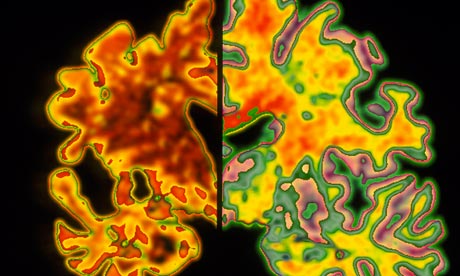
Brain with Alzheimer’s (left) vs. normal brain (right)

Fasting can help protect against brain diseases, scientists say

Researchers at the National Institute on Ageing in Baltimore said they had found evidence which shows that periods of stopping virtually all food intake for one or two days a week could protect the brain against some of the worst effects of Alzheimer’s, Parkinson’s and other ailments.

“Reducing your calorie intake could help your brain, but doing so by cutting your intake of food is not likely to be the best method of triggering this protection. It is likely to be better to go on intermittent bouts of fasting, in which you eat hardly anything at all, and then have periods when you eat as much as you want,” said Professor Mark Mattson, head of the institute’s laboratory of neurosciences.

“In other words, timing appears to be a crucial element to this process,” Mattson told the annual meeting of the American Association for the Advancement of Science in Vancouver.

Cutting daily food intake to around 500 calories – which amounts to little more than a few vegetables and some tea – for two days out of seven had clear beneficial effects in their studies, claimed Mattson, who is also professor of neuroscience at the Johns Hopkins University School of Medicine in Baltimore.

Okay, well this one is simple, if perhaps not truly easy. How hard would it be to go without eating (or eating an extremely small amount) one or two days a week?
Or let’s put the question another way — how hard would it be to try to live with Parkinson’s or Alzheimer’s?
Personally, I’m ready to try to do what it takes — even some “hard” things — to avoid them.

If you’re really serious about getting started with life extension, don’t miss Christine Peterson’s Personalized Life Extension Conference. Here’s our recent interview with Christine for those who missed it.

Cross-posted from Better All the Time.

Extend Your Life Now — Part 1

Healthy life extension is not something that we’re going to “discover” in the future. It is something we have been working towards for a long time and to which we are getting closer every day. Writing at PJ Media, Patrick Cox explains a major shift in thinking which has occurred in the past few years concerning the importance of Vitamin D, driven primarily by the work of Dr. Michael Holick, a professor of medicine, physiology and biophysics at the Boston University School of Medicine:

Optimal vitamin D serum blood levels, attained through sunlight or supplementation, dramatically reduce the risk of many diseases other than bone maladies. Many of the most serious are ameliorated by an astonishing 50 to 85 percent. These diseases include cancers, from breast and colon to deadly melanoma skin cancers.

The big killers and most expensive diseases respond similarly to adequate D. I’m talking about hypertension, cardiovascular disease, and stroke. So do type 1 diabetes, type 2 diabetes (to a lesser extent), rheumatoid arthritis, peripheral vascular disease, multiple sclerosis, dementia, autoimmune diseases, and apparently even viral diseases such as H1N1 and AIDS.

Want to live longer? Cut your chances of suffering from the afflictions listed above (and many others.) Make sure you’re getting enough Vitmain D.

Simple.

And if you’re really serious about getting started with life extensions, don’t miss Christine Peterson’s Personalized Life Extension Conference. Here’s our recent interview with Christine for those who missed it.

Listen to internet radio with The Speculist on Blog Talk Radio

I’m Just (Super) Sayin’

You have to see this video to believe it. And even then, it’s hard to be 100% sure it’s on the level.

Before he goes batshit crazy for the grueling final couple of minutes, I kind of sympathize with this kid. He’s a transhumanist, really; he just doesn’t understand that New Age crapola will never get him to where he wants to be. In the future, human beings will far surpass Super Saiyans. But you can’t get there by willing yourself there. You have to…do stuff.

BTW, according the Dragonball Wiki, even in that fictional universe a Saiyan can’t just will himself to Super Saiyan status out of desire. You have to NEED to become one.

The Headless Chicken Solution

In the not-too-distant future meat products will be grown in vats. Meat, fish, and poultry produced in this way will be much healthier than meat taken from slaughtered animals, and all the ethical concerns about humane farm conditions and animal suffering will be removed. These processes will also be much more environmentally sound than current methods used to raise animals for meat.

It will be a wonderful, life-improving technology. Unfortunately, most people are pretty grossed out by the idea. And it’s not hard to see why.

It sounds gross. Meat grown in vats? What is that, anyway? Yuck.

I wonder if the idea of meat growing on its own (ick) in vitro gives us an opportunity to know what our reaction to the idea of killing and eating animals would be if we had somehow never heard of that before. I think we would find the idea shocking and repulsive. (And I love meat.)

With all that in mind, I’m not too surprised by the general reaction to this story:
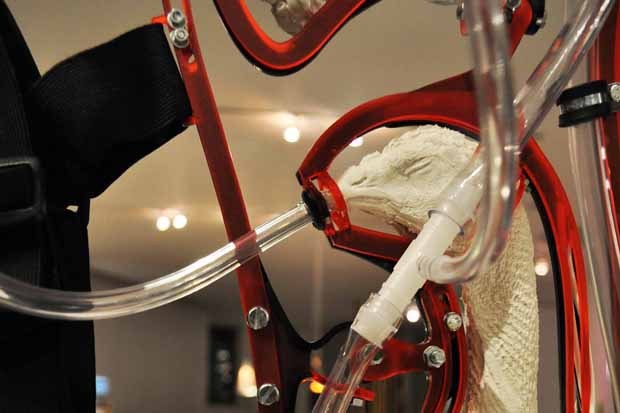
Food project proposes Matrix-style vertical chicken farms

Architecture student André Ford has proposed a new system for the mass production of chicken that removes the birds’ cerebral cortex so that they don’t experience the horrors of being packed together tightly in vertical farms.

Philosopher Paul Thompson from Purdue University has suggested ” The Blind Chicken Solution”. He argues that chickens blinded by “accident” have been developed into a strain of laboratory chickens that don’t mind being crowded together as much as normal chickens do. As a result, he argues, we should consider using blind chickens in food production as a solution to the problem of overcrowding in the poultry industry. He argues that it would be more humane to have blind chickens than ones that can see.

Ford goes a step further and proposes a “Headless Chicken Solution”. This would involve removing the cerebral cortex of the chicken to inhibit its sensory perceptions so that it could be produced in more densely-packed conditions without the associated distress. The brain stem for the chicken would be kept intact so that the homeostatic functions continue to operate, allowing it to grow.

Okay, we can all agree that both the description and the picture are kind of creepy.

Implementing such an approach would be a major step towards vat-grown chicken. If they were to develop a strain of chicken that lacks the neocortex to begin with, that would be even closer.

Closer, but not the same thing. This would still be a chicken, although a chicken modified to suffer less. But even with parts of its brain missing, there would still be arguments about what it is feeling, what it is experiencing, and so forth.

I find the comments on the linked story very interesting. A few snippets:

My sweet Lord -tell me this is an elaborate joke or a terrifying performance art project. If not then we are all truly doomed.

If we can just allow this kind of disgusting practice to go on…then where does it end?

Its [sic] times like these I feel ashamed to be the dominant species on this planet.

Well, here’s the deal, Sparky. Such an arrangement would actually represent a huge decrease in suffering as experienced by chickens raised for the sole purpose of being slaughtered. I don’t know what the quality of life is for any chicken — not from the inside, I mean  – but we can assume that some of the organic, free-range ones have it pretty good; others even in those categories, not so much. But the vast majority of chickens are treated in a manner we wouldn’t wish on any living creature. (Before I provide this link — you might not want to look at the pictures shown. Fair warning. Here’s the link.)

If André Ford’s idea seems gruesome and inhumane, it’s only because we have chosen not to deal with the gruesomeness and inhumanity of how these animals are currently treated.

Personally, I think it’s a good idea. A step in the right direction.