Monthly Archives: August 2006

This Day in History

Selected dates from the Wikipedia article, with a few key annotations.

1056 – Byzantine Empress Theodora dies suddenly without children to succeed the throne, ending the Macedonian dynasty.

1864 – American Civil War: Union forces led by General William T. Sherman launch an assault on Atlanta, Georgia.

1888 – Mary Ann Nichols is murdered. She is the first of Jack the Ripper’s known victims.

1920 – First news radio program broadcast in Detroit, Michigan.

1939 – Nazi Germany mounts a staged attack on Gleiwitz radio station, giving them an excuse to attack Poland the following day, starting World War II in Europe.

1957 – The Federation of Malaya gains its independence from the United Kingdom. Selamat Hari Merdaka!

1962 – Trinidad and Tobago become independent; blogger Phil Bowermaster born.

1980 – The Solidarity trade union is formed in Poland; blogger Phil Bowermaster celebrates 18th birthday

1992 – Pascal Lissouba is inaugurated as the President of the Republic of the Congo; blogger Phil Bowermaster turns 30.

1997 – Diana, Princess of Wales, dies in a car crash in Paris; blogger Phil Bowermaster gets the news while celebrating his 35th birthday in Port Dixon, Malaysia over the Merdaka Day weekend.

2006 – Stolen on August 22, 2004, Edvard Munch’s famous painting The Scream was recovered from a raid by Norwegian police. The paintings were said to be in a better-than-expected condition. Blogger Phil Bowermaster turns 44.

Real Time!

Interesting choice of words:

Supernova captured in ‘real time’

Astronomers say they have witnessed a stellar explosion – or supernova – unfolding in real time.

Supernovae occur when huge, mature stars effectively run out of fuel and collapse in on themselves.

Okay, they didn’t say “live.” It just so happens that this real-time event occured some 400 million years ago. But hey, on the galactic time scale anything less than a billion is pretty much a rounding error.

Anyhow, it’s great that scientists are getting to see this as it is happening / as it happened hundreds of millions of years ago. We can learn a lot about what really takes place when a star blows. This might be good information to have should this ever take place in the more immediate stellar vicinity. On the other hand, if a nearby star ever blows, the damage will already be done by the time we know about it.

Just like in this instance, come to think of it.

It's a New Phil, Week 34

The Big Six-Oh

Down one more pound this week to 237, bringing me (at long last) to a total weight loss of 60 pounds!!!

Amanda was kind enough to decorate her party hat with insignia appropriate to the occasion and to lend me a bear to model the hat for the celebratory photo shown here.

bearhat.jpg

Very nice, eh?

The next big milestone is 75 pounds. At the rate we’re going, that should be sometime between Halloween and Thanksgiving.

By the way, I know I’m a little remiss in getting this entry up, but I don’t want to fail to mention that there was an excellent Glenn and Helen Show last week on the subject of real food. I’ve become a huge fan of real food over the past eight months. Especially fruit. And tomatoes.(Technically, they’re fruit anyhow.) And Caesar’s salads. And that really chewy Italian bread they sell at Whole Foods — the kind that only has three or four ingredients. Now that’s real food.

Also, as a follow-up to the show, Glenn linked to this blog, The Crisper, where blogger Dave Johnston tells how he lost 51 pounds eating real food. Way to go, Dave!

It’s a New Phil, Week 34

The Big Six-Oh

Down one more pound this week to 237, bringing me (at long last) to a total weight loss of 60 pounds!!!

Amanda was kind enough to decorate her party hat with insignia appropriate to the occasion and to lend me a bear to model the hat for the celebratory photo shown here.

bearhat.jpg

Very nice, eh?

The next big milestone is 75 pounds. At the rate we’re going, that should be sometime between Halloween and Thanksgiving.

By the way, I know I’m a little remiss in getting this entry up, but I don’t want to fail to mention that there was an excellent Glenn and Helen Show last week on the subject of real food. I’ve become a huge fan of real food over the past eight months. Especially fruit. And tomatoes.(Technically, they’re fruit anyhow.) And Caesar’s salads. And that really chewy Italian bread they sell at Whole Foods — the kind that only has three or four ingredients. Now that’s real food.

Also, as a follow-up to the show, Glenn linked to this blog, The Crisper, where blogger Dave Johnston tells how he lost 51 pounds eating real food. Way to go, Dave!

Push or be Pulled

If you think about the space program – getting to the moon – the lunar space program was literally achieved using slide rules. It’s a technical achievement which shouldn’t have happened. It is incredible that they were able to do it… They did it 50-60 years ahead of when they should have been able to do it… The orbital tracking system that was up on the wall… it was updated with motors and gears – someone was back there checking to make sure it was in the right spot. That’s gearpunk. That isn’t a space program in a modern sense. That’s gears and slide rules and people doing the math… It was a political race, so it’s not that surprising that we had a lull after [achieving the Moon]. The goal and function of the program had been achieved. The political point was made.”

Sci-Fi author Tobias Buckell (March 20, 2006 Fast Forward Radio interview)

The science fiction subgenres of steampunk and gearpunk are set in alternate histories in which modern technological paradigms happen earlier, but are accomplished by way of the science available in that time period.

In “real life” inspiration often leads what should be possible. The transatlantic telegraph cable was laid in 1866. The U.S. Civil War had just finished and it would be another three years before the first U.S. transcontinental railroad would be completed, but from that year forward there has always been instantaneous communication between America and Europe. That was 50 years before the more obvious solution to transatlantic communication – radio – was able to broadcast across the ocean.

Other times it seems that we miss opportunities. Charles Babbage came close to delivering a Turing-complete computer in the mid-19th century – almost a century ahead of the 1943 arrival of the first working Turing-complete computer, ENIAC. It’s little wonder that steampunk is commonly set in an alternate history where Babbage was successful. Imagine where we’d be today if computer development were 100 years further along.

It seems likely that most breakthroughs arrive “right on time.” The Wright brother’s flight is a good example. Of course their achievement was remarkable. Internal combustion engines might have been developing nicely at the turn of the century, but there still wasn’t an engine with a sufficient power to weight ratio when they got started. So the Wright brothers took the best engines they could find and rebuilt and tinkered with them until they could coax just enough power out of the engine to make that first flight possible.

Meanwhile, there were other inventors working to be the first in the air. It’s even possible that there were other heavier-than-air flights before the Wright’s. With all this activity flying was destined to happen by 1903 – give or take a few years.

Phil once suggested that expectation has a lot to do with our advancement. If there is an expectation that something worthwhile is possible, we tend to work hard to make it happen. I agree. And if we’re moving slow, the problem could be a failure of imagination.

The idea that history has momentum but inspired individuals can make a difference also came up in our recent conversation with Dr. Aubrey de Grey. De Grey agreed that if life extension is possible it would come about eventually, even if he or any other single individual pursuing the goal stopped working. But, he quickly added, if his work helped advance the life extension timetable by even a little, then millions of lives that would otherwise be lost would be saved. That, he said, “strikes me as a worthy goal.” Indeed it is.

By the way, I think Tobias is exactly right about the 1969 Moon landing. It was accomplished about 50-60 years ahead of time. That would put us returning to the Moon, to stay, sometime between 2020 and 2030. That sounds about right.

Um, no

You would almost think this headline came from The Onion:

Pluto row could lead to Neptune losing planet status

RICHARD GRAY

SCIENCE CORRESPONDENT

THE solar system’s biggest planets are at risk of being stripped of their status after the world’s top astronomers voted to downgrade Pluto into the dwarf planet category.

Experts claim that the definition for planets adopted by the International Astronomical Union (IAU) could also see Neptune downgraded.

They say that both planets fail to meet all the criteria set by the IAU.

But other leading astronomers insist the decision to demote Pluto to the status of a “dwarf planet” has allowed them to deal with the difficult problem that there are several other Pluto-like objects orbiting our Sun.

I think that Science Correspondent Richard Gray needs to explain to the folks writing the headline that this is a rhetorical position that some astronomers are taking…

“Yeah, well if you apply those rules, then Neptune shouldn’t be a planet, either!”

They’re making a defense of calling Pluto a planet, not arguing to strip Neptune of its planetary status. No one is seriously doing that, and there is zero chance that it will happen.

Embryonic Stem Cell Debate Now Moot

Well, sort of. Idealogues can always find something to argue about, but for most of us the moral dilemma is over. Even the Bush administration called this a “step in the right direction.

Advanced Cell Technology researchers have announced that they can remove a single cell from an 8 cell embryo to create a new embryonic stem cell line. The remaining 7 cells can go on to form a perfectly healthy baby.

I understand that this research is an outgrowth of genetic testing. Fertility clinics have been taking a cell for genetic testing purposes for some time. If the tests showed that the embryo is healthy, it was implanted and grew into a healthy baby.

Now they can take that single cell, let it divide once, and use one cell for testing and the other to grow into a embryonic stem cell line that did not destroy an embryo.

It has been argued that since this does not benefit the baby, such procedures should not be allowed. Well, this is wrong. One might argue that genetic testing does not benefit the embryo. That’s part of the whole “wrongful life” can of worms. But nobody can seriously argue that it would not be a benefit to be born with a perfectly genetically matching embryonic stem cell line thriving at the doctor’s office.

And it’s not a small benefit to be born into a world that has an unlimited supply of embryonic lines for research.

Final Table

I played in an online poker tournament over the weekend. This is something I do from time to time. It isn’t gambling per se, because I only play the “free-roll” tournaments, which cost nothing to enter but which pay out (very small amounts of) real money to the winners. I also like to play the one-table “sit-and-go” tournaments, which also cost nothing, and which only pay out play money chips.

I have won several of the latter, but that’s not that big an accomplishment when you’re talking about a table with nine other players and the stakes are meaningless. People get bored. They like the action so they take stupid risks. With a little bit of patience (and luck — we’ll get to that part) I find that I can get to a pay-out position (1st, 2nd, or 3d place) at a sit-and-go table more than half the time. Probably two times out of three.

But the big multi-table tournaments are different. There are thousands of people entered, and real money is on the line. Again, not much — first prize is usually between $20 and $50, depending on the size of the tournament — but it makes a huge difference. Plus, the free-roll is almost always a qualifier for a real, paying tournament with a much more substantial prize. This means that the top 10-20 finishers will be entered into a later tournament where the other players have had to pay, say $10 to enter.

So the tournament started with 1650 tables with 10 players seated at each — 16,500 players at the beginning. I had an unusually good night and played for several hours. When I finally went out, my rank was 153. Of course, that’s still quite a ways from any prize money, but — modesty aside — it’s a lot closer to it than most of the players got. In fact, I ended up in the 99th percentile. Mathematically, that’s pretty much the same as finishing in first place at one of the sit-and-go’s, but it feels a lot different beating thousands of people — even though I was only personally up against a few dozen of them over the course of the evening — than it does beating nine.
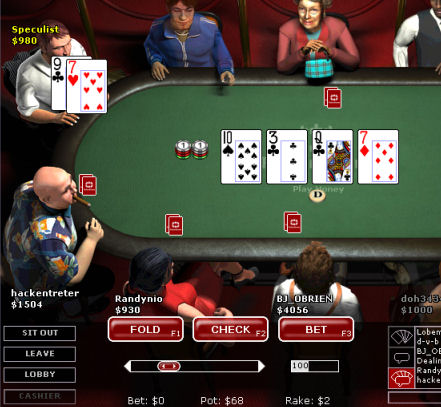
specpoker.jpg

My recent reading of Nassim Taleb’s Fooled By Randomness got me to thinking about the whole idea of poker strategy. In the book, Taleb shows how a population of bad traders — that is to say, traders whose strategy will consistently provide losses over the long term — will produce a few big winners over the course of a year thanks to the magic of random distribution. Moreover, a few of those winners will repeat their lucky results in successive years (even as the majority of the traders in this population drop out of the business) . A small subset of them will go on and have a great third year and an even smaller subset will have a successful fourth year.

By then, you’ve got a trader with a four-year winning record who doesn’t deserve it. He’s heading for a fall — remember, it’s a given that his strategy won’t pay out over the long term. So if you meet this trader who’s had a good four-year run, it’s very difficult to determine whether he’s some kind of ace or just the beneficiary of survival bias. This kind of puts the whole issue of success into a new light, doesn’t it?

Getting back to poker, you see the same basic two factors at work — skill and luck. I want to think that I finished up in the 99th percentile because of my Doyle Brunsonesque mastery of the game. But I did have this sense that I was catching some pretty good cards here and there throughout the night. And of course, the really skilled poker players are the ones who win hands even when their cards are not so hot.

Unlike Taleb’s example with the traders, everyone in the poker tournament is using his or her own strategy. So could the results of a poker tournament be used to check the validity of the different strategies? At the end of the night, you would have two different distributions — one showing who got the best cards and one showing who won the most chips. If the player who won the tournament also happened to be the one who got the best hands throughout the night, this doesn’t mean that he or she is not a skilled player. But it would be hard to make the case that skill had much to do with the win.

But what if the tournament winner ranked low — or even in the middle — of the overall deal? Say the winner of the tournament was ranked around 10,000th in terms of the value of cards received and overall hand situations faced — just kept getting 7-2 off suit and other trash hands all night. Wouldn’t this validate the player’s skill?

Actually, I’m not sure. It seems to me that you would need to look at the quality of cards received by all of the opponents our player faced with an eye to estimating how well each of them played. Logically, if our player was in the lower third of overall value of cards received, he or she must have faced many opponents with better hands and yet still came out on top. But was that because our player played skillfully or because those opponents played badly?

Obviously, I want to make the case that I’m some kind of poker wizard, but I’m having a hard time doing so.

Anyhow, the dynamics of poker strategy vs. the randomness of the cards coming off the deck puts me in mind of the evo-devo school of evolutionary thought, particularly where this is mapped to the question of the Singularity. Evo-devo talks about random evolutionary changes (cards coming off the deck) working towards certain developmental optima. In the case of a poker tournament, the developmental optima would be defined by advancing to the next level of play. Winning a hand is evolutionary; getting to the final table is developmental. Maybe winning the tournament is the Singularity.

Stephen wrote the other day about how we beat out the Neanderthals for the position of top human species on the planet. In the comments, I suggested that we might have beaten them out not because we’re better, but because they were nicer. Which would be kind of shame if that’s how it came down. If human evolution was a poker tournament, the final table had four players:

Homo sapiens
Homo neanderthalensis
Homo erectus
Homo heidelbergensis

Unfortunately, both Homo erectus Homo heidelbergensis were sitting on the short stack and pretty soon it was a head to head match between us and the neanderthals.

And we won. Does that mean that we are a better model of human, or did we somehow manage to suck out on the river in the final showdown? Stephen’s entry talked about some evolutionary adaptations that didn’t work out so well for the neanderthals. Did we get better cards than they did? Are we the pinnacle of evolution, or are we like one of Taleb’s lucky traders?

It would seem that I can no more answer that than I can say whether my performance in the poker tournament indicates that I am an unusually good player.

But these are important questions, because we may be well into yet another tournament where the final table ends up looking something like this:

Homo sapiens (or MOSHes, if you prefer)
Human / AI hybrids
“Pure” AI, Friendly
“Pure” AI, Unfriendly

Now who’s sitting on the short stack? One of the nasty things about the previous final table that Homo sapiens had a seat at was that being eliminated from the game meant being eliminated from existence altogether. That may not be the case in this round. But if the unfriendly AI is a better poker player — or catches better cards than the other power players at the table — we may end up like the neanderthals. The friendly AI may be more intelligent, may be nicer (as I commented earlier, niceness might not help all that much; it certainly doesn’t in poker), may be superior in every way we can imagine, and still might lose.

I think it’s better that we avoid the final table scenario altogether.

Your World Frightens Me

I caught The Science Channel’s special “Neanderthal: The Rebirth” last night. With that title I was hoping the show would touch on the possibility of resurrecting Neanderthal – at least virtually – with recovered DNA. They didn’t go there.

Instead, the special showcased the heroic efforts to piece together a full Neanderthal skeleton and what that skeleton reveals about the great Neanderthal mystery – why are they gone while we remain?

Neanderthals were very stong. Muscle attachment points on the upper arm were much more obvious than seen in modern humans. They were short and squatty and possessed no waist to speak of. Their hands were stronger. A Neanderthal pinky, for example, is nearly as big and powerful as his other fingers. These adaptations helped Neanderthal perform well with up-close hunting using heavy hand spears in thick forests. It also protected him against the cold.

Other reconstruction work showed that Neaderthal had a bigger brain than modern people and, more importantly, a fully developed neocortex. Voice box reconstruction showed that Neanderthal could have talked – but, interestingly, with a higher pitched voice. I imagine their voices sounded rather nasal too.

The bones in the inner ear showed that Neanderthal was not adapted to be as agile as modern humans. A universal rule about agility across all species is that the more acrobatic a species, the larger the space between the bones of the inner ear. Neanderthal inner ear bones indicate that Neanderthal was less agile than even more primitive hominids. Modern humans are more agile than either Neanderthal or other forerunners.

Lastly the show emphasized the changing climate at the time of the Neanderthal extinction. It had been cold for thousands of years. It remained cold, but grew much dryer. The forests that the Neanderthals were adapted to hunt were replaced by open plains.

Modern humans were better suited to hunt these open plains because they were better adapted to run. They also, according to the program, possessed a spear launching technology called atlatl. This basically gave modern humans the leverage of another arm’s length when throwing their light throwing spears.

atlatl-man-lg.jpg

The awkwardness with which the show dealt with the issue of Neanderthal intelligence was humorous. It was almost as if they were afraid of actually living out those GEICO commercials. Even though Neanderthal had a large brain and a voice box, it seems likely that there were cognitive and/or communicative differences. Intelligence and language has allowed modern humans to be flexible enough to adapt to almost all climates. Had Neanderthal been as flexible, those short, squatty guys might be running GEICO. Instead, it appears that even the atlati technology was beyond them.

“Neanderthal: The Rebirth” made a good case that direct confrontation between the two human species would have been unnecessary to cause Neanderthal’s extinction. Neanderthal’s more muscular body required more calories – not an advantage during a famine. His adaptation to up-close hunting meant that his range shrank as the forests died back. This would have shrank and fragmented the Neanderthal population. Extinction was inevitable.

Still, its a uniquely human trait to function beyond our physical adaptations or limitations. Neanderthal must have been doomed by a lessor ability to adapt to a changing environment.

Extreme Measures

FuturePundit Randall Parker outlines Brazil’s successful ethanol program, which has now replaced an impressive 40% of the gasoline consumed in the country. Unfortunately, he goes completely off the rails when he gets on the subject of trade barriers that prevent Brazilian ethanol from being imported into the US:

I feel compelled to digress again into trade politics but only because I have a really great idea for Brazil. My advice to the Brazilians: Stop letting any of your models come to the US and pose in Victoria’s Secret catalogs until the US government agrees to let in Brazilian sugar and sugar cane ethanol. American citizens might tolerate having to pay more for Breyers than Dreyers in order to get sugar rather than corn syrup as ice cream flavoring. But American men will only find the backbone they need to stand up to the corn farmers and ADM when they find out that the farmers are preventing them from looking at Gisele Bündchen, Michelle Alves, Shirley Mallmann, Isabeli Fontana, Fernanda Tavares, and Ana Beatriz Barros.

Whoah, whoah, whoah…slow down there, son. Take a breath. Let’s not do anything rash, okay? I mean, come on.

It’s just ethanol.

Where is your sense of proportion?

UPDATE: I replicated Randall’s links without checking on whether they were completely work / kid safe. I think they’re pretty much okay. I mean, anybody who doesn’t approve of that Gisele Bündchen photo must just hate art or horses or something.

UPDATE II: Looks like they swap those photos out every now and then, so never mind about the horses.