I played in an online poker tournament over the weekend. This is something I do from time to time. It isn’t gambling per se, because I only play the “free-roll” tournaments, which cost nothing to enter but which pay out (very small amounts of) real money to the winners. I also like to play the one-table “sit-and-go” tournaments, which also cost nothing, and which only pay out play money chips.
I have won several of the latter, but that’s not that big an accomplishment when you’re talking about a table with nine other players and the stakes are meaningless. People get bored. They like the action so they take stupid risks. With a little bit of patience (and luck — we’ll get to that part) I find that I can get to a pay-out position (1st, 2nd, or 3d place) at a sit-and-go table more than half the time. Probably two times out of three.
But the big multi-table tournaments are different. There are thousands of people entered, and real money is on the line. Again, not much — first prize is usually between $20 and $50, depending on the size of the tournament — but it makes a huge difference. Plus, the free-roll is almost always a qualifier for a real, paying tournament with a much more substantial prize. This means that the top 10-20 finishers will be entered into a later tournament where the other players have had to pay, say $10 to enter.
So the tournament started with 1650 tables with 10 players seated at each — 16,500 players at the beginning. I had an unusually good night and played for several hours. When I finally went out, my rank was 153. Of course, that’s still quite a ways from any prize money, but — modesty aside — it’s a lot closer to it than most of the players got. In fact, I ended up in the 99th percentile. Mathematically, that’s pretty much the same as finishing in first place at one of the sit-and-go’s, but it feels a lot different beating thousands of people — even though I was only personally up against a few dozen of them over the course of the evening — than it does beating nine.
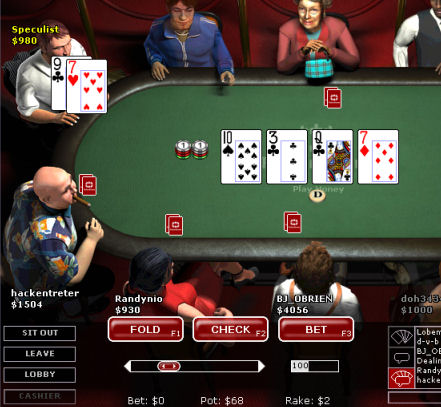
My recent reading of Nassim Taleb’s Fooled By Randomness got me to thinking about the whole idea of poker strategy. In the book, Taleb shows how a population of bad traders — that is to say, traders whose strategy will consistently provide losses over the long term — will produce a few big winners over the course of a year thanks to the magic of random distribution. Moreover, a few of those winners will repeat their lucky results in successive years (even as the majority of the traders in this population drop out of the business) . A small subset of them will go on and have a great third year and an even smaller subset will have a successful fourth year.
By then, you’ve got a trader with a four-year winning record who doesn’t deserve it. He’s heading for a fall — remember, it’s a given that his strategy won’t pay out over the long term. So if you meet this trader who’s had a good four-year run, it’s very difficult to determine whether he’s some kind of ace or just the beneficiary of survival bias. This kind of puts the whole issue of success into a new light, doesn’t it?
Getting back to poker, you see the same basic two factors at work — skill and luck. I want to think that I finished up in the 99th percentile because of my Doyle Brunsonesque mastery of the game. But I did have this sense that I was catching some pretty good cards here and there throughout the night. And of course, the really skilled poker players are the ones who win hands even when their cards are not so hot.
Unlike Taleb’s example with the traders, everyone in the poker tournament is using his or her own strategy. So could the results of a poker tournament be used to check the validity of the different strategies? At the end of the night, you would have two different distributions — one showing who got the best cards and one showing who won the most chips. If the player who won the tournament also happened to be the one who got the best hands throughout the night, this doesn’t mean that he or she is not a skilled player. But it would be hard to make the case that skill had much to do with the win.
But what if the tournament winner ranked low — or even in the middle — of the overall deal? Say the winner of the tournament was ranked around 10,000th in terms of the value of cards received and overall hand situations faced — just kept getting 7-2 off suit and other trash hands all night. Wouldn’t this validate the player’s skill?
Actually, I’m not sure. It seems to me that you would need to look at the quality of cards received by all of the opponents our player faced with an eye to estimating how well each of them played. Logically, if our player was in the lower third of overall value of cards received, he or she must have faced many opponents with better hands and yet still came out on top. But was that because our player played skillfully or because those opponents played badly?
Obviously, I want to make the case that I’m some kind of poker wizard, but I’m having a hard time doing so.
Anyhow, the dynamics of poker strategy vs. the randomness of the cards coming off the deck puts me in mind of the evo-devo school of evolutionary thought, particularly where this is mapped to the question of the Singularity. Evo-devo talks about random evolutionary changes (cards coming off the deck) working towards certain developmental optima. In the case of a poker tournament, the developmental optima would be defined by advancing to the next level of play. Winning a hand is evolutionary; getting to the final table is developmental. Maybe winning the tournament is the Singularity.
Stephen wrote the other day about how we beat out the Neanderthals for the position of top human species on the planet. In the comments, I suggested that we might have beaten them out not because we’re better, but because they were nicer. Which would be kind of shame if that’s how it came down. If human evolution was a poker tournament, the final table had four players:
Homo sapiens
Homo neanderthalensis
Homo erectus
Homo heidelbergensis
Unfortunately, both Homo erectus Homo heidelbergensis were sitting on the short stack and pretty soon it was a head to head match between us and the neanderthals.
And we won. Does that mean that we are a better model of human, or did we somehow manage to suck out on the river in the final showdown? Stephen’s entry talked about some evolutionary adaptations that didn’t work out so well for the neanderthals. Did we get better cards than they did? Are we the pinnacle of evolution, or are we like one of Taleb’s lucky traders?
It would seem that I can no more answer that than I can say whether my performance in the poker tournament indicates that I am an unusually good player.
But these are important questions, because we may be well into yet another tournament where the final table ends up looking something like this:
Homo sapiens (or MOSHes, if you prefer)
Human / AI hybrids
“Pure” AI, Friendly
“Pure” AI, Unfriendly
Now who’s sitting on the short stack? One of the nasty things about the previous final table that Homo sapiens had a seat at was that being eliminated from the game meant being eliminated from existence altogether. That may not be the case in this round. But if the unfriendly AI is a better poker player — or catches better cards than the other power players at the table — we may end up like the neanderthals. The friendly AI may be more intelligent, may be nicer (as I commented earlier, niceness might not help all that much; it certainly doesn’t in poker), may be superior in every way we can imagine, and still might lose.
I think it’s better that we avoid the final table scenario altogether.