Monthly Archives: February 2005

It’s Personal

Note: Stephen suggested that my comments
on his follow-up
to my entry about
Human Savants
would make for a good posting in their own right. What the
hey, who am I to disagree with Stephen?

I like the idea of being able to switch back and forth. There’s a scene in
Star
Trek: First Contact
where Data and Picard are about to face down the Borg
for the first time. Data begins to observe his emotions and realizes that he’s
terrified. So he announces that he’s going to "turn off his emotion chip."
Picard tells Data that he envies him sometimes.

The good side of being able to switch back and forth between normal social
interaction and enhanced — or maybe it’s better to say modified — modes of
mental operation is that we would be more functional in some areas and we woldn’t
be distracted by things that normally get in the way.

I wrote a while back that being able to get "in the zone" like that
could prove helpful to sales people. A sales rep who can bump up her ability
to speak and to think on her feet, and tone down her fear of rejection, is going
to have a substantial advantage over the competition. The downside, of course,
is that it could also prove quite helpful to criminals and/or government officials.
How much easier it would be to commit appalling acts of violence if you can
just switch off your capacity to be appalled. Or maybe closer to the lives of
everyday people — think how much easier it would be to dump somebody.

Yikes.

Life on Mars

Here’s some pretty big news that is being largely overlooked (so far) by the MSM:

A pair of NASA scientists told a group of space officials at a private meeting here Sunday that they have found strong evidence that life may exist today on Mars, hidden away in caves and sustained by pockets of water.

The two scientists, according to sources at the Sunday meeting, based their case in part on Mars’ fluctuating methane signatures that could be a sign of an active underground biosphere and nearby surface concentrations of the sulfate jarosite, a mineral salt found on Earth in hot springs and other acidic bodies of water….

Okay, granted, it’s not a six-limbed furry creature or the ruins of some ancient temple. It’s methane signatures potenitally indicative of microbes. Big deal.

Well, yeah. It is a big deal.

If, like me, you suspect that there is probably life elsewhere in the universe, what does it say about how abundant life may be if we just happen to find some on, oh, you know…the next planet over? Maybe it’s just a coincidence. Or maybe it’s not that big a deal because both Earth and Mars are in the orbital sweet spot for life in this solar system.

Doesn’t matter. It’s a big deal. If this pans out, we now know of life on twice as many planets as we did before. And we shouldn’t go dissing microbes. The individual cells that make up our complex, sophisticated bodies owe quite a bit to single-celled organisms. In fact, it’s what they used to be. Finding microbes on one planet pegs the odds of eventually finding wookies — or some such — elsewhere much, much higher.

Granted, there’s a tendency to be a little twice shy about this whole “life on Mars” thing. Actually, we may even be thrice shy. Seems like the first scoop of soil that the Viking lander analyzed just about proved that there was life on Mars. Followed by some major backpedaling. Then there was that Martian meteor with fossils in it a few years ago. Yup, more backpedaling.

Maybe the MSM is playing it safe. No harm in being cautious, I suppose. After all, if they ignore it, they’re just missing out on the single biggest news story of all time. Still, rather than running huge headlines declaring that life has definitely been found on Mars, couldn’t they at least just mention that the issue is being revisited?

But there could be more than just caution at work, here. After all, both J. Lo and Michael Jackson are sick. How much bandwidth is the MSM supposed to have?

All I can say to that is: thank God for GeekPress. Not to mention InstaPundit! Thanks for the link, Glenn.

Stillness Part VI, Chapter 61

Jerry positioned himself directly behind the stranger. He crossed his arms and planted his feet firmly in place. I’d seen this pose a few times before — our little roadside diner wasn’t immune to the occasional troublemaker. I knew from past experience that Jerry was prepared to act more quickly and decisively then many would give him credit for. And I’d never seen anyone tangle with him who didn’t regret it almost immediately.

But I wasn’t so sure about this one.

“I think it’s time for you to leave,” said Jerry.

The stranger spun around on his stool.

“No, it is not that time all,” he said. “As I indicated, it is time for a choice to be made. I will select one from three. You will not be the one.”

“Look, Mister, the only choice you have to make is whether you leave under your own power or you get thrown out. Now which is it going to be?”

For a moment it looked as though the stranger was going to say something, but he didn’t. He spun around on his stool and, ignoring both Sybil and myself, began to study the back counter and wall. Apparently seeing what he was looking for, he gave Jerry a dismissive mechanical wave without even glancing his way. Jerry turned and walked back to the far end of the counter. He then stepped behind it, and took a position approximately where the stranger had been looking. He did not look at Sybil. He drew a large carving knife from the rack next to the cutting board and then walked once again out from behind the counter and took a seat across from me at my booth.

He didn’t look at me. His attention was focused solely on the knife. He gripped the handle firmly with both hands—its point was just below his chin, aimed directly at his own throat.

Human Savants

The Guardian presents a fascinating look into the mind of the autistic savant:

Last year Tammet broke the European record for recalling pi, the mathematical constant, to the furthest decimal point. He found it easy, he says, because he didn’t even have to “think”. To him, pi isn’t an abstract set of digits; it’s a visual story, a film projected in front of his eyes. He learnt the number forwards and backwards and, last year, spent five hours recalling it in front of an adjudicator. He wanted to prove a point. “I memorised pi to 22,514 decimal places, and I am technically disabled. I just wanted to show people that disability needn’t get in the way.”

Daniel Tammet stands out from other autistic savants because of his ability to describe what’s going on inside his mind. Professor Allan Snyder of the Centre for the Mind at the Australian National University in Canberra theorizes that all human beings have the capacity to perform the kinds of mental feats associated with autistic savants. Savants are able to access these capabilities as a form of compensation for damage or malfunction elsewhere in the brain.

Stillness, Part VI Chapter 60

Ksenia stood up. She crossed the room to stand by the fire.

"I see," she said. "The government of the United States believes
that the world is ending. And the two of you share in that belief?"

"Well, yes and no," said Keyes, looking to Sergei. "I mean,
I don’t think we’re either one convinced that it’s really the end
of the world. I shouldn’t have used that phrase. It’s needlessly melodramatic."

"And it lacks precision," Sergei agreed. "Perhaps it is more
accurate to say that world that we know will come to end. But that has happened
before, has it not, Ksenia Ivanova?"

Well, Here's a Pretty Good Use

On the question of what practical use brown dwarves (dwarfs?) could serve, here’s an unexpected answer: suns. Or at least hubs of planetary systems:

The construction site of a miniature solar system has been spotted but, unusually, its central star is a tiny brown dwarf. The star is so small it could be mistaken for a giant planet and it is surrounded by a disc of material chunky enough to form several planets the size of Earth or Mars.

There’s more. And here’s the really cool part:

What is more, these would-be planets could be habitable. The surface temperature of the mini brown dwarf is about 2000°C, which means that any planet 1.5 to 7 million kilometres away could maintain liquid water. The disc probably straddles this range.

So there could be warm, wet planets orbiting brown dwarves. And if there are, in fact, a lot of brown dwarves out there, they might be a good place to start looking for Earth-like planets.

But wouldn’t they be awfully dark?

Well, Here’s a Pretty Good Use

On the question of what practical use brown dwarves (dwarfs?) could serve, here’s an unexpected answer: suns. Or at least hubs of planetary systems:

The construction site of a miniature solar system has been spotted but, unusually, its central star is a tiny brown dwarf. The star is so small it could be mistaken for a giant planet and it is surrounded by a disc of material chunky enough to form several planets the size of Earth or Mars.

There’s more. And here’s the really cool part:

What is more, these would-be planets could be habitable. The surface temperature of the mini brown dwarf is about 2000°C, which means that any planet 1.5 to 7 million kilometres away could maintain liquid water. The disc probably straddles this range.

So there could be warm, wet planets orbiting brown dwarves. And if there are, in fact, a lot of brown dwarves out there, they might be a good place to start looking for Earth-like planets.

But wouldn’t they be awfully dark?

Exploring the Development Space

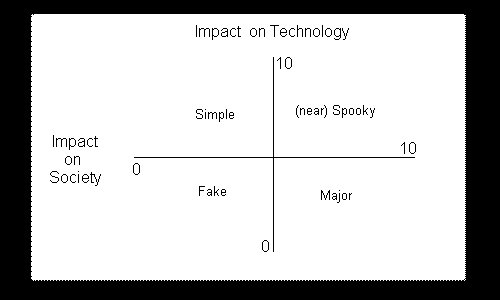
Over a year ago Phil posted “Mapping The Development Space.” Phil’s post took four categories of possible nanotech developments (as conceived, I believe, by Glenn Reynolds) and put them on a grid:

Nspace0.jpg

These four categories are:

  1. Fake (where it’s basically a marketing term, as with nanopants);

  2. Simple: high-strength materials, sensors, coatings, etc — things that are important, but not sexy;
  3. Major: advanced devices short of true assemblers;
  4. Spooky: assemblers and related technology (true Molecular Nanotechnology).

At the time that post was written (waaay back in December of 2003) neither Glenn nor Phil believed any nanotech developments fell outside the “fake” quadrant.

We may have just entered a new quadrant.

Self-assembled nano-sized probes allow Penn researchers to see tumors through flesh and skin

PHILADELPHIA – Nano-sized particles embedded with bright, light-emitting molecules have enabled researchers to visualize a tumor more than one centimeter below the skin surface [in rats] using only infrared light…

“We have shown that the dispersion of thousands of brightly emissive multi-porphyrin fluorophores within the polymersome membrane can be used to optically image tissue structures deep below the skin – with the potential to go even deeper,” said Michael J. Therien, a professor of chemistry at Penn State. “It should also be possible to use an emissive polymersome vesicle to transport therapeutics directly to a tumor, enabling us to actually see if chemotherapy is really going to its intended target.”

…Polymersomes function much like the bilayered membranes of living cells. Whereas cell membranes are created from a double layer of fatty phospholipid chains, a polymersome is comprised of two layers of synthetic co-polymers. Like a living cell, the polymersome membrane has a hydrophobic core. The study shows that the fluorophores evenly disperse within this core, giving rise to a nanometer-sized light-emitting structure.

Another feature that makes emissive polymersomes so useful is that they self-assemble. Simply mixing together all component parts gives rise to these functional nanometer-sized, cell-like vesicles.”

via KurzweilAI

This development involves self-assembled nano-sized structures that emit light. AND scientists “can use these [structures] to target markers on the surface of a specific type of tumor cells” so that they can see the tumor. AND these researchers are hopeful that this same nano-structure will also be useful in delivering chemotherapy.

While there is room for debate over whether this qualifies as “simple” or “major” nanotech (it isn’t quite spooky), this development is much more than “fake” nanotech.

They Used to Call this "Wisdom"

FuturePundit reports:

The long-held belief that older people perform slower and worse than younger people has been proven wrong. In a study published today in Neuron, psychologists from McMaster University discovered that the ageing process actually improves certain abilities: Older people appear to be better and faster at grasping the big picture than their younger counterparts.

In this study, wisdom takes the form of high-contrast pattern recognition. The results lead Randall Parker to pose an intriguing question: is this an aspect of aging that we would want to reverse?

They Used to Call this “Wisdom”

FuturePundit reports:

The long-held belief that older people perform slower and worse than younger people has been proven wrong. In a study published today in Neuron, psychologists from McMaster University discovered that the ageing process actually improves certain abilities: Older people appear to be better and faster at grasping the big picture than their younger counterparts.

In this study, wisdom takes the form of high-contrast pattern recognition. The results lead Randall Parker to pose an intriguing question: is this an aspect of aging that we would want to reverse?