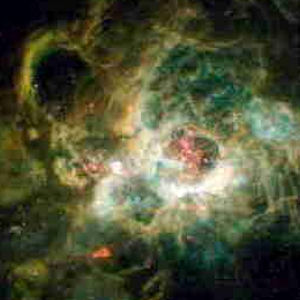
 Years ago I remember reading a book by Isaac Asimov (one of his many collections of essays) in which — if I recall correctly — he provided answers to questions that he had never addressed before, or that wouldn’t have been a good fit for any of his other books. One of these questions was, “What lies beyond the universe?”
Asimov’s glib initial response was “non-universe.” He then spent some time talking about what non-universe might be. Whatever it is, one would think that it would also be the correct answer to the question, “What came before the universe?”
But maybe not:
Before the Big Bang: A Twin Universe?
Until very recently, asking what happened at or before the Big Bang was considered by physicists to be a religious question. General relativity theory just doesn’t go there – at T=0, it spews out zeros, infinities, and errors – and so the question didn’t make sense from a scientific view.But in the past few years, a new theory called Loop Quantum Gravity (LQG) has emerged. The theory suggests the possibility of a “quantum bounce,†where our universe stems from the collapse of a previous universe. Yet what that previous universe looked like was still beyond answering.
Now, physicists Alejandro Corichi from Universidad Nacional Autónoma de México and Parampreet Singh from the Perimeter Institute for Theoretical Physics in Ontario have developed a simplified LQG model that gives an intriguing answer: a pre-Big Bang universe might have looked a lot like ours. Their study will appear in an upcoming issue of Physical Review Letters.
“The significance of this concept is that it answers what happened to the universe before the Big Bang,†Singh told PhysOrg.com. “It has remained a mystery, for models that could resolve the Big Bang singularity, whether it is a quantum foam or a classical space-time on the other side. For instance, if it were a quantum foam, we could not speak about a space-time, a notion of time, etc. Our study shows that the universe on the other side is very classical as ours.â€
So if a pre-Big Bang universe looked a lot like ours, does it follow that our universe looks a lot like a pre-Big Bang universe? Remember the old computer programming joke that goes…
__AM I IN A LOOP?
__AM I IN A LOOP?
__AM I IN A LOOP?
__AM I IN A LOOP?
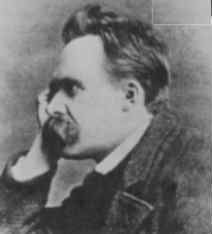 The idea that our universe sprang from one much like it puts me in mind of Friedrich Nietzsche’s idea of eternal recurrence. Corichi and Singh talk in terms of our universe being a lot like the one that came before it, but nothing I read above rules out the possibility that this universe is a dead ringer for its ancestor. If that were the case, if the current universe were an exact copy of the one that came before, it would only be reasonable to expect that the next one will also be exactly the same. Or as Nietzsche put it:
This life as you now live it and have lived it, you will have to live once more and innumerable times more; and there will be nothing new in it, but every pain and every joy and every thought and sigh and everything immeasurably small or great in your life must return to you-all in the same succession and sequence-even this spider and this moonlight between the trees, and even this moment and I myself. The eternal hourglass of existence is turned over and over, and you with it, a grain of dust.
How many times have you read this blog post? How many times have I typed it? Is it possible we have each done these things a dozen or a hundred or a billion times, and that we will continue doing so for all eternity?
Also — and this is the part that makes my head twinge just a bit — if it is exactly the same thing occurring over and over and over and over…exactly the same…does it really make sense to talk in terms of the number of times it happens? Is one instance of the universe somehow different from an infinite repeating series of the same universe? How? And to what observer?
UPDATE: Michael Darling directs us to this talk by Stephen Hawking, in which he asserts that the universe could have spontaneously created itself out of nothing. As far as satisfactory explanations go, this one has to be the bottom of the barrel. Which doesn’t mean it’s wrong, of course.