 Saw this headline on Kurzweil this morning:
The world’s first 3D-printed gun is a terrifying thing
(The full story is here.)
Are printable guns “terrifying?” At first glance, I would have to say no. At least not based on the fact that they are printed out. There are millions of guns out there and I am not particularly frightened by any of them. Not right now, anyway. And certainly not based on where they came from. The gun that scares me is the loaded one that some hostile / insane person chooses to aim at me or one of my loved ones. If and when that ever happens, the question of how that individual acquired the firearm will be of little importance to me.
Bought it legally after undergoing appropriate background checks? I don’t care.
Bought in on the black market or directly stole it from someone else? I don’t care.
Printed it out in a home workshop? I don’t care.
I don’t care about any of that. I care about whether I (or somebody I care about) is about to get shot.
What’s supposedly “scary” about a printed gun is that now anybody can get a gun. Right. Look, I wish there was some delicate way of explaining this to people who haven’t grasped it yet, but ladies and gentlemen, ANYBODY WHO REALLY WANTS ONE CAN GET A GUN NOW.
Let’s say we had a consitutional convention that spit out a sleek new bill of rights with no second amendment. The next week, congress passes a law banning the manufacture and sale of all firearms save those going to the military and police. Nobody can make a gun; nobody can sell a gun; nobody can buy a gun.
Hooray! We’re all safe at last!
Well, we’re all “safe” except for the millions of guns that already exist. Even if our new government then went on the biggest Round Up the Guns campaign the world has ever seen, there would still be lots and lots of guns out there. And anybody who wanted one, really wanted one, would still be able to get his hands on one.
But suppose that wasn’t the case. Suppose you really could create a situation where nobody, and I mean nobody, could get his hands on a firearm. Would we be safe? I think it’s important to remember that Tim McVeigh didn’t use a gun and that the Columbine shooters were also bomb-makers. In fact, had those two monsters not been distracted by the glamour of preparing for their shooting rampage, they might have put a little more care and effort into their bomb-making — in which case the death toll at Columbine would have been an order of magnitude higher than it was.
I guess some people truly believe that the unavailability of firearms would have prevented that whack job in Aurora from trying to kill as many people as possible last week. I doubt it.
Guns have becoming totemized in our society; we have something like a cargo cult around them. It’s an unusual cult because it comprises both pro-gun and anti-gun devotees. All of the cult members agree that guns are vastly important, if not magical objects.
But they aren’t.
Guns are inanimate objects with no inherent moral character and no mystical properties. They are machines; they are pieces of technology.
And here’s the thing about technology. It is rapidly evolving. What’s potentially “scary” about a printed gun is the recognition that technology is providing more and more capability to individuals, and it is doing so at a faster and faster pace. So our computers, which let us make our own music and edit our own movies, will soon let us make any physical object. One whole class of objects is projectile-firing weapons. People will be able to make those, along with the projectiles, in the privacy of their garages or basements.
Scary? If you say so. But not half as scary as the recognition that people will be able to make a lot of other lethal and destructive objects that bear little or no resemblance to weapons that fire projectiles. Guns represent just one of many ways to kill people, and perhaps a rather quaint and ineffectual one at that. We may soon regret our current obsessive focus on guns — or even less importantly, where they come from — as the major issue. This represents a real failure of imagination.
Our imaginations are in for a jolt when some truly innovative lethal gizmos begin to be produced in home workshops. Guns might finally lose their mystical hold on us, with 3D printers supplanting them as either evil incarnate or the last best defense of individual rights — take your pick.
But it’s important to keep in mind that not all new capability is destructive. In fact, most of it isn’t. The vast majority of effort expended by humanity is towards constructive ends. When we increase our capability, most of us (most of the time) are endeavoring to become more capable of doing good things. Yes, technology enables Moore’s Law for Mad Scientists, but it also enables our rapid ascent to SIBwS status. We can expect 3D printers, the hacker ethic, the maker movement, and eventually nanotechnology to provide new and unexpected ways to defend ourselves.
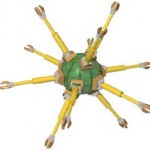
Personally, I’m looking forward to having a utility fog swarm accompany me wherever I go:
Nanotechnology is based on the concept of tiny, self-replicating robots. The Utility Fog is a very simple extension of the idea: Suppose, instead of building the object you want atom by atom, the tiny robots linked their arms together to form a solid mass in the shape of the object you wanted?
Going back to the scenario I mentioned earlier wherein a hostile has aimed a loaded gun at me, my swarm would be able to detect that situation and neutralize it in any number of ways. Of course, in a world with utility fog there would be many, many more threatening situations than exist today. But also many more remedies than exist today. A bad guy with swarm version 3.x would have a huge advantage over a potential victim with version 2.9. So we will potentially see a technological arms race that makes today’s virus and malware wars look like nothing. But keep in mind, an attacker taking on a large group of people would need to be able to neutralize everybody’s personalized defenses at the same time — which becomes an exponentially taller order as more people “arm” themselves with nano swarms, and the increasingly intelligent foglets develop increasingly hard-to-predict patterns of behavior.
But wait, will we all need concealed carry permits in order to use utility fog? Will their be a mandatory waiting period when buying a 3D printer?
What if the “hostile” who has a gun aimed at me is actually a police officer?
And, of course, what happens when bad-guy utility fog goes rogue and begins recursively increasing its capability until it is a threat to all humanity?
The answers are:
Probably.
Um, that’s an interesting situation you’ve gotten yourself into.
And well, that’s the reason we need somebody who wants to make nice, recursively improving utility fog to get a first-mover advantage.
These are going to be the points of debate in the near future. It will be interesting to see whether gun-rights proponents or gun-control advocates will be able to see past their current current obsession with conventional firearms and start framing the debate around this larger picture. Once again, there will probably be a distinct first-mover advantage for whichever group figures this out first.

 Writing in


 Jim Elvidge is a Cornell-educated entrepreneur and inventor who holds four patents in digital signal processing. His love of music inspired him to develop one of the first PC-based digital music samplers and to co-found RadioAMP, which was the first private-label online streaming radio company. In recent years he has turned his attention to the ultimate question of existence and, drawing on a broad and eclectic base of knowledge and interests, has come up with a unique explanation for…pretty much everything.
 Giulio Prisco is a writer, technology expert, futurist, cosmist, and transhumanist. A former manager in European science and technology centers, he writes and speaks on a wide range of topics, including science, information technology, emerging technologies, virtual worlds, space exploration and future studies. He is especially interested in the convergence of science, religion, technology, and spirituality. Prisco is a former senior manager in the European space administration. He currently serves on the Board of Directors of the Institute for Ethics and Emerging Technologies and the Italian Transhumanist Association.

 Stewart Hendler is a theatrical film director who recently helmed two hotly-anticipated projects in the groundbreaking world of digital entertainment, both of which launch this year.
 John Cabrera is an actor, writer, and producer. His many film and TV appearances include the role of Brian Fuller on Gillmore Girls. He has made a number of short films and not long ago wrote and directed a teen musical. He is a co-creator of H+ the Digital Series and one of the writers for the show as well.