Phil and Stephen demonstrate that the future we’ve been looking for just might be happening right now.

Also on FastForward Radio:
Archived Show
First Aired April 6, 2008
Saturday May 29
8:00 PM PDT / 11:00 PM EDT

Phil and Stephen demonstrate that the future we’ve been looking for just might be happening right now.
Also on FastForward Radio:
Archived Show
First Aired April 6, 2008
This makes me want to rethink the whole geek vs. nerd thing.
There’s nothing wrong with being a nerd. In fact, it can be fun!
The Internet is fundamentally transforming education. Games are fundamentally transforming…everything. Are we heading for a future that’s all about learning and playing? If so, is that a good thing? Phil and Stephen discuss…
Here’s the piece on how the Internet is revolutionizing education.
Also on FastForward Radio:
Watermelons exploding all over China.
Jane McGonical believes that the solutions to the world’s problems can be found in upping the amount of game-playing going on worldwide by a factor of seven.
She makes a surprisingly persuasive argument
In a recent email exchange with a friend, I set out some of the reasons that, while I am not apolitical, I am less interested in politics as a means to achieving sweeping change than I am other channels, which I believe are more promising. Here’s part of that message:
I used to be very political…back when I was your age.
I still advocate massive change but I see it primarily coming bottom-up through non-political channels. Right now our whole political process seems to be geared to:
1. Getting people elected / into power
2. Getting interested parties paid
3. Making people distrust each other
4. If there’s any time, money, and other resources left — actually doing stuff.
I would be more political if item 4 were more like, say, item 1. In the US, both of our major political parties talk about item 4, but most of what they spend their time on is around items 1-3.
I think this whole process has to be reformed, and until it is, technology and bottom- up social change are more promising than politics for making things better.
But then I also believe that things ARE getting better.
A good example of what I’m talking about can be found in the piece I posted yesterday on my other blog. Here you’ve got a questionable (arguably — actually, almost certainly — corrupt) practice of people in the UK getting gag orders to keep the press from talking about things they don’t want discussed. A political solution might have taken months or years. The social / technological solution occurred overnight.
As I note in the linked piece, the Twitter solution doesn’t solve all the problems. Social-media-empowered social action can provide a good end-run around ineffective political and government processes. But ultimately those processes need to be more effective and responsive — they need to be more bottom-up.
I think it’s important to note that these principles don’t apply just to politics. The people with the capability to change the world are all around us. Look in the mirror and you’ll see one. Right now our world has some clearly defined rules about who makes the rules and who gets to make a difference. Technology makes it possible to challenge those rules.
Here’s a great example from outside the political sphere (hat-tip to PJ Manney on Facebook):
Teen Discovers Promising Cystic Fibrosis Treatment
A 16-year-old from the Toronto area used a supercomputer system to find a new drug combination that shows potential in treating the genetic disorder cystic fibrosis, and won top honors for his work.
At his mentor’s lab, (Marshall) Zhang used the Canadian SCINET supercomputing network to investigate how two promising new compounds acted against the defective protein responsible for the condition. Using computer simulations, he figured out how each of these drugs acted against the protein and discovered they acted on the protein in different spots, raising the possibility they could be used simultaneously without interfering with each other.
Bravo to this remarkable young man and to the mentor who gave him a chance. That’s really the crux of the story:
After taking Advanced Placement Biology last year, in Grade 10, Zhang decided he wanted to do what real scientists do and began contacting professors to see if he could work in their labs.
“Most of them said ‘no’ because I didn’t have the experience I needed,” he said. “I emailed the entire list of faculty in biochemistry at the University of Toronto.” The last one, Dr. Bear, said yes.
The current infrastructure that dictates who gets access to facilities for conducting independent scientific research isn’t terribly open to 10th-graders. And of course not all 16-year-olds are ready to make a major contributions to science.
But Marshall Zhang demonstrates that amazing things can happen when individuals are empowered to act. Technology is increasingly empowering each of us; social media technology is at the forefront of challenging the rules concerning who gets to make the rules. One of the biggest challenges we face is recognizing that things have changed and are continuing to change.
We each have a lot to learn about how big a difference we truly can make. The sooner we all start figuring this out, and putting it into practice, the better.

Traveling through time is as easy as getting from here:

To here:

Phil and Stephen discuss the one method of time travel that really works, and that is available to all of us. Plus other fun future topics and an update on the World Transformed 2!
 We don’t know. But whatever it is, it’s big.
I was chatting once with Michael Anissimov and somehow we got onto the subject of parallel universes, and whether we could ever know anything about them. Michael’s answer was no, we can’t. By definition, he explained, a separate universe is an entity we can’t get any information about. It is something that lies completely outside our knowledge.
As described in the linked article above, dark flow is a mysterious force that is mysteriously accelerating the movement of some galaxies in a particular direction. One explanation for dark flow is that there is some massive megastructure exerting gravitational pull on these galaxies, drawing them to the very edge of the universe.
In fact, one theory is that the megastructure is, itself, a separate universe.
Aha, but if we know that very large thing is out there because it’s exerting force in this universe, doesn’t that mean that it can’t be a separate universe?
I know the confusion results from using two different definitions of “universe.” That megastructure might be a separate massive collection of galaxies that had its own Big Bang…whenever. But it’s all part of our same universe, which is therefore much, much bigger than we’ve been thinking.
Of course, it doesn’t have to be galaxies. It could be anything. All we know for sure is that, if it is in fact there, it’s really, really big.
And by big I mean massive.
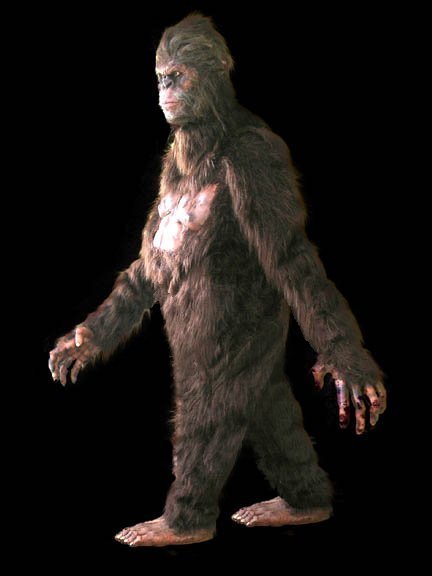
UPDATE: In response to Zapboomer’s comment, there is a non-zero — but I’m going to say extremely remote — possibility that the megastructure beyond the edge of the visible universe exerting the force on those galaxies is, in fact, a giant Sasquatch. It would have to be made up of different stuff than the ones we have here on earth, or subject to different laws. But it can’t be ruled out altogether. If there, it might look something like this:
However, I’m going to say that another universe is more likely.

We don’t know. But whatever it is, it’s big.
I was chatting once with Michael Anissimov and somehow we got onto the subject of parallel universes, and whether we could ever know anything about them. Michael’s answer was no, we can’t. By definition, he explained, a separate universe is an entity we can’t get any information about. It is something that lies completely outside our knowledge.
As described in the linked article above, dark flow is a mysterious force that is mysteriously accelerating the movement of some galaxies in a particular direction. One explanation for dark flow is that there is some massive megastructure exerting gravitational pull on these galaxies, drawing them to the very edge of the universe.
In fact, one theory is that the megastructure is, itself, a separate universe.
Aha, but if we know that very large thing is out there because it’s exerting force in this universe, doesn’t that mean that it can’t be a separate universe?
I know the confusion results from using two different definitions of “universe.” That megastructure might be a separate massive collection of galaxies that had its own Big Bang…whenever. But it’s all part of our same universe, which is therefore much, much bigger than we’ve been thinking.
Of course, it doesn’t have to be galaxies. It could be anything. All we know for sure is that, if it is in fact there, it’s really, really big.
And by big I mean massive.
UPDATE: In response to Zapboomer’s comment, there is a non-zero — but I’m going to say extremely remote — possibility that the megastructure beyond the edge of the visible universe exerting the force on those galaxies is, in fact, a giant Sasquatch. It would have to be made up of different stuff than the ones we have here on earth, or subject to different laws. But it can’t be ruled out altogether. If there, it might look something like this:
However, I’m going to say that another universe is more likely.
NOTE: As we prepare for the launch of the World Transformed 2, we are suspending rebroadcasts of archived shows. We will list a recommended archive show each week and will resume archive broadcasts in August.
Monday: FFR 25 Exploring the Brain
Stephen Gordon and Michael Darling talk about the human brain – past, present, and future.
Originally aired March 23, 2008
Available on-Demand
—-
Wednesday: FastForward Radio — Practical Time Travel 2011
Phil Bowermaster and Stephen Gordon explain an approach to time travel that really works and that we can all use.
(Live show.)
7 PM Pacific / 10 PM Eastern
—-
Saturday WT 1.5: Questions for a World Transformed
Phil Bowermaster outlines the questions that will guide discussions in the upcoming special series, The World Transformed 2.
8 PM Pacific / 11 PM Eastern

