
Dean’s World has hosted a spontaneous blogwave over the past few days on the subject of whether the traditional recommended course of diet and exercise is an effective long-term cure for obesity. Like Battlestar Galactica and the question of whether “bible-thumpers” should be considered “true Protestants,” this is one of those topics that comes up from time to time on DW: obviously a subject of interest to host Dean Esmay. In arguing that diet and exercise have not been shown to constitute an effective long-term cure for obesity, Dean is challenging mainstream thinking (something that regular readers of his blog know that he likes to do.) Whether I agree with him or not, anyone willing to take on the overwhelming consensus opinion in the face of a large body of established research gets a few points from me for chutzpah if for nothing else.
But here’s the rub: in this case, the overwhelming consensus opinion and the body of established research are at odds with one another. Or as Dean likes to put it:
No study has ever shown that human beings can drop more than 5-40 pounds or so of excess weight through diet and exercise alone. Not long-term anyway. Those who can do so are so rare they barely qualify as statistical anomalies.
I added italics to the third sentence because it is an integral part of the argument. If you read the first two sentences on their own, you might take Dean to be saying that it is impossible for an obese person to lose more than 40 pounds of excess weight and keep it off for more than five years, or that no one has ever done so. And, in fact, several commenters and at least one of the co-bloggers at DW have read it that way, and have responded by linking to research that tracks the progress of obese people who have demonstrated that “impossible” level of success.
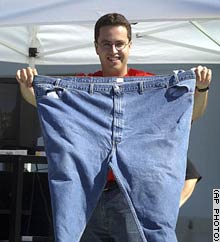
But Dean isn’t arguing that it’s impossible. Rather, after reading over the literature, he has found that — in study after study over the course of the past century — the number of clinical trial subjects who have kept more than 40 pounds off for a period of five or more years is vanishingly rare. The number that’s thrown around on DW is 0.1%, although I haven’t seen where Dean specifically raised this number, only where people arguing with him have. So if we can name people who have met the criteria — Jared comes to mind — we have only found an example of that 0.1% of the population for whom diet and exercise is an effective long-term obesity cure. Likewise, the participants in the National Weight Control Registry (NWCR) study (linked above) asked to participate if they had already achieved a certain level of long-term weight loss, is just another example of this same selection bias.
It’s like “proving” that the lottery is a smart bet because somebody won!
But let’s say that the 0.1% number is off by a factor of 10. Could be. In fact, let’s say it’s off by a factor of 100. I doubt that Dean has misread the literature that severely, but even if he has, diet and exercise has only been shown to be an effective long-term cure for obesity for about 10% of the population — assuming that dozens of trials performed over many years have produced results representative of the population as a whole.
Just for a moment, set aside the question of why this approach doesn’t work. Can we all agree that, for any other condition, a treatment with a 10% success rate would be considered a pretty crappy excuse for a cure?