In his speech at the World Transhumanist conference, Ray Kurzweil claimed that life expectancy is currently increasing by 3 months per year. If that rate of improvement stayed constant, my two-year-old son would have a life expectancy nine years longer than my current expectancy when he reaches my current age of 38.
That sort of linear improvement does not upset the status quo. Career and retirement plans would gradually change to accommodate slightly longer lives, but not much else would change.
Fortunately Kurzweil doesn’t expect us to stay at the current rate of improvement. He believes that in 15 years life expectancy will increase more than one year for each year that passes. For every year that passes the average person would get at least another year added to their life expectancy. That would be an indefinite lifespan very soon – by the year 2022. That would change everything.
If we placed our progress on a life expectancy calendar – presently we’re at March 31… three months into the life expectancy year. December 31 represents the threshold of indefinite lifespans. If Kurzweil’s right, how many days improvement in life expectancy will we see added each year until 2022?
365 days – 91 days = 274 days.
274 days / 15 years = approximately 18.25 days/year
But that’s linear. When it comes to technological advancement, Kurzweil never thinks linear.
If Kurzweil’s forecast is right (that we get 3 months of life expectancy improvement per year now and that we will pass 1 year of life expectancy improvement per year in 15 years), AND if life expectancy improvement is subject to the same doubling trend that we’ve seen with computers, what would this look like?
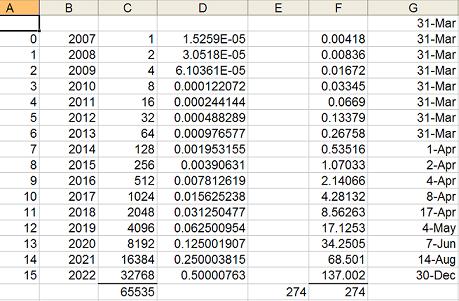
Obviously, this was a job for a spreadsheet. Columns A and B represent the years in Kurzweil’s forecast. Column C shows a simple annual doubling trend. Notice that column C is totaled at the bottom. I generated D in reverse order. Starting at the bottom, I calculated 2022′s doubling as a portion of the sum of all progress made since 2007. Working backward I did the same with 2021 on up.
The closer I got to the current year, the smaller the percentage. Excel had to resort to scientific notation for 2009, 2008, and 2007.
At the bottom of column E, I placed the number 274 – the number of days improvement in life expectancy per year needed to achieve an indefinite lifespan. Again, working backwards in column F, I showed the number of days improvement we could expect to see each year if Kurzweil is right (and if this improvement were subject to doubling). Column G is where we fall on the life expectancy calendar.
Notice how this could sneak up on us. Imagine some critic writing an article in 2013 about how we’re 6 years into Kurzweil’s forecast timeframe and we’ve seen no real progress, “Obviously good ol’ Ray is just a lovable crank.”
By 2018 the critic might admit that there has been modest improvement, but indefinite lifespans are perhaps a century away, not four years, “Kurzweil’s optimism obviously got the best of him with that prediction he made back in 2007.”
The progress of the last four years is so explosive that it might take the critic several years after 2022 to admit that we achieved indefinite life spans in 2022.