Monthly Archives: January 2009

Let's be Amazed

Via GeekPress, blogger Jesus Diaz at Gizmodo is quite taken with this video of a Yoshimoto cube in action.

Diaz comments that the video “blows his mid and fries his brain.”

I was interested to see in the comments that quite a few readers don’t share his enthusiasm:

Wow…he can use both of his hands at the same time to do the same thing….how does he do it!?!?!?!? (sarcasm).

What’s so hard to understand? I mean, it’s just able to fold into 2 separate cubes because there’s space on the inside that you can’t see. And when they are together, it is only gold and silver on 3 sides of the 2x2x2 cube, the sides which are facing you.

I don’t know how this is impressive. It’s a simple concept….

Nothing new here. I had one of these as a child more than 20 years ago. It was fun at the time, but nothing too tricky to work out.

Say — and I’m just asking, here — can’t something have a simple mathematical explanation, and be perfectly understandable, and have been around for long time, and still be really impressive? Totally amazing, even?

I don’t see how a sense of wonder — especially somebody else’s sense of wonder — does anyone any harm. And, other than a need to establish one’s own relative sophistication and intellectual superiority, why would anyone ever go to the trouble of telling someone else that they shouldn’t be impressed by something?

I think I’ll go ahead and be amazed, anyway. The world is a little more interesting and a lot more fun if we don’t insist that there’s nothing worth getting all worked up about. Let’s go ahead and get worked up, shall we?

Let’s be amazed.

Let’s be Amazed

Via GeekPress, blogger Jesus Diaz at Gizmodo is quite taken with this video of a Yoshimoto cube in action.

Diaz comments that the video “blows his mid and fries his brain.”

I was interested to see in the comments that quite a few readers don’t share his enthusiasm:

Wow…he can use both of his hands at the same time to do the same thing….how does he do it!?!?!?!? (sarcasm).

What’s so hard to understand? I mean, it’s just able to fold into 2 separate cubes because there’s space on the inside that you can’t see. And when they are together, it is only gold and silver on 3 sides of the 2x2x2 cube, the sides which are facing you.

I don’t know how this is impressive. It’s a simple concept….

Nothing new here. I had one of these as a child more than 20 years ago. It was fun at the time, but nothing too tricky to work out.

Say — and I’m just asking, here — can’t something have a simple mathematical explanation, and be perfectly understandable, and have been around for long time, and still be really impressive? Totally amazing, even?

I don’t see how a sense of wonder — especially somebody else’s sense of wonder — does anyone any harm. And, other than a need to establish one’s own relative sophistication and intellectual superiority, why would anyone ever go to the trouble of telling someone else that they shouldn’t be impressed by something?

I think I’ll go ahead and be amazed, anyway. The world is a little more interesting and a lot more fun if we don’t insist that there’s nothing worth getting all worked up about. Let’s go ahead and get worked up, shall we?

Let’s be amazed.

Despair Sucks

[Note: this post contains spoilers concerning the final episode of Battlestar Galactica last season, and a few mild tonal and thematic spoilers for last night's season premiere -- but I don't give away any plot points.]

In honor of the return of Battlestar Galactica, I give you Five Ways the World Can End. The five listed ways are all plausible, although I think grey goo and robot (Cylon) uprising really should have made the cut. If you want a more complete list, these folks are paying very serious attention to the whole question of how the world might end.

Those who follow Battlestar Galactica know that the end of the world is key to the storyline — although the show actually began with the world ending and then had things get more challenging from there. When last we saw our heroes (and the villains, with whom they had made a probably temporary alliance) they had come to the end of their long search for the planet Earth. Their hopes were utterly dashed when Earth turned out to be a devastated wasteland — a world that had itself apparently ended long ago.

So the big question for all these many months has been — and THEN what happened? Last night, we found out. In a word, what happens is despair. As executive producer Ron Moore puts it:

It felt like, if we were going to get to a place where we’re going to find Earth mid-season and it’s not going to be what they’d hoped, it’s all going to be ashes, you had to play it truthfully. You had to say it’s really going to devastate them. It’s going to hit them in a way we’ve never seen before. Our heroes are not going to be heroic. They’re not going to be able to come back from this easily. It’s going to take their fondest hope away from them.

galacticaEarth.jpg

Well, the season premiere delivered all that and then some. It was one of the most gripping and relentless hours of television I have seen in a long time. If you are spoiler-tolerant, read the interview with Moore from which the above quote was taken. It provides a fascinating look at how this bleak story was put together. It also includes this rather worrying exchange between the interviewer (bold type) and Moore:

My attitude was pretty much, “Look, we’re in the last chapter here. Anyone who’s come this far and doesn’t want to watch the rest — they’re a minority at best.” People are going to want to see how this turns out. And yeah, this is a very dark chapter. This may not even be the darkest chapter.

That’s a scary thought.

[laughs] It may not get better.

I hope he’s kidding. An hour of despair can be an extremely moving and cathartic experience. But speaking as a fan of the show, you don’t go dragging me halfway across the galaxy for the past half decade just to tell me that the world is a harsh place and that things don’t always work out well, and in fact that sometimes they work out horribly.

As the Old Man might say, “I already frakking knew that.”

And speaking as someone who is concerned about the future, and who takes the idea of the end of the world seriously, I will be very much disappointed if our heroes don’t turn it around and find something to hope for. An orgy of bleakness might be cutting edge TV, and it might be an original way to bring a series to its resolution, but it is, if you will pardon the expression, a sucky way of looking at the world. Nihilism isn’t new, and it isn’t an especially serious or realistic way of looking at the world, Goth arguments to the contrary notwithstanding.

If you really want to be hard-edged and fearless, show people who have had everything taken away from them — or even just people who stand to lose it all, which is the position we are all in, all the time — finding a way to push on. That’s what the show has always been about — I hope it finds its way back to that before it’s all over.

The World May Be a Hologram

Reader Mike D directs us to this very interesting New Scientist article:

Our world may be a giant hologram

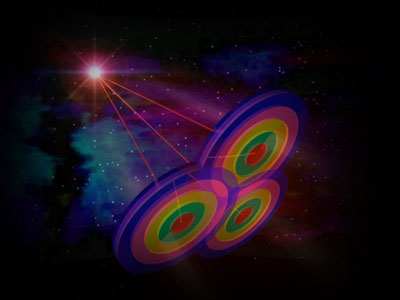
The idea that we live in a hologram probably sounds absurd, but it is a natural extension of our best understanding of black holes, and something with a pretty firm theoretical footing. It has also been surprisingly helpful for physicists wrestling with theories of how the universe works at its most fundamental level.

The holograms you find on credit cards and banknotes are etched on two-dimensional plastic films. When light bounces off them, it recreates the appearance of a 3D image. In the 1990s physicists Leonard Susskind and Nobel prizewinner Gerard ‘t Hooft suggested that the same principle might apply to the universe as a whole. Our everyday experience might itself be a holographic projection of physical processes that take place on a distant, 2D surface.

The research cited in the article, measurements taken as part of the GEO600 experiment outside of Hanover, Germany, fall well short of proving that we live in a hologram. What we have so far is some background noise very similar to the background noise predicted by Craig Hogan, director of the Fermilab Center for Particle Astrophysics, in his description of the ultimate “graininess” of the universe.

So out at the edge of the universe, you will find the “real” universe: a two-dimensional structure with resolution down to the Planck length. Here in the (fake? shadow? projected?) less-real universe, life is a lot blurrier than that, as our “pixels” are much, much bigger — 19 orders of magnitude bigger, if I’m reading it correctly. So we live in this big, blurry, 3D rendering of the real, much smaller and more fine-grained universe.

I’m not sure how significant this is. It all sounds kind of strange, but then the universe has to work somehow or other, doesn’t it?

A topic for discussion: would such a structure of the universe — if proved — tend to support the suggestion that we are living in a computer simulation, or would it be of no relevance?

hologramuniverse.jpg

You Heard it Here First

How Google Is Making Us Smarter

The argument that Stephen has made more than once is that Google vastly expands our ability to recall information — making it a tremendous memory aid. Philosophers Andy Clark of the University of Edinburgh and David Chalmers with the Australian National University agree — for those of us who use it, Google is now part of our “extended minds.”

But this isn’t exactly something new. A generation or two ago, one’s library card or set of encyclopedias — or even paper and something to write with — served to extend the capabilities of the human mind in perhaps slower, but still very effective ways. Google just has the advantage of being massive and more or less instantaneous.

Oh, and by the way (also covered in the linked article) texting actually helps to build literacy skills.

Yep.

Sure does.

neonbrain.jpg

Image by Dierk Schaefer

Time Travel Update

Not long ago we reported on how scientists managed to catch a re-run of an astronomical event that occurred several hundred years ago. Well maybe we can do that one better — how about looking back before the beginning of time?

Might be doable.

Hallucinating for a Better Tomorrow

I Just love the headline. Well, really, the sub-head:

Hack your brain

How to hallucinate with ping-pong balls and a radio

DO YOU EVER want to change the way you see the world? Wouldn’t it be fun to hallucinate on your lunch break? Although we typically associate such phenomena with powerful drugs like LSD or mescaline, it’s easy to fling open the doors of perception without them: All it takes is a basic understanding of how the mind works.

The first thing to know is that the mind isn’t a mirror, or even a passive observer of reality. Much of what we think of as being out there actually comes from in here, and is a byproduct of how the brain processes sensation. In recent years scientists have come up with a number of simple tricks that expose the artifice of our senses, so that we end up perceiving what we know isn’t real – tweaking the cortex to produce something uncannily like hallucinations. Perhaps we hear the voice of someone who is no longer alive, or feel as if our nose is suddenly 3 feet long.

I like the assumption that there’s an eager audience for quick, simple, and inexpensive ways to hallucinate.

The research cited is interesting, especially the the description of the Ganzfeld procedure. I remember reading a while back that this procedure was being used to test precognition and other paranormal phenomena. I didn’t know that it was also a means of getting a cheap — and presumably reasonably safe? — hallucinogenic high.

We were talking about how to teach and instill creativity on the most recent FastForward Radio. Well, here’s outside-the-box suggestion: perhaps the Ganzfeld procedure has a role to play. Once a month or so, maybe we should white out our visual field and pump white noise into our ears and see what kind of creative imagery our subconscious coughs up for us.

Granted, it would probably be a small part of a much larger overall program to instill creativity. But, who knows? Hallucinations may have an important role to play in helping us understand ourselves and our place in the world better.

Reporting on my trip to Arizona a couple of years ago, I mentioned a sacred grotto in the Palatki ruin, near Sedona, where people went for hundreds or possibly thousands of years to eat peyote and other hallucinogens and then stare at the petroglyphs.

Why did they keep coming back? Was it just that hallucinogens were part of their religion? (If so, they were hardly alone.) Perhaps these rituals served a practical purpose beyond spiritual discipline and / or recreation. Maybe these ancient peoples were trying to be more creative?

FastForward Radio — Future of Scarcity and Robot Utopia

Phil Bowermaster and Stephen Gordon talk about the importance of teaching creativity, how robotics could change the world, mysterious underwater stoneworks, and a new “Tales of the Paranormal.”


Listening Options:

Stream our latest shows:


Or:

add_to_itunes.gif

Or download MP3′s for all the archived shows at:

Listen to FastForward Radio... on Blog Talk Radio


Friday Video

Who would have thought corn starch could be so interesting?

Of course I first saw this on Big Bang Theory: