Not to get a whole thing going again, but one of the arguments offered against flex fuels is that any flex-fuel program requires ethanol and ethanol (if it could ever work at all) is problematic in that its production requires making energy production competitive with food production, which can drive up the price of produce such as corn which is applicable to both.
One solution, as I noted in the comments section of that lengthy discussion, might be to open up other agriculture markets for fuel production, while relegating corn back to what it’s best at — feeding us and our livestock. At the same time, we might look at crops that would give us a bigger bang for our buck in terms of domestic ethanol production. As reader Odograph pointed out, it would be next to impossible for the US to match Brazil’s successful ethanol program, partly because corn just doesn’t crank out energy as efficiently as sugarcane, and partly because we’re such pigs when it comes to energy consumption.
Solutions such as plug-in hybrids might at least cut down our rate of consumption of liquid fuels for powering cars (if not our total energy footprint). I mentioned crops such as sugar beets, fodder beets, and sweet sorghum which yield ethanol at about the same rate as sugar cane. And here’s another possibility, which we discussed briefly on our most recent podcast — switchgrass:
Previous studies on switchgrass plots suggested that ethanol made from the plant would yield anywhere from 343% to 700% of the energy put into growing the crop and processing it into biofuel. But these studies were based on lab-scale plots of about 5 square meters. So 6 years ago, Kenneth Vogel, a geneticist with the U.S. Department of Agriculture in Lincoln, Nebraska, and colleagues set out to enlist farmers for a much larger evaluation. Farmers planted switchgrass on 10 farms, each of which was between 3 and 9 hectares. They then tracked the inputs they used–diesel for farm equipment and transporting the harvested grasses, for example–as well as the amount of grass they raised over a 5-year period. After crunching the numbers, Vogel and his colleagues found that ethanol produced from switchgrass yields 540% of the energy used to grow, harvest, and process it into ethanol. Equally important, the researchers found that the switchgrass is carbon neutral, as it absorbs essentially the same amount of greenhouse gases while it’s growing as it emits when burned as fuel.
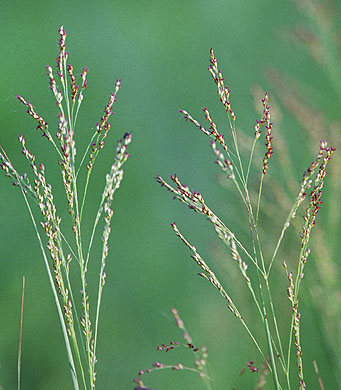
Switchgrass looks promising, but it’s no panacea. As a natural part of the North American prairie ecosystem, this plant has been touted by some as a crop that could solve all our energy needs with minimal fertilizer, herbicides, or other inputs. But the research says not so fast:
A final significant finding, Vogel says, is that yields on farms using fertilizer and other inputs, such as herbicides and diesel fuel for farm machinery, were as much as six times higher than yields on farms that used little or no fertilizer, herbicides, or other inputs to grow a mixture of native prairie grasses. That result contrasts sharply with a controversial study published just over a year ago in Science that suggested that a mixture of prairie grasses farmed with little fertilizer or other inputs would produce a higher net energy yield than ethanol produced from corn (Science, 8 December 2006, p. 1598). Instead, the current study–published online today in Proceedings of the National Academy of Sciences–shows that switchgrass farmed using conventional agricultural practices on less-than-prime cropland yields only slightly less ethanol per hectare on average than corn. “The bottom line is that low-input systems are not economically viable,” Vogel says.
Switchgrass may be part of the overall solution, but it’s going to take some real effort to make it work.