Author Archives: Phil Bowermaster

Horse / Barn Door or Something Even More Unexpected

it’s the biggest science news of the year, right?

OBAMA SIGNS ORDER LIFTING STEM-CELL BAN

WASHINGTON — Before an East Room audience of doctors, scientists, lawmakers and religious leaders President Obama signed an executive order Monday lifting the ban on federal funding for stem cell research, fulfilling a promise he made on the campaign trail.

The order overturns the Bush policy that said no government money could be used for research on stem cell lines created after Aug. 9, 2001.

“Medical miracles do not happen simply by accident,” Obama said. “They result from painstaking and costly research, from years of lonely trial and error, much of which never bears fruit, and from a government willing to support that work.”

This is great news. The previously imposed limits on stem cell research were silly and arbitrary, and we are well rid of them. However, it is interesting that this story is getting all the press coverage while at the same time we see something like this occurring:

Induced Pluripotent Stem Cells Take a Big Step Towards Clinical Applications

This week, researchers from Canada and Scotland made a major advancement in the field of stem cell biology. They discovered a method to successfully reprogram somatic cells into stem cells without the use of viruses.

Induced pluripotent stem cells (iPSCs) are a type of stem cells derived from adult somatic cells by forcing expression of genes shown to sufficiently reprogram somatic cells into stem cells. iPSCs have been shown to possess key characteristics of embryonic stem cells (ESCs), the most important of which is the ability to give rise to cells of all three germ layers. iPSCs are an ideal source of stem cells because they circumvent the need for human embryos to generate stem cells. Additionally, because they can be generated from one’s own somatic cells which are readily available, iPSCs can be used for patient-specific therapies, thereby reducing the risk of immune rejection.

President Obama may have just closed the barn door after the horses got out. Is there any doubt that, once we have a safe and reliable means of producing them, induced pluripotent cells from the patient’s own body will be the lynchpin of future stem-cell therapies? Opening up all those post-2001 lines of stem cells for research is a terrific thing, but this research potentially makes the stem cells from every human genome on the planet — including yours and mine — available for both research and treatment.

Moreover, this approach would have been doable under the just-removed restrictions.

Here’s a question to ponder. What role did those restrictions play in inducing some researchers to begin working on iPSCs? Seeing as the work described here comes from Canada and the UK, it would be difficult to draw a direct line. But it would be, to say the very least, ironic if the much-hated stem cell research funding ban actually played a positive role in moving us towards a better solution.

There must be other examples of this sort of thing in the history of science and technology — arbitrary and capricious limitations to progress leading to workarounds that are superior to what might have been accomplished otherwise. It certainly says something for the resilience of the process of inquiry.

Some Technologies Are Slow to Arrive

Or, as The Wall Street Journal puts it:

The Jetpack: An Idea Whose Time Has Never Come, but Won’t Go Away

….The question is whether any normal person would do this. Pilots flying the devices jet around with 1,300-degree steam shooting inches from their legs while they worry about landing before the pack runs out of fuel in 30 seconds.

I think jetpacks will become increasingly popular, but they are a long way from being practical. They have that in common with lighter-than-air aircraft. People like the idea of blimps and dirigibles, but by and large the practical applications aren’t there. Until a technology has a practical application — and it’s hard to imagine one for jetpacks until they become a lot safer and enjoy a much greater range than they do today — it is destined to remain a niche (in the case of blimps) or cult (in the case of jetpacks) technology.

Niche is one peg up from cult. If jetpacking were to, pardon the expression, “take off” as an extreme sport (which has been predicted for a few years now) it would achieve niche status.

But the dream of sustained, individual jet- or rocket-powered flight, say something like this…

…is probably going to remain a dream for a long time to come.

Goodbye, Rocky Mountain News

I always called it “the News” — I thought “the Rocky” was a stupid nickname for a newspaper. But that nickname was an example of marketing that worked. When I first came to Colorado two and a half decades ago, I remember there were either TV or radio ads with a jingle that went:

The News gets Denver up
Every morning!

(Sheesh, I feel like James Lileks rattling something like that off.)

I don’t think that ever caught on. A few years later, they did another set of ads in which locals gave testimonials as to how much they like the paper, with several of these folks referring to the paper as “the Rocky.” I had never heard anyone call it that before those ads — but the last couple of days I’ve hard people all over town lamenting the death of “the Rocky” — so maybe the Rocky Mountain News marketing folks got a meme going, there.

Anyway, it was “the News” to me. It was a two-paper city. You got your Post and you got your News. I liked the News because it was easier to read on public transportation, plus I liked the sports coverage better. On the other hand, the Post had Dilbert. So, you know, that’s something.

I haven’t subscribed to a local paper for years, but I was still sorry to see the News close down after 150 years. It was a real institution.

Also, I can’t help but wonder what the deaths of all these newspapers across the country has to say about my bet with Stephen. Newspapers are going away, but books will still be with us, and will thrive?

I got one US dollar that says so. We shall see.

Black Hole Eats Star

Very well made, and frightening to contemplate:

I note that the star keeps glowing at about the same level of luminosity throughout. At some point, the mass of the star would be less than the threshold required for fusion — but I’m not sure at what point the fusion process would begin to shut down. Maybe the black hole would swallow the entire star before it had the chance to burn out.

Also, I wonder what the time scale is. Decades? Centuries?

UPDATE: The first time I watched this, I didn’t have audio. The narrators says the process takes “millions of years.”

(via Geekpress.)

Can Genius Be Learned?

It’s an age-old question and I don’t think we’re any closer to a definitive answer. Are geniuses born that way? Malcolm Gladwell says anybody can be genius if they’re ready to devote 10,000 hours to the subject or discipline in which they want to display said genius. Dean Keith Simonton of the University of California, Davis, offers a somewhat more nuanced definition:

Geniuses are those who “have the intelligence, enthusiasm, and endurance to acquire the needed expertise in a broadly valued domain of achievement” and who then make contributions to that field that are considered by peers to be both “original and highly exemplary.”

I guess it isn’t really a matter of whether genius can be learned so much as acquired. (In my case, it took years of a watching TV plus a steady diet of Little Debbie Nutty Bars.) Whether the techniques that Gladwell suggests or the process that Simonton describes can actually lead to genius, I don’t know. But the Age of Acquirable Genius will arrive one day. That will be the day that we can master a new skill by taking a pill or simply “jacking in” to a learning interface that transfers the skills directly to us.

Of course, some will argue that this isn’t “real” genius, in the same sense — I suppose — that a face corrected by plastic surgery doesn’t reflect “real” beauty. (And, yes, sometimes they are far from it!)

And, relatively speaking, an individual in that age who learns how to compose Mozart-like symphonies in a matter of hours won’t be a genius. Anybody can do that. Maybe the individual who combines that skill with the ability to churn out Shakespeare-like poetry and Christopher-Wren-like architecture who then designs an entire virtual world — an ongoing interactive opera combining the most beautiful music, the most thrilling drama, and the most stunning sets imaginable — maybe that individual begins to approach genius. But then at that point, we might be back to Gladwell and his 10,000 hours.

Sharing the Highway

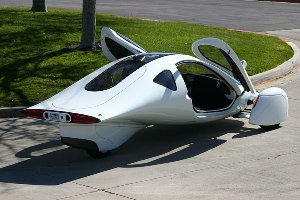
When I was in California last week, I was driving down highway 101 south from SFO towards the San Mateo bridge when I passed (and was later passed by) a truck pulling a trailer with the Tesla logo proudly displayed. The trailer was fully enclosed, so I couldn’t see the vehicle inside, but it was pretty cool to be sharing the road with the all-electric roadster of the future — even if the Tesla itself wasn’t moving under its own power.

Likewise, it will be very gratifying to see one of these babies out on the road in the very near future.

apterafromtherear.jpg

Interesting write-up available here. A year and a half ago, the Aptera seemed like a great idea, but a long way off and kind of science-fictiony. Now, not so much. Aptera appears to be on its way.

A Hundred Billion Trillion

From the department of Cool your jets, there, Sparky:

Life on Earth used to be thought of as a freak accident that only happened once.

But scientists are now coming to the conclusion that the universe is teeming with living organisms.

The change in thinking has come about because of the new belief there are an abundant number of habitable planets like Earth.

Alan Boss, of the Carnegie Institution in Washington DC, said there could be as many Earths as there are stars in the universe – one hundred billion trillion.

Um, no.

If he had said “planets,” okay. Maybe. But an Earth for every star? Nonsense. Let me put it this way — what makes an Earth an Earth? Size? Color? Moon?

Is Mars an Earth? Is Venus?

thehood.jpg

What about location? This planet is in the Mother of All Sweet Spots. How many Earths have the right combination of water, nitrogen, oxygen, and so forth, and sit in that tiny orbital band that lets water be liquid a lot of the time — not always ice or steam?

No that many, I’m thinking — something less than a hundred billion trillion bazillion or whatever.

So then why in the world would we call any planet that doesn’t meet those basic criteria an “Earth?” I don’t think we should.

Boss has some other thoughts:

Whether the life we find is intelligent is, however, less than inevitable.

“Intelligent life seems to be fleeting,” he said. “In terms of the universe it only exists for a fraction of time.”

He said it would be a massive coincidence for us to find intelligent life that exists at the same time as us. It is more likely to be bacteria or microbes.

“It is unlikely that ‘we’ will exist for a further 100,000 years,” he said.

Scare quotes around ‘we’ notwithstanding, I would lay even money — with anyone who cares to make such a bet –that 100,000 years from now there will be somebody living on this planet. Double or nothing these beings will still believe that they are us.

Any takers?