Via our DNC 08 correspondent Michael Darling, here’s an intriguing Ted Talk by journalist / publisher / big thinker Kevin Kelly at last year’s eg conference:
Kelly asserts that less than 5000 days into the history of the world wide web, we should have learned that we need to get better at believing in the impossible. Many of the items we take for granted on the Internet today were technologically and (perhaps more importantly) economically inconceivable just a couple of decades ago.
His model going forward is that we should understand that there is only one machine; and he points out that it’s the most reliable machine ever built. Zero downtime. Uninterrupted for more than 5000 days. All of our laptops, PDAs, mobile phones, etc. are all just windows into this one machine.
Kelly notes that the size and complexity of this One Machine is roughly equal to a single human brain, with the big difference being that this particular brain is doubling in size and capacity every two years. At that rate, the One Machine will have the processing power of 6 billion human brains in 30 years, and will supersede the processing power of all humanity by the year 2040.
That ought to get us to the singularity if nothing else does.
Kelly suggests that the next 5000 days will be all about giving the machine a body. As we have noted in our many discussions of rapid replication, we’re heading towards a scenario in which the most valuable component of any manufactured item is the information that describes it. Kelly argues that physical objects become even more valuable as information objects when they are connected into the One Machine. So a shoe becomes a chip with heels; a car becomes a chip with wheels.
nd watching as every bit gets sucked into the one machine. Right now there’s a lot of data that isn’t part of this machine, but that will change.
Kelly also talks about the restructuring of the web. We started with an Internet that linked computers. Then we went to a web that links pages. The third stage will be the linking of data itself. In such a setup, this page would be automatically linked to other pages that talk about Kevin Kelly or the next 5000 days of the web. Google and RSS and various kinds of tagging already provide a hint as to how something like this semantic web will work — and it will, in fact, probably grow out of these things.
The whole idea reminds me a lot of the notion of hypertext as it was discussed and written about when I was in grad school 20 years ago or so. For me, one of the big disappointments of the world wide web was that you actually had to build the links from one page to another. The great vision was for an underlying infrastructure that would automatically make the links, and which would surprise us by making connections that were not as obvious as the top-level ones. I wasn’t wrong to want that, just wrong to expect it 20-30 years before it was slated to show up.
Beyond the semantic Internet, and some time after the next 5000 days, we will see the the Internet of things, where physical objects, not just chips grafted on to them, are connected into the web. At that point, the line between the cyber world and the real world starts to break down in a totally unexpected way. We’ve had this model for a long time of a new, separate reality emerging in cyberspace, one that eventually becomes as robust or even more robust than the physical world of the substrate which contains it. That model may yet prove to be true, but it doesn’t stop what Kelly is describing from happening — having that cyber world reach up and embed itself in the real world.
Ultimately, we may no longer know which world contains the other.
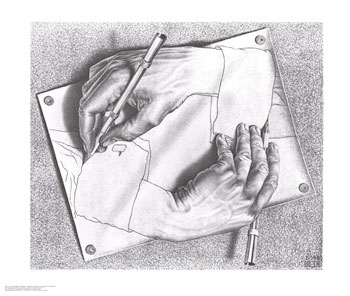
But then at that point, we won’t care. Our world will be the web at that point, and we will be the web. We will be the One Machine, just as, in a very real sense, we are now.